The choice between an island stand (open on all four sides) and a peninsula stand (open on three sides, with one back wall against the aisle) is one of the most consequential booth-design decisions a European exhibitor makes. It determines visitor traffic patterns, lead-capture geometry, brand visibility, lighting strategy, and a meaningful slice of the total budget.
The decision also gets made under time pressure, often without enough data, and the choice is locked the moment space is contracted with the fair organiser.
This guide compares the two layouts across every dimension that matters: traffic and dwell, lead-capture mechanics, cost-per-square-metre, sightlines, lighting and overhead options, brand visibility from across the hall, and the venue-specific quirks that change the answer at Messe Frankfurt versus Fiera Milano versus IFEMA Madrid. The conclusion: there is no universal winner.
Island wins for brands at the centre of their fair’s narrative; peninsula wins for capital-efficient lead capture in vertical B2B contexts. Get the choice wrong, and you have spent thirty to seventy percent more than necessary, or you have under-presented at the fair where your brand needed to land.
The geometric difference, and why it matters more than it looks
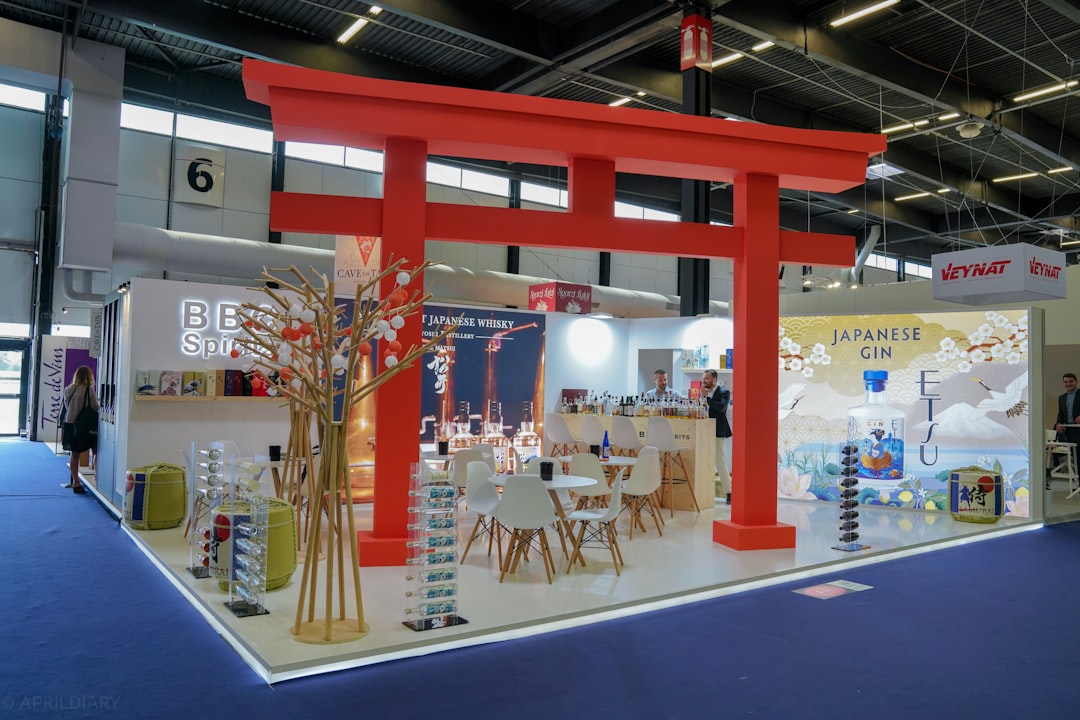
An island stand sits in the middle of an aisle grid with all four sides open to visitor approach. A peninsula stand attaches to one neighbour or to the end of a hall row, presenting three open sides and one wall. The difference looks small on a floor plan and feels enormous on the show floor.
Island stands receive visitor approach from four directions. Peninsula stands receive approach from three. That sounds like a 25 percent disadvantage, but the practical difference is smaller because of how visitor traffic actually flows: most fair-goers walk down aisles in a directional pattern, not approaching from random directions. The fourth side of an island typically captures roughly fifteen to twenty percent of total visitor approach, not twenty-five.
The geometry has a larger consequence than approach percentage: the back wall on a peninsula stand becomes the dominant brand-statement surface. A six-metre-wide peninsula back wall is the most valuable graphic real estate the stand owns. An island stand has no equivalent, every surface is approach-facing, and graphic strategy must distribute brand across all four sides. The two layouts therefore reward different design philosophies.
| Dimension | Island stand | Peninsula stand |
|---|---|---|
| Open sides | 4 | 3 |
| Visitor approach directions | Multi-directional | Predominantly forward + 2 sides |
| Dominant graphic surface | None (distributed) | Back wall (concentrated) |
| Minimum footprint at most EU fairs | 36-50 sqm | 18-25 sqm |
| Cost-per-sqm premium vs row stand | 20-35% | 10-18% |
| Best-fit fair size | Tier-1 brand presence | Mid-size lead capture |
| Build complexity | High | Moderate |
What island stands actually deliver
Island stands deliver four advantages that justify their cost premium when the brand strategy warrants it.
The first is visual centrality. An island stand sits in the middle of a visitor route, visible from multiple aisles, and acts as a wayfinding landmark within the hall. At Hannover Messe Hall 11 or Messe Frankfurt’s Halle 4, well-positioned islands at intersections become “meet me at” reference points for entire days of fair traffic. This is brand value that doesn’t appear on the floor plan but shows up in lead conversation quality.
The second is overhead visibility. The fourth open side allows hanging banners, suspended brand elements, and ceiling architecture that reads from across the hall. Peninsula stands constrained by the back wall lose this overhead axis on one side, which matters for brands that win attention through ceiling-line presence rather than ground-level graphics.
The third is internal flexibility. With no back wall, the floor plan inside an island stand has no fixed orientation. Meeting rooms, product zones, demo theatres, and hospitality areas can be arranged around any internal axis. Peninsula floor plans always have a long axis perpendicular to the back wall, which constrains internal layout in ways that experienced exhibition managers feel before they articulate.
The fourth is the brand-impact halo. An island stand reads, simply, as more serious. The decision to take an island position signals to visitors and to competitors that the brand is investing meaningful budget in the fair. At fairs where brand status is part of the visitor’s evaluation, Salone del Mobile, Maison&Objet, EuroShop, the island position is part of the message.
“An island stand at a tier-one fair is not just a layout choice. It is a brand statement to the visitor and to the rest of the industry about where the company sits in the hierarchy. Brands that take peninsula positions at fairs where their main competitors take islands have, in effect, conceded a category-leadership argument before the fair opens.”, Common framing within FAMAB working groups on brand-impact assessment, 2024-2025
What peninsula stands actually deliver
Peninsula stands deliver three advantages that often dominate the cost-per-lead arithmetic at vertical B2B fairs.
The first is capital efficiency. A peninsula stand at IFEMA Madrid for Fitur costs roughly EUR 380-540 per sqm in modular configuration versus EUR 460-680 per sqm for an equivalent-specification island. Across a 60 sqm footprint, the saving runs EUR 4,800-8,400, meaningful at any exhibitor scale and decisive for first-time or budget-constrained exhibitors. The peninsula premium over a row stand sits at ten to eighteen percent; the island premium sits at twenty to thirty-five percent.
The second is back-wall brand consolidation. Peninsula stands concentrate brand messaging on the largest single graphic surface the stand owns. A six-metre back wall at 2.5 metres height provides fifteen square metres of continuous brand surface, ideally suited to a single dominant message that visitors read from twenty metres away as they approach down the aisle. Island stands distribute this surface across four faces, which dilutes graphic impact for brands with a single dominant message.
The third is operational simplicity. Peninsula stands require less complex traffic flow design, simpler lighting (the back wall anchors one lighting zone), and fewer demo-station orientations. Build days run shorter; dismantle is faster; the stand survives more deployment cycles before component fatigue. These savings compound across multi-fair calendars.
“For a vertical B2B exhibitor running four fairs a year on a 60-90 square metre footprint, peninsula will almost always win the cost-per-qualified-lead calculation against island. The brand-impact argument for island is real but rarely pays back in lead economics at this scale.”, Cost-per-lead analysis circulated within AUMA exhibitor working groups, 2025
The cost difference in concrete EUR figures
The table below shows observed 2026 all-in cost ranges for equivalent-quality island and peninsula stands across major European venues at the most common footprint band (60-90 sqm). Figures include modular structure, graphics, lighting, transport, install, and dismantle. Space rental from the fair organiser is excluded.
| Venue (fair) | Island 75 sqm (EUR) | Peninsula 75 sqm (EUR) | Island premium |
|---|---|---|---|
| Messe Frankfurt (Light + Building) | 46,000-62,000 | 38,000-52,000 | 17-19% |
| Messe Düsseldorf (drupa, Medica) | 44,000-58,000 | 36,000-50,000 | 16-22% |
| Fiera Milano (Salone del Mobile) | 38,000-52,000 | 30,000-44,000 | 18-26% |
| IFEMA Madrid (Fitur) | 34,000-46,000 | 26,000-38,000 | 21-30% |
| RAI Amsterdam (ISE) | 40,000-54,000 | 32,000-46,000 | 17-25% |
| Paris Expo (Maison&Objet) | 42,000-56,000 | 34,000-48,000 | 17-23% |
| ExCeL London | 46,000-62,000 | 38,000-52,000 | 17-19% |
| Fira de Barcelona Gran Via (MWC) | 36,000-50,000 | 28,000-42,000 | 19-29% |
The island premium runs consistently in the high teens to low thirties as a percentage. In absolute EUR terms, the premium at a 75 sqm footprint runs EUR 7,000-12,000 in southern European markets and EUR 8,000-12,000 in German markets. Across a five-fair calendar, the cumulative island premium runs EUR 35,000-60,000, equivalent to roughly one additional fair’s lead-capture budget.
The premium scales with footprint. At 36 sqm, the island premium is closer to twenty-five percent; at 150 sqm, it drops to around twelve percent because the fourth open side carries proportionally less of the total perimeter cost.
Traffic and dwell: what the numbers actually show
Multiple European fair organisers have published visitor-flow studies showing the practical difference between island and peninsula stands. The summary, consistent across Messe Frankfurt, RAI Amsterdam, and Fiera Milano studies from 2022-2024, is that islands see roughly fifteen to twenty-five percent higher total visitor approach but only five to fifteen percent higher qualified-conversation conversion.
The fourth side of an island captures casual passers-by who do not convert to qualified leads.
For exhibitors whose stand-staff capacity is the binding constraint on lead capture, typically true for any team smaller than ten on-stand people during peak fair hours, the additional visitor approach from the fourth side overwhelms staff capacity without producing additional qualified leads. For exhibitors with deep stand-staff capacity or strong qualification systems that filter visitors before they reach senior staff, the additional approach is captured productively.
The diagnostic question is whether your lead-capture system is approach-limited or capacity-limited. If approach-limited (you have spare conversation capacity for more visitors), island pays back. If capacity-limited (you are turning away qualified conversations during peak hours), the additional traffic from an island position is wasted.
“We measured visitor approach and qualified-lead conversion on identical stand specifications across an island position at Hannover Messe 2023 and a peninsula position at Hannover Messe 2024. Approach was twenty-two percent higher on the island. Qualified conversion was nine percent higher. The cost-per-qualified-lead was meaningfully lower on the peninsula. The fourth side mostly caught browsers we couldn’t convert anyway.”, Common framing among AUMA member exhibitor measurement teams
Sightlines and visual reach
Island stands win the long-distance visibility question across most European hall configurations. From an aisle thirty metres away, an island reads as a destination, overhead branding, multi-axis architecture, and the absence of an obscuring back wall make it visible from multiple approach paths. Peninsula stands read clearly from the aisle they face but read as ordinary row stands from the back.
At fairs where visitors plan their day before arriving (most tier-one fairs), this matters less because pre-planned visitors find your peninsula regardless. At fairs where significant traffic walks the hall opportunistically, the long-distance visibility advantage of an island pays back.
Hall configuration changes the answer. In halls with long, parallel aisles (Messe Frankfurt Halle 11, ExCeL London North Hall), peninsula stands present their full front length to passing aisle traffic, which captures most of the practical island advantage at lower cost. In halls with cross-aisles, mezzanines, and multi-directional flow (Salone del Mobile pavilions at Fiera Milano), island stands genuinely exploit the multi-directional approach.
Lighting strategy differs between the layouts
Island and peninsula stands require fundamentally different lighting approaches because of the geometric difference.
Peninsula stands anchor their lighting strategy on the back wall: a continuous wash of indirect light makes the brand surface read from twenty metres while track lighting and accent fixtures pick out product zones forward of the wall. The back-wall lighting plan typically consumes thirty to forty percent of the stand’s total fixture count. The /booth-design/lighting-design guide unpacks the lux-level and CRI specifications.
Island stands distribute lighting across four edges and a central overhead grid. Without a back-wall anchor, the lighting plan needs more fixtures (typically twenty-five to forty percent more lumens per square metre) and more thoughtful zoning to avoid creating a uniformly bright but visually flat space. Island lighting also needs to address ceiling-line presence, pendant fixtures, suspended elements, and overhead brand architecture that read from outside the stand perimeter.
The lighting cost premium for island stands runs roughly fifteen to twenty-five percent versus equivalent peninsula stands of the same footprint, before considering any overhead architecture.
Venue-specific quirks that change the answer
Every major European fair venue has technical regulations and aesthetic conventions that subtly favour one layout over the other at specific halls.
At Messe Frankfurt, several halls (notably Halle 4, Halle 11) have ceiling heights that genuinely reward island stands with overhead branding. The hall is large enough that lower stands disappear; the height creates an opportunity for vertical presence that peninsula stands struggle to capture without an island’s overhead axis.
At Fiera Milano during Salone del Mobile, island stands are effectively the table-stakes choice for any brand at the tier-one design-brand level. Peninsula stands signal a positioning two tiers below where the brand likely wants to be perceived.
At IFEMA Madrid for Fitur (tourism), the convention runs the other way: peninsula stands dominate the hall because the visitor pattern is heavily destination-driven (tourism boards meeting buyers by appointment), and the cost-efficiency of peninsula is favoured by public-sector exhibition budgets that dominate the fair.
At MWC Barcelona, both layouts thrive but at different scales. Island wins at 100+ sqm tier-one brand presence (the major operators and chipmakers in Hall 2 and Hall 3). Peninsula wins at 30-80 sqm for vertical B2B telecoms exhibitors throughout the hall complex.
At RAI Amsterdam during ISE, the AV-integration nature of the audience favours peninsula stands with strong back-wall demo content. Island stands at ISE are common for the largest exhibitors but rarely deliver lead-capture advantages proportional to their cost premium.
“Different fair audiences read stand layout differently. A tourism buyer at Fitur does not penalise a peninsula position; a design buyer at Salone del Mobile absolutely does. Knowing your audience’s reading of the layout is more important than knowing the layout’s objective merits.”, Common framing within UFI member organiser visitor-research presentations
Smaller layout cousins: row and corner
Island and peninsula are the upper end of the side-openings spectrum. Two other layouts dominate smaller European stand footprints.
Row stands sit between two neighbouring stands with only one open side facing the aisle. Footprints typically run 12-30 sqm. Cost-per-sqm runs ten to twenty-five percent below peninsula equivalents. The /booth-design/stand-types-by-side-openings/row-corner-peninsula-island-stand-orientation-european-fairs reference guide covers row stand strategy in depth.
Corner stands sit at the intersection of two aisles with two open sides forming an L. Footprints typically run 18-40 sqm. Cost-per-sqm runs roughly midway between row and peninsula. Corner stands capture roughly seventy to eighty percent of peninsula visitor approach at modestly lower cost, the strongest cost-efficiency layout for mid-size B2B exhibitors at most European fairs.
The decision sequence for most exhibitors: row if budget-constrained at 12-25 sqm; corner if 18-40 sqm and lead capture matters; peninsula if 40-100 sqm and brand-impact matters moderately; island if 75+ sqm and brand-impact dominates the strategy.
Decision framework: a four-question test
Use the questions below in sequence. The first answer that meaningfully favours one layout determines the choice.
First, what is the available budget envelope per fair? Below EUR 40,000 all-in, peninsula or corner is the only honest answer at most major European venues. Above EUR 80,000, both layouts are available.
Second, what is the brand-impact strategy at this specific fair? If the goal is to be a talking point, the brand visitors discuss after the fair, island wins. If the goal is qualified-lead capture per EUR spent, peninsula wins.
Third, what is your stand-staff capacity? If approach-limited (spare capacity exists for additional visitor conversations), the fourth side of an island pays back. If capacity-limited (peak-hour conversations queue), the additional approach traffic is wasted.
Fourth, what is the convention at this specific fair? At Salone del Mobile, Maison&Objet, EuroShop, and Watches & Wonders, island is the convention for serious brands. At Fitur, Anuga, ISE, and Bauma, peninsula is the convention even for serious brands. Defying convention without strategic reason burns budget on a positioning signal visitors may not read.
What changes for double-decker stands
Both island and peninsula layouts can support double-decker construction (a second-storey usable level above the main floor), but the engineering and cost arithmetic shifts meaningfully.
Double-decker island stands cost EUR 1,400-2,400 per sqm all-in versus EUR 900-1,800 for double-decker peninsula equivalents, because the four-sided structural support and complete absence of a back wall to brace against the second storey is more expensive to engineer. The /booth-design/double-decker-stands guide covers the structural and permit considerations in detail.
For most exhibitors considering double-decker construction, the peninsula layout is the more cost-efficient path to additional usable floor area. The exception is tier-one brand presence at fairs where the double-decker is itself a brand statement (Salone del Mobile, IFA Berlin, MWC Barcelona for major operators), in those cases the island double-decker is the only configuration that delivers the intended message.
Putting it all together
The right answer for most European exhibitors most of the time is peninsula. The combination of cost efficiency, back-wall brand concentration, operational simplicity, and lead-capture mechanics aligns with the typical European B2B fair calendar. Island is correct for tier-one brand presence at design-led fairs, at footprints above 100 sqm, where stand-staff capacity is genuinely deep, and where brand-impact dominates lead-capture in the strategy.
The cost difference at typical European footprints runs EUR 7,000-12,000 per fair, or roughly EUR 35,000-60,000 across a five-fair calendar. Spending that premium is justified when the brand-impact case is concrete and measurable. Spending it because “we’d like to be in the middle” without a tested case usually burns budget without proportional return.
Use the /calculator to test sensitivity of total fair budget to stand layout choice. Use /rfq to circulate a layout-specified brief to vetted European builders. The /cities pages list builder concentrations near each major venue for exhibitors who prefer local logistics, and /fairs/salone-del-mobile and /fairs/hannover-messe-2027 cover fair-specific layout conventions in more depth.
References
- AUMA, “Exhibition Stand Visitor Flow and Lead Conversion Study,” 2024 working-group report
- FAMAB Communication Association, “Stand Layout Cost and Performance Benchmarks: DACH Region,” 2025
- UFI Global Exhibition Barometer, “Visitor Flow Patterns at European Trade Fairs,” 35th edition, 2024
- Messe Frankfurt, “Technical Guidelines for Exhibitors and Stand Builders,” 2026 edition
- Fiera Milano, “Salone del Mobile Stand Design Conventions and Approval Process,” 2025
- IFEMA Madrid, “Exhibitor Technical Manual: Stand Types and Approval Process,” 2025-2026
- RAI Amsterdam, “Approved Stand Builders Programme: Layout and Engineering Standards,” 2025
- IFES (International Federation of Exhibition and Event Services), “European Stand Layout and Cost Survey,” 2025 edition
FAQFrequently asked questions
Island stands cost 17-30% more than equivalent-specification peninsula stands at typical European footprints. For a 75 sqm stand in 2026, the absolute difference runs EUR 7,000-12,000 per fair across Messe Frankfurt, Fiera Milano, IFEMA Madrid, RAI Amsterdam, and Paris Expo.
The premium scales inversely with footprint: at 36 sqm the premium is closer to 25%, while at 150 sqm it drops to around 12% because the fourth open side carries proportionally less of the total perimeter cost. Across a five-fair European calendar, the cumulative island premium runs EUR 35,000-60,000.
Islands see 15-25% higher total visitor approach but only 5-15% higher qualified-conversation conversion, according to visitor-flow studies from Messe Frankfurt, RAI Amsterdam, and Fiera Milano in 2022-2024. The fourth open side captures casual passers-by who do not convert to qualified leads.
For exhibitors whose stand-staff capacity is the binding constraint on lead capture (most teams smaller than ten on-stand people), the additional approach traffic from an island overwhelms staff without producing additional qualified leads. The diagnostic question: is your lead capture approach-limited or capacity-limited? If capacity-limited, the island premium is largely wasted.
Island stands are effectively the table-stakes choice for tier-one brand presence at design-led fairs: Salone del Mobile, Maison&Objet, EuroShop, and Watches & Wonders Geneva. At these fairs, a peninsula position at the same footprint signals a positioning two tiers below where the brand likely wants to be perceived.
Island also wins at IFA Berlin and MWC Barcelona for tier-one operators and chipmakers at 100+ sqm, and at large Hannover Messe stands above 250 sqm. At vertical B2B fairs (Bauma, EMO, productronica, Anuga, Fitur, most of the ISE floor), peninsula is the cost-efficient convention even for serious brands.
Yes, consistently across European venues. The back wall on a peninsula serves both as a structural anchor (reducing the engineering required) and as the dominant graphic surface (consolidating brand investment in one location). Peninsula stands also simplify lighting strategy because the back wall anchors one lighting zone, reducing total fixture count by 15-25% versus an equivalent-footprint island.
The savings extend to faster build days, simpler dismantle, more deployment cycles before component fatigue, and fewer venue technical-approval complexities. Across a multi-fair calendar these operational savings compound meaningfully.
Practically, island stands work below 50 sqm but rarely deliver value at that scale because the four-sided geometry leaves too little internal space for meeting zones, demo stations, and staff areas after subtracting perimeter circulation. Most major European fairs set a minimum island footprint of 36-50 sqm, but the layout earns its premium at 75 sqm and above.
Below 75 sqm, peninsula or corner layouts deliver better cost-per-qualified-lead arithmetic. Above 100 sqm, island becomes structurally more competitive because the fourth open side and overhead axis genuinely change the brand-presence calculation.
Double-decker construction shifts the cost arithmetic toward peninsulas. Double-decker islands cost EUR 1,400-2,400 per sqm all-in versus EUR 900-1,800 for double-decker peninsula equivalents, because the four-sided structural support without a back wall to brace against is more expensive to engineer.
For most exhibitors considering a second usable storey, peninsula is the more cost-efficient path to additional floor area. The exception is tier-one brand presence at fairs where the double-decker is itself a brand statement, such as Salone del Mobile or MWC Barcelona for major operators, where the island double-decker is the only configuration that delivers the intended message regardless of cost premium.