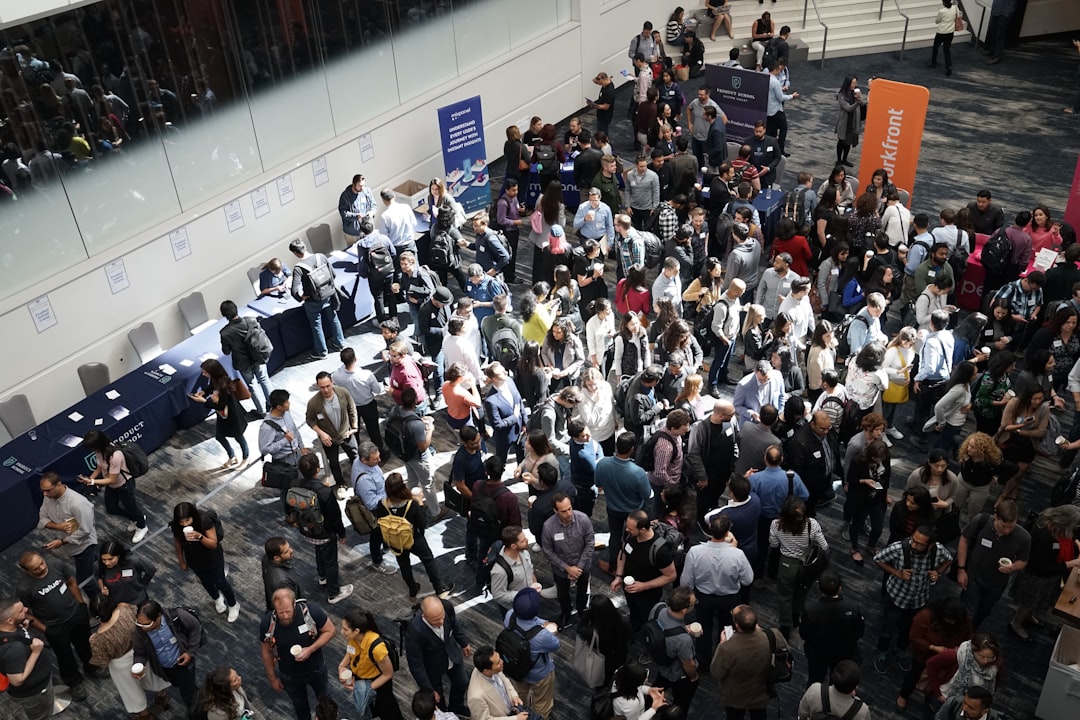
Trade fairs are the highest-density competitive intelligence venues in the European B2B calendar. In a single four-day window at Hannover Messe, EuroShop, MWC Barcelona, or Anuga, every direct competitor in the vertical exhibits their current positioning, product portfolio, partnership ecosystem, executive priorities, and brand investment level in publicly observable form.
Adjacent to those competitor displays, the same fair hosts the customers, channel partners, industry analysts, and trade-press contacts whose perspectives provide the interpretive frame for the observable signals.
The result: a structured competitive intelligence programme tied to a tier-one European fair produces 60-80 percent of the actionable competitive intelligence the company will gather across the entire fiscal year, in 96 hours of structured fieldwork. Mature European B2B exhibitors treat the CI dimension of their fair programme with equal seriousness to the lead-generation dimension and budget accordingly.
This article walks through the SCIP-compliant competitive intelligence framework that experienced European B2B exhibitors deploy, drawing on the SCIP (Strategic and Competitive Intelligence Professionals) Code of Ethics, the EU Trade Secrets Directive (2016⁄943) and equivalent national implementations, and the operational practices documented at AUMA-affiliated industrial-sector exhibitors.
What SCIP-compliant intelligence means
The Strategic and Competitive Intelligence Professionals society publishes a Code of Ethics that defines the legitimate boundaries of competitive intelligence practice. The core principles applied to trade fair contexts:
- Honest identification. Identify yourself, your employer, and your purpose accurately when asked. Do not misrepresent identity or affiliation to gain access or information.
- Publicly available sources. Gather information from sources that are public, voluntarily disclosed, or accessible through legitimate professional channels.
- Lawful means. Do not engage in theft, unauthorised recording, hacking, eavesdropping in private areas, or other illegal information-gathering methods.
- Source consent. Where information is gathered through conversation or interview, the source should understand the nature of the conversation and consent to the use of the information.
- Respect for confidentiality. Do not seek or accept information that the source is contractually or legally bound to keep confidential.
- Accurate representation in reporting. Report findings accurately, distinguish between observed facts and analytical inference, and acknowledge uncertainty.
The SCIP Code of Ethics is the international standard for the practice and is the framework most European multinationals reference in their internal competitive intelligence policies. Compliance is both an ethical baseline and a strategic discipline.
“Common framing among SCIP-certified practitioners is that the legitimacy line is the difference between observing what competitors choose to display publicly and extracting what they would not choose to display if they understood who was asking. The line is clear in principle. Maintaining it across the temptations of a four-day fair requires team discipline, briefing, and a debrief practice that surfaces near-misses before they become incidents.”, Common framing among SCIP-certified European CI practitioners
What is legitimate at a trade fair
The table below summarises the legitimacy of common competitive intelligence activities at European trade fairs. The categories track to the SCIP Code of Ethics and the EU Trade Secrets Directive.
| Activity | SCIP-compliant | Notes |
|---|---|---|
| Walking into a competitor booth as a fair visitor | Yes | Identify accurately if asked |
| Collecting publicly displayed brochures and printed materials | Yes | Materials offered to all visitors |
| Observing booth design, staffing, hospitality investment | Yes | Public-area observation |
| Photographing booth exterior and publicly displayed materials | Usually | Subject to organiser policy and any explicit no-photography signage |
| Photographing competitor booth interior or product demos | Sometimes | Check organiser policy; ask explicit consent for product close-ups |
| Watching publicly run product demonstrations | Yes | Demo is offered to all visitors |
| Listening to publicly delivered presentations or stage events | Yes | Public-area information |
| Asking demo-staff questions as an identified visitor | Yes | If you identify your employer when asked |
| Asking demo-staff questions while concealing affiliation | No | Misrepresentation |
| Interviewing industry analysts about competitive landscape | Yes | Standard professional practice |
| Interviewing channel partners about competitor capabilities | Yes | With understanding the conversation is for CI purposes |
| Conversations with competitor customers attending the fair | Yes | If you identify yourself and the customer chooses to discuss |
| Recording private conversations without consent | No | Illegal in most EU jurisdictions |
| Eavesdropping on competitor private meetings | No | Outside SCIP boundaries |
| Bribing competitor staff for information | No | Illegal under FCPA, UK Bribery Act, EU anti-corruption frameworks |
| Theft of physical materials | No | Criminal |
| Misrepresentation of identity to gain access to private areas | No | Fraud in most jurisdictions |
| Hacking competitor systems via fair wifi or networks | No | Criminal under Computer Misuse Act, EU equivalents |
| Gathering trade secrets through inducement of confidentiality breach | No | Civil and potentially criminal under EU Trade Secrets Directive |
The pattern: anything a competitor displays publicly to all fair visitors is fair game. Anything that requires deception, theft, or breach of confidentiality to obtain is not.
The three-track competitive intelligence programme
Mature competitive intelligence programmes tied to tier-one European fairs run three parallel tracks:
Track 1: structured observation of competitor booths
A dedicated CI team member (or two, for fairs with 10+ direct competitors) visits each competitor booth daily across the four show days, capturing structured observations against a pre-built framework. The framework typically includes:
- Booth design and investment level: estimated booth size, build type (modular / custom / hybrid), apparent budget tier, visual brand investment.
- Staffing patterns: number of staff visible, role mix (sales / product / executive / brand), language coverage, hospitality staffing.
- Demo content: publicly run demonstrations and their content focus, capabilities demonstrated, claimed differentiators, demo frequency.
- Hospitality investment: coffee bar, seated meeting area, private suite, evening event signals.
- Traffic patterns: apparent visitor volume at different times of day, type of visitor (technical / executive / press), conversation length patterns.
- Public collateral: brochures, product sheets, case studies, partnership announcements.
- Partnership signals: co-located partners, integration announcements, displayed customer logos.
- Executive presence: identified senior leaders attending, executive-level meetings observed.
The observation framework produces structured data that can be compared across competitors and across multiple fair cycles. Track 1 typically requires 30-60 minutes per competitor booth per day, scaling to roughly 25-40 hours of CI team time across the four-day fair for a 10-competitor analysis.
Track 2: structured interviews with industry contacts
Track 2 captures the interpretive frame around the Track 1 observations. The interview targets:
- Industry analysts: scheduled meetings with sector analysts attending the fair (Gartner, IDC, Forrester, vertical-specialist firms). Typical agenda: competitive positioning shifts, vendor strategy commentary, customer feedback themes.
- Channel partners: distribution partners, system integrators, resellers attending the fair. Typical agenda: competitor performance from the partner’s perspective, customer feedback, pricing dynamics, partnership programme comparisons.
- Customers (your own): customers attending the fair who also evaluate or use competitor products. Typical agenda: competitor comparison from the customer’s perspective, recent product or service experiences.
- Trade-press contacts: journalists covering the vertical. Typical agenda: themes they are observing across vendors, pre-publication intelligence on upcoming launches or announcements.
Track 2 typically requires 20-40 hours of CI team time across the fair, depending on the number of scheduled interviews. The interviews are explicitly identified as CI conversations, the SCIP-compliant approach is to be transparent about the nature of the discussion.
Track 3: daily synthesis and final reporting
Track 3 integrates Tracks 1 and 2 into a coherent intelligence picture. The structure:
- End-of-day debrief: 60 minutes at the end of each show day, CI team and any other observers (sales, product, executive) share observations. Patterns are surfaced, hypotheses are tested, gaps in the picture are identified for the next show day.
- Mid-fair checkpoint: at the end of day 2, the CI lead writes a preliminary 2-3 page memo capturing the strongest emerging signals. This memo informs adjustments to Tracks 1 and 2 for days 3 and 4.
- Final synthesis session: 2-3 hours immediately after fair close (or the morning of day 5), CI team produces the outline of the final intelligence report.
- Report writing: 14 days post-fair, the final 15-30 page report is delivered to sales, product, and executive leadership.
Total CI team time investment across the three tracks: 80-120 hours across the four-day fair, supporting a 15-30 page intelligence deliverable.
The intelligence report structure
“Standard practice at tier-one European industrial exhibitors is a 14-day delivery target for the final intelligence report. Reports delivered later than 14 days lose actionability because the operational decisions they should inform have already been made by sales, product, and executive teams reacting to fragmentary information.”, Common practice at SCIP-affiliated European CI leads
A typical intelligence report from a tier-one European fair contains:
| Section | Typical length | Audience |
|---|---|---|
| Executive summary | 1 page | Executive leadership |
| Competitive positioning shifts | 1-2 pages per direct competitor (5-15 pages total) | Product, sales, marketing |
| Product roadmap intelligence | 2-4 pages | Product, engineering |
| Pricing intelligence | 1-2 pages | Sales, finance |
| Organisational signals | 1-2 pages | Executive, talent |
| Market dynamics and analyst perspectives | 2-3 pages | Marketing, product |
| Partnership and ecosystem intelligence | 1-2 pages | Partnerships, business development |
| Strategic recommendations | 2-3 pages | Executive leadership |
| Appendices (observation data, interview notes, source citations) | Variable | CI team, audit |
Each finding in the report is sourced and classified by confidence level: observed fact (directly seen at booth or demo), corroborated source (multiple independent sources agreeing), single source (one source, treat with appropriate caution), and analytical inference (drawn from observed signals without direct corroboration). The classification matters because it tells the reader how much weight to put on each finding.
Worked example: structured competitor observation
The table below shows a redacted example of the Track 1 observation framework applied to two direct competitors at Hannover Messe.
| Observation | Competitor A | Competitor B | Inference |
|---|---|---|---|
| Booth size | ~280 sqm (estimated) | ~150 sqm | A: flagship-tier commitment; B: maintenance |
| Build type | Custom | Hybrid | A: maximum brand investment; B: efficient scaling |
| Staffing count (peak) | 22 visible | 9 visible | A: high meeting-handling capacity; B: lean |
| Executive presence | CEO + CTO observed | Regional VP only | A: strategic priority fair; B: standard cycle |
| Demo focus | New AI capability heavily emphasised | Stable platform-update messaging | A: launching/positioning AI as differentiator; B: defending existing positioning |
| Publicly named customer logos | 18 large enterprise logos including 3 new (vs prior year) | 12 logos, same as prior year | A: actively expanding enterprise; B: stable base |
| Partnership announcements | 2 major (with named system integrator and named cloud provider) | None observed | A: expanding ecosystem; B: standalone strategy |
| Hospitality investment | Full bar, seated dining, dedicated VIP suite | Coffee bar, light snacks | A: enterprise-relationship focus; B: transactional |
| Brochure positioning | “Enterprise AI platform for [vertical]” | “Trusted [vertical] platform since 2014” | A: forward-looking positioning; B: heritage positioning |
| Press-day presence | Major launch press event on day 0 | No standalone press activity | A: launch-cycle fair; B: maintenance-cycle fair |
The synthesis from this observation set: Competitor A is treating this fair as a major launch event with elevated investment across booth, staffing, hospitality, and PR. Competitor B is treating the same fair as a maintenance cycle with reduced investment relative to prior year.
Strategic implications: Competitor A is likely to be aggressive on new-business in the AI-platform positioning for the next 6-12 months; Competitor B may be vulnerable to displacement on existing accounts where their lack of forward-positioning becomes apparent.
This level of inference is the value the CI programme delivers. Sales, product, and executive teams can act on this intelligence in budget cycles, product roadmap decisions, and account-targeting choices.
The legal exposure of crossing the line
The EU Trade Secrets Directive (2016⁄943) and equivalent national implementations create specific exposure for unethical competitive intelligence practice. Acts that may constitute illegal acquisition of trade secrets under the Directive:
- Unauthorised access to documents, electronic files, or premises containing trade secrets
- Theft or removal of materials containing trade secrets
- Bribery or inducement of breach of confidentiality obligations
- Misrepresentation of identity or purpose to gain access to trade secrets
The Directive provides for civil remedies (injunctions, damages, account of profits) and in some implementations criminal penalties. The exposure scales with the value of the trade secrets at stake and the egregiousness of the conduct.
“Common framing among in-house counsel at European multinationals is that the strategic case for SCIP compliance is even stronger than the legal case. Intelligence obtained through unethical means is frequently inaccurate, because deceived sources provide misleading information defensively. Decisions made on bad intelligence damage commercial performance more than the absence of intelligence would. The compliance discipline is therefore both ethical and strategically wise.”, Common framing among AUMA-affiliated industrial exhibitor legal teams
Beyond the legal exposure, the European trade fair community is small. Major venue organisers (Messe Frankfurt, Messe Düsseldorf, Messe München, IFEMA, Fiera Milano, RAI Amsterdam, Koelnmesse) maintain informal awareness of known deceptive practitioners. Reputational damage from a publicised SCIP violation is severe and persistent.
Common competitive intelligence mistakes at fairs
- Operating without a brief. Sending team members to “see what competitors are doing” without a structured observation framework produces anecdote rather than intelligence.
- Skipping the synthesis step. Track 1 and Track 2 observations sitting in individual notebooks never become a shared intelligence asset. The end-of-day debrief and final synthesis session are not optional.
- Misrepresentation under pressure. Junior team members who feel exposed when identified as a competitor sometimes drift into misrepresentation. Briefing on the SCIP-compliant response (“Yes, I’m with [competitor]. I’m here as a fair visitor and I’d be interested in learning about your new platform if you’re willing to share what’s publicly available.”) prevents this.
- Late reporting. A 30-day report delivery target loses 50-70 percent of the report’s actionability because operational decisions have already been made.
- Conflating observation with inference in the report. Readers cannot distinguish what was directly seen from what was analytically inferred, which damages credibility when an inference is later challenged.
- No competitor intelligence on smaller players. Focusing exclusively on the 2-3 largest direct competitors misses the smaller competitors who are often the source of disruption and the larger competitors of the next 3-5 years.
- No multi-year comparison. Single-fair intelligence reports show snapshots. Year-on-year comparisons show trajectories, and trajectories are more actionable than snapshots.
Building a CI programme into the fair planning cycle
The CI programme is a planned component of the fair budget and team, not an afterthought:
- Pre-fair (week 12): CI team identified and briefed, observation framework finalised, interview targets confirmed and scheduled, SCIP compliance briefing delivered to the team.
- Pre-fair (week 4): competitor short-list confirmed, observation rotation scheduled across the four show days, interview calendar finalised.
- Show week: Track 1 daily observation, Track 2 scheduled interviews, end-of-day debriefs.
- Day 0 post-fair: final synthesis session.
- Day 14 post-fair: final intelligence report delivered to sales, product, executive.
- Day 30 post-fair: strategic action review with executive leadership on recommendations.
- Day 90 post-fair: intelligence-action tracker, which recommendations were implemented, which were rejected, which require additional intelligence.
The CI budget typically runs EUR 15,000-45,000 per tier-one fair for a focused 80-120 hour team commitment, including the analyst interview fees, the report production cost, and the share of CI team time. The investment is small relative to the fair programme cost and produces some of the highest-leverage strategic intelligence in the annual cycle.
How to act on this
Running a competitive intelligence track alongside the commercial programme takes deliberate preparation, from where your observers can stand to which fairs actually put your rivals in the same hall. Set the programme up using the following, well before the exhibitor lists are published:
- Brief stand builders via /rfq to include observation-friendly positioning for the CI team (the team needs unobtrusive observation points across the hall).
- Use the Builders Directory to find partners who understand the operational requirements of a multi-track fair programme.
- Use the Fairs Directory to validate which fairs have the highest competitor density in your vertical.
- Run the Booth Cost Calculator to model the CI budget line within the total fair programme cost.
Related reading
- Pre-Show Marketing Ramp, the pre-show ramp informs competitor positioning context
- KPI Framework, share-of-voice as a CI-adjacent KPI
- Budget Defense to CFO and CEO, CI value as a third leg of the fair investment case
- Objective Setting for Trade Fairs, CI objectives as a secondary pattern for any fair
- Account-Based Event Marketing, CI integration with named-account strategy
References and primary sources
- SCIP (Strategic and Competitive Intelligence Professionals) Code of Ethics
- EU Trade Secrets Directive 2016⁄943, European Parliament and Council
- AUMA-Trends and AUMA Exhibitor Outlook survey publications, auma.de
- UFI Global Barometer, 2026 wave, ufi.org
- MPI EventScape 2026 industry outlook, mpi.org
- FAMAB Verband Direkte Wirtschaftskommunikation member guidelines, famab.de
- UK Bribery Act 2010, US FCPA, and equivalent EU anti-corruption frameworks
- Computer Misuse Act 1990 (UK) and EU Cybercrime Convention equivalents
- Fuld + Company and Aurora WDC competitive intelligence methodology publications
FAQFrequently asked questions
SCIP, the Strategic and Competitive Intelligence Professionals society, publishes a Code of Ethics that defines legitimate competitive intelligence as gathering and analysis of publicly available or voluntarily disclosed information through honest means, without misrepresentation of identity, employer, or intent.
SCIP-compliant practice at trade fairs means: identifying yourself accurately when asked, gathering information from publicly accessible booth materials and demonstrations, conducting interviews with explicit acknowledgement of who you represent, and never using deception, theft, eavesdropping in private areas, or unauthorised recording.
The compliance line is clear in principle but requires discipline to maintain across the four-day fair window when temptations to cross the line accumulate.
Yes, with conditions. Walking into a competitor booth is legitimate competitive intelligence provided you do not misrepresent yourself when asked.
The standard SCIP-compliant approach: identify your company and role accurately if asked directly (do not lie), accept that the conversation will be shorter and more guarded than with a non-competitor visitor (treat that as honest), focus on publicly displayed information (booth materials, demo screens, brochures available to all visitors), and do not attempt to engage in deceptive conversations to extract non-public information.
Most experienced competitive intelligence practitioners send junior team members who do not carry obvious competitor brand recognition, but identify themselves honestly when asked.
The legitimately collectable sources are:
- Publicly displayed product information (positioning, claimed features, pricing where displayed)
- publicly accessible demo content
- brochures and printed collateral available to any visitor
- booth design and investment level as a proxy for strategic priority
- staff allocation patterns as a proxy for organisational focus
- partnership and integration announcements
- press releases and trade-press coverage during the fair window
- competitor pricing or positioning information obtained from third parties (your customers, channel partners, industry analysts) through legitimate professional conversations
What is not legitimate: unauthorised recording of private conversations, theft of physical materials not offered publicly, deceptive identification of yourself or your employer, and conversations with competitor staff under false pretences.
Three-track structure. Track 1 (observation): dedicated CI team member visits each direct competitor booth daily, captures publicly observable signals (booth design, staffing, demo content, hospitality, traffic patterns) against a structured observation framework.
Track 2 (interviews): scheduled conversations with industry analysts, channel partners, customers, and trade-press contacts attending the fair, focused on competitive landscape questions.
Track 3 (synthesis): daily 60-minute debrief at end of each show day to integrate observations from Tracks 1 and 2 into a running intelligence picture, with a final 2-hour synthesis session at fair close producing the intelligence report.
Total team time investment: roughly 80-120 hours across four days, supporting a 15-30 page intelligence deliverable shared with sales, product, and executive leadership within 14 days of fair close.
The report typically runs to the following sections:
- executive summary (one page)
- competitive positioning shifts observed (one page per direct competitor, typically 5-10 competitors)
- product roadmap intelligence (publicly demonstrated capabilities, announced launches, partnership signals)
- pricing intelligence (publicly displayed pricing, conversations with channel partners)
- organisational signals (staffing patterns, executive presence, hiring announcements)
- market dynamics (industry analyst perspectives, trade-press themes, vertical-specific trends)
- strategic recommendations (immediate actions, 90-day adjustments, longer-term implications)
The report length is 15-30 pages, the audience is sales, product, and executive leadership, and the delivery target is 14 days post-fair. Reports delivered later than 14 days lose actionability because the operational decisions they should inform have already been made.
Three categories of risk. Legal: depending on jurisdiction, deceptive misrepresentation to gain access, unauthorised recording, or theft of materials can violate criminal statutes (trade secret theft, fraud, computer misuse) and civil torts (misappropriation, defamation). The EU Trade Secrets Directive (2016⁄943) and equivalent national implementations create specific exposure.
Reputational: the European trade fair community is small and the major venues (Messe Frankfurt, Düsseldorf, Munich, IFEMA, Fiera Milano) maintain informal blacklists for known deceptive actors.
Strategic: intelligence obtained through unethical means is frequently inaccurate (because deceived sources provide misleading information defensively), and decisions made on bad intelligence damage commercial performance more than the absence of intelligence would. The compliance discipline is therefore both ethical and strategically wise.