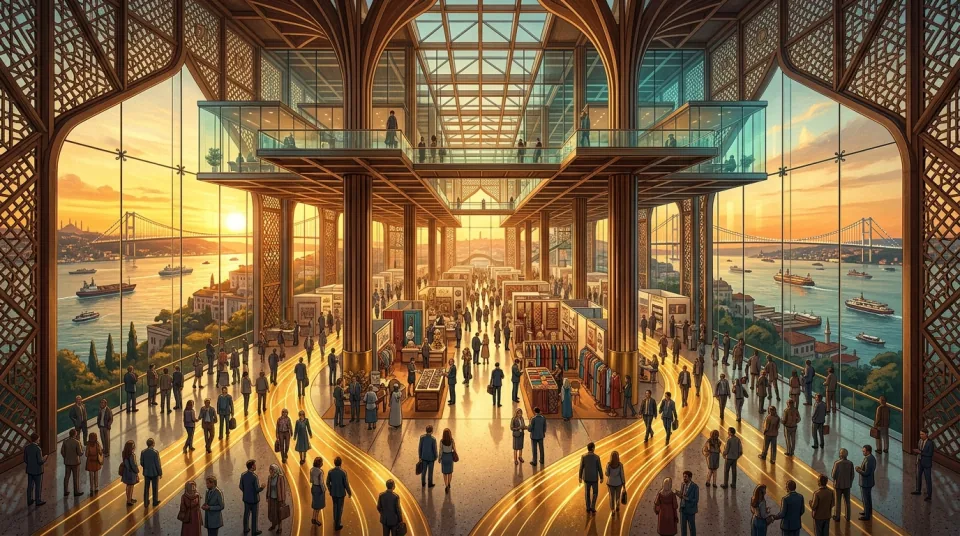
European exhibition strategy gives Turkey a distinctive place and geographically the country links European and Middle Eastern/North African buyer audiences. From industrial strength in textiles, automotive parts, machinery, food processing and construction materials come both Turkish-market commercial fairs and pan-regional B2B show activity.
Through 2018 to 2025, venue infrastructure has developed a great deal with major investment going into Istanbul venues. Cost structures sit notably below those of Western Europe and stands cost 40 to 60 percent less than equivalent stands at comparable Western European venues. How operations work affects procurement planning in particular ways.
Major Turkish trade fairs through 2026 get the cost of exhibiting in Turkey spelled out here and cost profiles venue by venue appear. Regulatory and operational issues particular to a non-EU country deeply integrated into European supply chains are covered as well as the strategic thinking exhibitors apply to Turkish fair calendars.
Observed quotes from TUYAP Istanbul, IFM Istanbul Expo Center, CNR Expo Istanbul, IZFAŞ Izmir and ATO Congresium Ankara through 2025 contracts and early 2026 commitments have been used to produce the figures.
Why Turkey matters as an exhibition destination
Three structural factors position Turkey in European exhibition strategy.
First up is geographic and demographic positioning that gives Istanbul the advantage of sitting where European and Middle Eastern/North African markets meet and Turkish Airlines flies directly to far more international destinations than its regional competitors. When major Istanbul fairs bring together visitor audiences that have both European and MENA buyer profiles, exhibitors at a single event get access to an expanded addressable market.
The second is industrial depth across categories relevant to European supply chains. Turkish textile manufacturing, automotive components, white goods, food processing, machinery and construction materials are deeply integrated into European supply chains. Trade fairs in these categories draw large groups of European visitors as well as buyers for the Turkish market.
Developing venue infrastructure is the third area addressed. Substantial investment in technical infrastructure by TUYAP Istanbul and CNR Expo Istanbul runs through 2018 to 2025 and stand technical requirements at these venues are now matched to those of tier-one European venues. Smaller venues are continuing to mature.
Industry perspective: Adding an Istanbul flagship fair to a European calendar allows industrial exhibitors to reach combined European, Turkish, and MENA buyer audiences at a single venue, with the lower per-sqm build cost in Turkey often funding the appearance out of broader calendar efficiencies.
Major Turkish venues and cost profiles
TUYAP Istanbul (Beylikdüzü)
The largest Turkish venue and the regional flagship hosting most major Istanbul-based international fairs. Fourteen halls totalling approximately 120,000 sqm of covered exhibition space.
| Cost category | 2026 figure |
|---|---|
| Space rental per sqm | EUR 160-340 |
| Standard 100 sqm stand all-in (mid-tier) | EUR 50,000-95,000 |
| Premium 100 sqm stand all-in | EUR 95,000-160,000 |
| Hidden-cost variance | 14-22% above headline |
| Typical major fairs | Automechanika Istanbul, REW Istanbul, BroadcastAsia Istanbul, MUSIAD Expo, Yapi Turkeybuild Istanbul |
CNR Expo Istanbul (Yeşilköy)
Located as a major venue next to Istanbul Airport, the site hosts mainly Turkish-market commercial fairs and is seeing growing international fair activity. It covers about 95,000 sqm across several halls.
| Cost category | 2026 figure |
|---|---|
| Space rental per sqm | EUR 180-360 |
| Standard 100 sqm stand all-in (mid-tier) | EUR 55,000-100,000 |
| Premium 100 sqm stand all-in | EUR 100,000-170,000 |
| Hidden-cost variance | 14-20% above headline |
| Typical major fairs | IFEX Istanbul, IDEF Defence Expo, Eurasia Boat Show |
IFM Istanbul Expo Center
Mid-sized Istanbul venue serving specialised Turkish-market fairs. Approximately 32,000 sqm of exhibition space.
| Cost category | 2026 figure |
|---|---|
| Space rental per sqm | EUR 140-280 |
| Standard 100 sqm stand all-in (mid-tier) | EUR 42,000-80,000 |
| Premium 100 sqm stand all-in | EUR 80,000-135,000 |
| Hidden-cost variance | 12-18% above headline |
| Typical major fairs | Specialised industry fairs |
IZFAŞ Izmir International Fair
Established Izmir venue serving primarily Aegean-region commercial fairs. Approximately 28,000 sqm of exhibition space.
| Cost category | 2026 figure |
|---|---|
| Space rental per sqm | EUR 120-240 |
| Standard 100 sqm stand all-in (mid-tier) | EUR 38,000-72,000 |
| Premium 100 sqm stand all-in | EUR 72,000-125,000 |
| Hidden-cost variance | 12-16% above headline |
| Typical major fairs | Izmir International Fair, regional industrial and agricultural fairs |
ATO Congresium Ankara
Ankara venue serving primarily government-and-defence procurement fairs and Anatolian commercial fairs. Approximately 22,000 sqm of exhibition space.
| Cost category | 2026 figure |
|---|---|
| Space rental per sqm | EUR 140-280 |
| Standard 100 sqm stand all-in (mid-tier) | EUR 40,000-78,000 |
| Premium 100 sqm stand all-in | EUR 78,000-135,000 |
| Hidden-cost variance | 12-18% above headline |
| Typical major fairs | Government-procurement fairs, defence industry fairs, regional commercial fairs |
Cost comparison: Turkey versus European equivalents
The table below compares typical 100 sqm mid-tier hybrid stand cost at Turkish venues versus equivalent European tier-one venues.
| Venue | 100 sqm stand cost EUR | % vs Frankfurt baseline |
|---|---|---|
| Messe Frankfurt (baseline) | 165,000 | 100% |
| Hannover Messe | 158,000 | 96% |
| Fiera Milano | 138,000 | 84% |
| IFEMA Madrid | 125,000 | 76% |
| Brussels Expo | 132,000 | 80% |
| MTP Poznań | 85,000 | 52% |
| Hungexpo Budapest | 78,000 | 47% |
| TUYAP Istanbul | 78,000 | 47% |
| CNR Expo Istanbul | 82,000 | 50% |
| IZFAŞ Izmir | 60,000 | 36% |
| ATO Congresium Ankara | 62,000 | 38% |
Costs for Turkish venues match those of CEE venues and are much lower than for Western European tier-one venues. Space rental rates account for much of the cost advantage, Turkish venues most often coming in at 35 to 55 percent of what Western European rates are and local labour cost differences as well as Turkish lira depreciation against the Euro have helped international exhibitors through 2022 to 2024.
Turkey-specific operational considerations
Six operational considerations affect Turkish exhibitor planning beyond what applies at EU venues.
Customs and ATA Carnet operations come first. As Turkey is not an EU member state, customs docs including an ATA Carnet are needed for all stand freight from EU origins. Brokerage and labour costs add EUR 2,400 to EUR 6,800 per shipment for the documentation that is complex enough to bring delays at the Bulgaria-Turkey border crossing or at Istanbul ports if there are documentation errors.
The second is currency exposure and through 2020-2025, the Turkish lira has seen large volatility. International exhibitors can get most major Turkish venues on Euro-denominated contracts now but ancillary services like catering, local AV vendors and install labour may bill in lira and that brings in currency exposure.
Regulatory framework differences make up the third point. Turkey is not covered by EU rules like GDPR or the European Accessibility Act and yet Turkish data protection law (KVKK) works in a way similar to GDPR. Rules for workplace safety come from Turkish labour law. Product certifications most often differ from what is found in the EU.
Language operations make up the fourth category. International-fair contexts see high English business proficiency in global fairs but domestic-fair contexts show variability. Fluently operating in English are major TUYAP and CNR Expo fairs and many IZFAŞ and ATO Congresium fairs work mainly in Turkish. Fairs with much MENA attendance have trilingual signs (English-Turkish-Arabic) that show commercial awareness.
Local supplier ecosystem makes up the fifth element. Several builders now deliver tier-one international standards and Turkish stand-building capability has matured a lot. The AV and ancillary supplier ecosystems are less developed than their CEE counterparts but they do continue to grow.
Visa and travel rules make up the sixth point. Citizens of many EU member states need visas to go to Turkey and some need electronic visas, while others can travel visa-free. Pre-fair travel planning has to account for visa rules covering exhibitor staff and senior visitors.
Industry perspective: While Turkish stand-build labour and material rates resemble Central European pricing, procurement teams must treat Turkey as a distinct operational environment requiring dedicated ATA Carnet or temporary-import customs management, EUR/TRY currency controls, and local earthquake/fire compliance.
Strategic logic for Turkish fair calendar selection
Three strategic patterns characterise effective Turkish fair selection.
Turkish-market commercial access is the first thing. Large commercial activity goes on in Turkish industrial sectors that European markets cannot get directly to. Accessing the Turkish market most often needs a fair presence in Turkey.
MENA-bridge audience access is the second point. Buyer audiences from MENA are drawing to Istanbul fairs along with Turkish and European audiences and exhibitors aiming at MENA commerce can get large MENA audience reach by going to a single Istanbul fair instead of separate MENA fairs.
Pan-European supply chain coordination as the third point is what comes next. Turkish manufacturing is strongly integrated into European supply chains. That makes Turkish fairs commercially relevant for European exhibitors managing supply-chain relationships even when the main commercial market is European rather than Turkish.
Worked example: automotive components exhibitor at Automechanika Istanbul
At Automechanika Istanbul held at TUYAP, an automotive components exhibitor has set up shop. The stand is a 150 sqm island stand with a mid-tier hybrid execution aimed at drawing in both Turkish and MENA buyer audiences.
- Space rental at EUR 285/sqm: EUR 42,750
- Stand build through Turkish builder (mid-tier hybrid): EUR 75,000
- Lighting and AV (CRI 90+, hero LED wall 8 sqm, touchscreens, demo station): EUR 38,000
- Meeting rooms (3 enclosed for varied audience engagement): EUR 32,000
- Hospitality (premium café-lounge with Turkish coffee element): EUR 14,000
- Transport via Bulgaria border crossing (ATA Carnet): EUR 12,000
- Install and dismantle: EUR 12,000
- Accessibility (compliant baseline): EUR 7,200
- Project management and on-stand coordination: EUR 16,000
- Insurance (covering equipment demonstration): EUR 4,800
- MESAM music licensing: EUR 380
- Trilingual signage and materials (English-Turkish-Arabic): EUR 9,800
- Senior staff and executive travel: EUR 22,000
- Hidden-cost contingency at 18%: EUR 51,000
- Total: EUR 336,930 for the fair
At substantially below what EUR 3,000 to EUR 3,500 per sqm is typical for an equivalent stand at IAA Mobility Munich or any other top European automotive fair of its class, EUR 2,246 per sqm appears in the figure. Savings from existing fair calendar entries pay for the extra fair attendance that the cost difference makes possible.
Tooling at Exhibition Stands EU
Turkish venue selection and customs scope appear in the /rfq workflow. Turkish venue cost differences and models for ATA Carnet cost appear in the /calculator. The /builders directory contains a list of Turkish builders that have documented international delivery capability.
Related reading
- Exhibiting in Turkey: TUYAP Istanbul MEA Gateway
- Stand Design Cost Breakdown
- Shipping Timelines and Deadlines
- Insurance and Liability
- Freight Cost for European Trade Fairs
- Find a Builder
References and primary sources
- AUMA exhibitor cost benchmarks (2024-2026 edition), auma.de
- FAMAB Verband Direkte Wirtschaftskommunikation member best-practice exchanges
- IFES (International Federation of Exhibition and Event Services) member working group papers
- IELA (International Exhibition Logistics Association) freight cost benchmarks 2024
- TUYAP Istanbul Exhibitor Manual 2026
- CNR Expo Istanbul Exhibitor Manual 2026
- World Customs Organization ATA Carnet system documentation
- Turkish KVKK (Kişisel Verilerin Korunması Kanunu) data protection framework
FAQFrequently asked questions
Turkish cost structures sit notably below Western European equivalents, often 40 to 60 percent below comparable Western European venues for equivalent stand specifications. A 100 sqm mid-tier hybrid stand costs EUR 78,000 at TUYAP Istanbul against EUR 165,000 at Messe Frankfurt, which is 47 percent of the Frankfurt baseline. IZFAŞ Izmir sits lowest at 36 percent.
Space rental runs EUR 180 to 360 per sqm at CNR Expo Istanbul and EUR 160 to 340 at TUYAP Istanbul. IFM Istanbul Expo Center and ATO Congresium Ankara both sit at EUR 140 to 280 per sqm, and IZFAŞ Izmir International Fair is lowest at EUR 120 to 240 per sqm. Rates vary within each band by fair and hall.
TUYAP Istanbul at Beylikdüzü is the largest Turkish venue and the regional flagship, with fourteen halls totalling approximately 120,000 sqm of covered exhibition space. It hosts most major Istanbul-based international fairs including Automechanika Istanbul, REW Istanbul, BroadcastAsia Istanbul, MUSIAD Expo and Yapi Turkeybuild Istanbul.
Headline figures understate the real total. Hidden-cost variance runs 14 to 22 percent above headline at TUYAP Istanbul and 14 to 20 percent at CNR Expo Istanbul. IFM Istanbul Expo Center and ATO Congresium Ankara sit at 12 to 18 percent, and IZFAŞ Izmir at 12 to 16 percent. Budgets should carry that contingency explicitly.
Yes. Turkey is not an EU member state, so all stand freight from EU origins requires customs documentation including ATA Carnet for temporary import. The documentation complexity adds EUR 2,400 to 6,800 per shipment in brokerage and labour costs. Documentation errors can produce delays at the Bulgaria to Turkey border crossing or at Istanbul ports.
No. Turkey is not subject to EU regulatory frameworks including GDPR or the European Accessibility Act. Turkish data protection law, known as KVKK, operates similarly to GDPR. Workplace safety frameworks operate under Turkish labour law, and product certifications often differ from EU equivalents, so compliance cannot simply be carried over from an EU fair.
The Turkish lira has experienced substantial volatility through 2020 to 2025. Most major Turkish venues now offer Euro-denominated contracts for international exhibitors, but ancillary services including catering, local AV vendors and install labour may invoice in lira with corresponding currency exposure. Procurement teams should treat EUR and TRY controls as a distinct workstream.
It depends on the fair. English business proficiency is high in international-fair contexts but variable in domestic-fair contexts. Major TUYAP and CNR Expo fairs operate fluently in English, while some IZFAŞ and ATO Congresium fairs operate predominantly in Turkish. Trilingual signage in English, Turkish and Arabic shows commercial sensitivity where MENA attendance is substantial.
The worked example totals EUR 336,930 for the fair, or EUR 2,246 per sqm. That covers EUR 42,750 space rental at EUR 285 per sqm, EUR 75,000 build through a Turkish builder, EUR 38,000 lighting and AV, EUR 32,000 for three meeting rooms, EUR 12,000 ATA Carnet transport and an 18 percent hidden-cost contingency of EUR 51,000.
Yes, audience reach. Istanbul sits at the intersection of European and Middle Eastern or North African markets, and major Istanbul fairs draw visitor audiences combining both European and MENA buyer profiles. Exhibitors with MENA objectives can achieve substantial MENA reach through single-Istanbul fair attendance rather than running a separate MENA fair calendar.