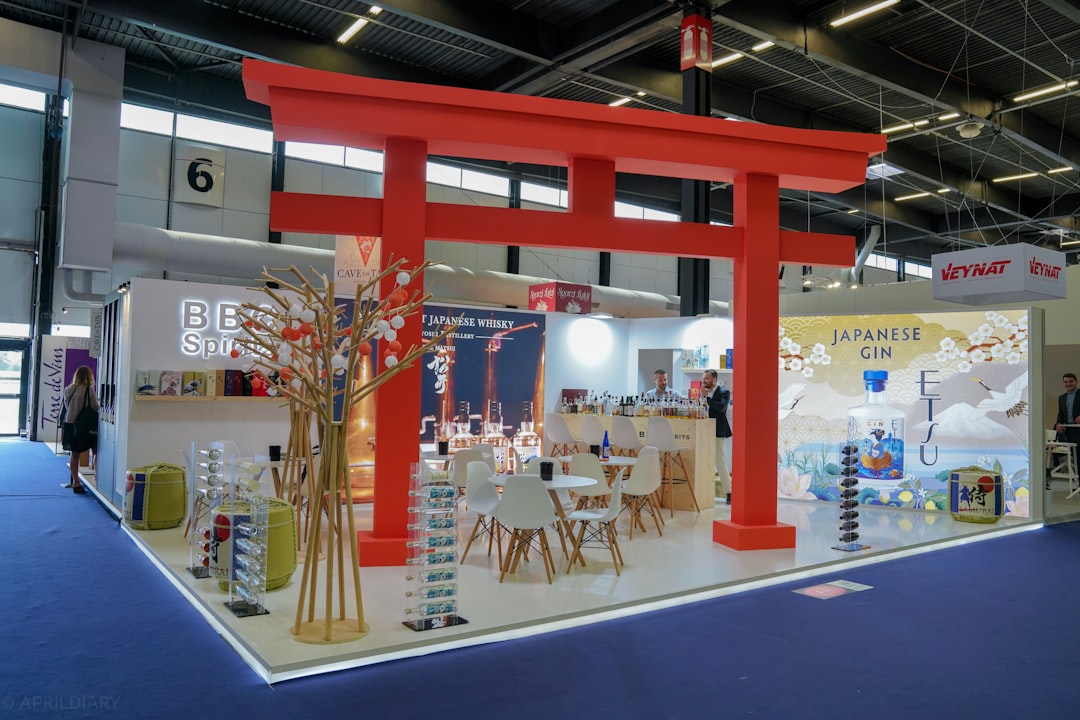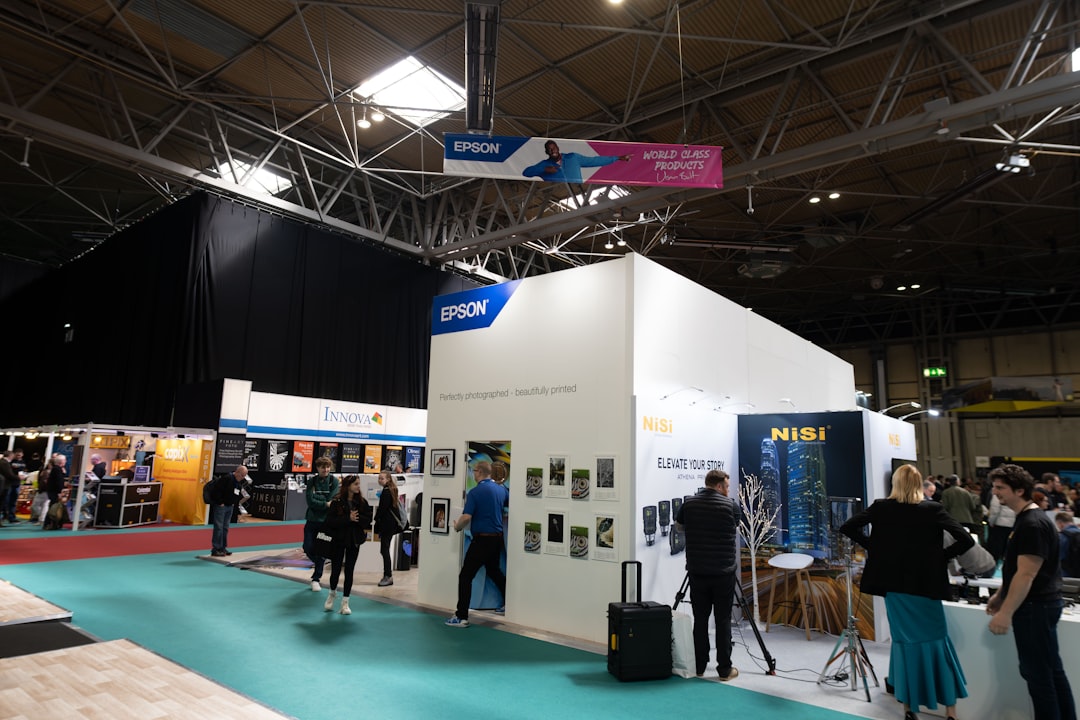
Stand graphics carry the brand promise in the two to four seconds of aisle approach a typical European fair visitor allocates to deciding whether to enter your stand. The graphic surface in that window does more brand work than every other element of the stand combined. Get the hero sizing right, the substrate selection right, and the file preparation right, and the stand performs above its budget class.
Get any one of them wrong and the cleanest construction in the world reads as forgettable from across the hall.
This article documents the graphics decisions experienced European stand designers make at brief stage, the substrate choice between SEG fabric, backlit fabric, and vinyl, the print-shop file specifications that prevent late-stage rework, the lead-time realities at the major European print shops, and the venue-specific considerations that affect graphic deployment at Messe Frankfurt, Messe Düsseldorf, Fiera Milano, IFEMA Madrid, RAI Amsterdam, ExCeL London, Koelnmesse, and Messe München.
The three-second test
Visitor traffic at European trade fairs moves at roughly 3-5 km/h in main aisles, accelerating to 5-7 km/h on through-routes. A stand front of 4 metres reads in roughly two to four seconds of walking past. The graphic content visible and processed during that window determines whether the visitor enters the stand or continues to the next.
The cognitive load research applied to retail signage transfers directly to exhibition graphics: a visitor in motion at fair-walking pace can process roughly three discrete visual elements in three seconds. The implication for hero-wall design is brutal: a brand mark, one hero visual, and one short value-proposition line is the maximum effective content load.
Stands that violate this rule with dense bullet lists, multiple competing visual elements, or unreadable body copy fail the three-second test regardless of how beautifully each individual element is designed.
“We banned bullet lists from aisle-facing graphics about four fair cycles ago. The graphic designers fought it; the post-fair lead numbers settled the argument. Nobody reads bullets at fair-walking pace. Nobody.”, Common framing among brand-experience leads at tier-one European exhibitors
Hero sizing: how big the brand statement actually needs to be
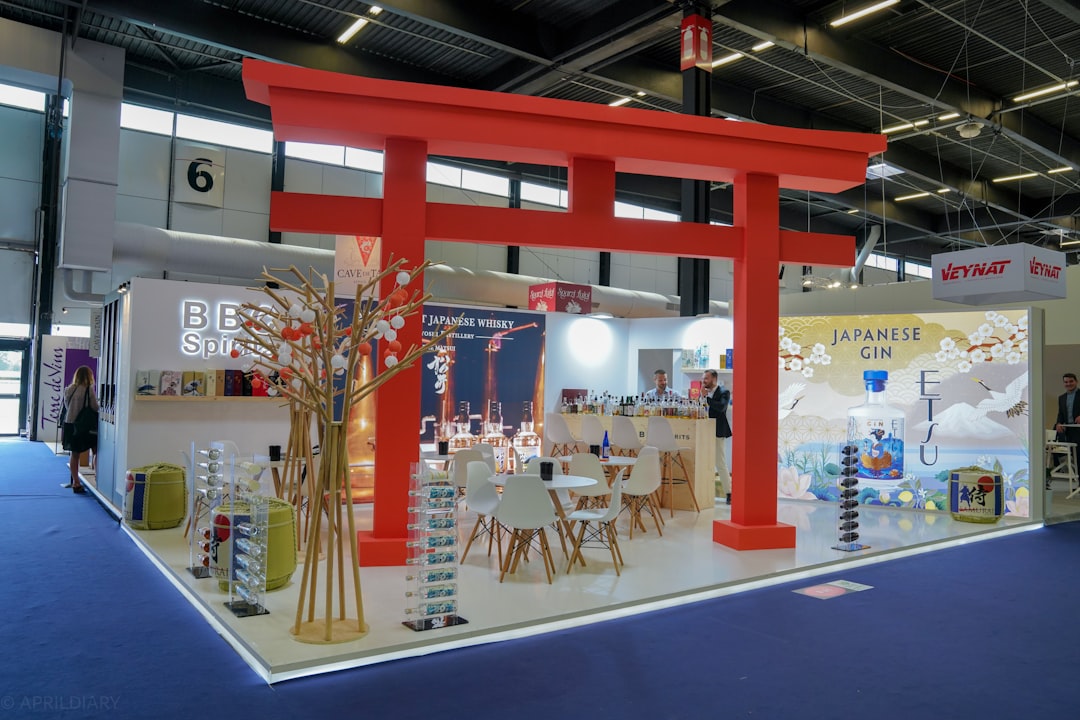
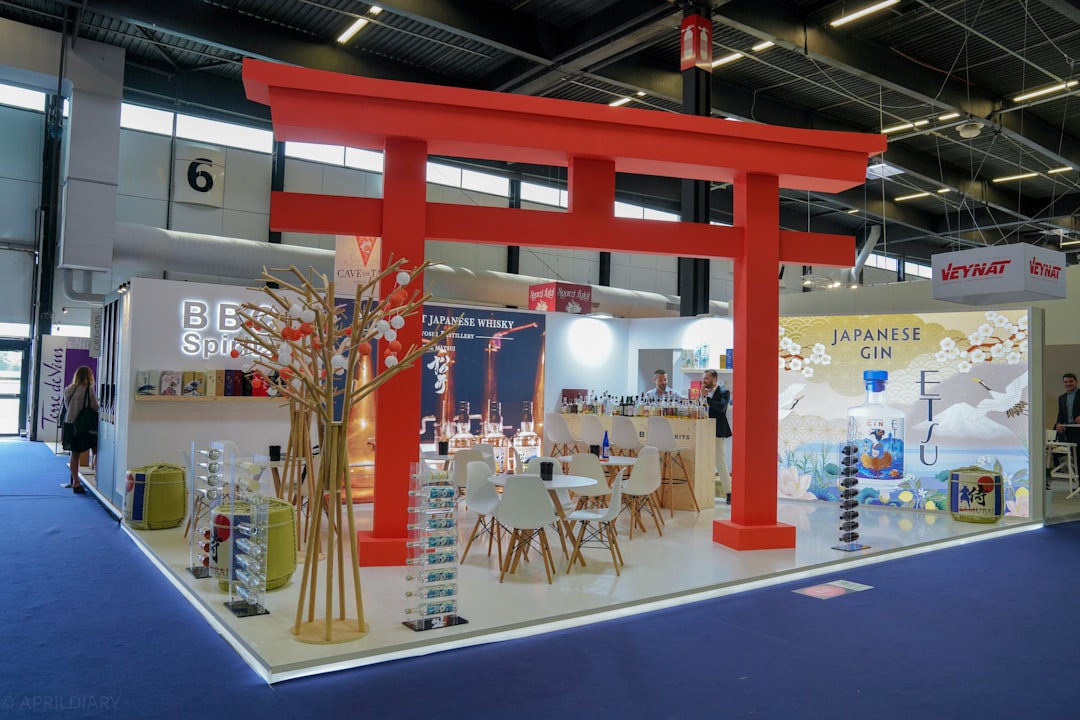
The hero graphic, the single largest brand-statement surface visible from the aisle approach, should occupy at least 60-70 percent of the visible aisle-facing wall area on stands above 30 sqm, and at least 75-85 percent on stands above 80 sqm. The working rule:
| Stand size | Aisle-facing wall area (typical) | Recommended hero minimum size |
|---|---|---|
| 18-30 sqm | 4-6 sqm visible | 2.5 sqm hero (60-70% of visible) |
| 30-50 sqm | 8-12 sqm visible | 6-8 sqm hero (70-75%) |
| 50-100 sqm | 12-20 sqm visible | 10-16 sqm hero (75-80%) |
| 100-200 sqm | 20-40 sqm visible | 18-32 sqm hero (80-85%) |
| 200+ sqm | 40+ sqm visible | 80%+ of visible aisle face |
Smaller heros disappear into the visual noise of the hall. At a fair with 1,200 exhibitors all competing for the same three seconds of aisle attention, the hero either dominates or it loses. The middle position, a moderately sized hero with respectable but not dominant scale, is the most expensive failure mode in stand graphic design because it costs nearly as much as a properly sized hero and delivers a fraction of the brand impact.
Hero brand-mark height is also worth specifying explicitly. The working European convention: brand mark height should be at least 12-15 percent of the total hero surface height. For a 3 metre tall hero wall, the brand mark should be at least 36-45 cm tall. Brand marks below this threshold read as logos rather than brand signatures, which is a different design intention with different commercial consequences.
The substrate decision: SEG, backlit, or vinyl
Three substrates dominate European stand graphic production. The choice between them depends on illumination intent, touch-interaction risk, and brand register.
SEG fabric (dye-sublimated tensioned polyester)
The dominant European substrate since 2020. Dye-sublimation print transfers ink chemistry into the polyester fibre, producing a permanent colour bond that does not crack, peel, or fade under typical fair-duration lighting. The fabric tensions tight into an aluminium channel frame via a thin silicone bead sewn into the edge.
Cost: EUR 45-75 per sqm finished, including print, sewing, and the SEG channel frame.
Lead time: 7-12 working days from approved artwork to delivery at a European print shop.
Use for: front-lit feature walls, aisle-facing brand graphics, ceiling-tile graphics, large panel applications above 2 sqm.
Avoid for: surfaces visitors will touch, lean on, or grip; acoustic-sensitive zones where you want the wall to block sound (SEG fabric is acoustically transparent); applications where the print needs to read clearly under low light without supplementary illumination.
Backlit fabric (translucent polyester in LED light box)
Translucent dye-sublimated polyester mounted in an aluminium LED light box, illuminated from the rear by a uniform LED panel. Produces a self-illuminating brand statement visible from far longer aisle distances than front-lit graphics.
Cost: EUR 180-320 per sqm finished, including print, fabric, light box frame, and LED panel.
Lead time: 10-14 working days from approved artwork to delivery.
Use for: hero brand statements above 8 sqm where dramatic visual presence is part of the brand objective; trade-fair entrances where the brand must be visible from the venue main concourse; flagship stands at design-led fairs (Salone del Mobile, EuroShop, Maison&Objet) where backlit is the table-stakes expectation.
Avoid for: graphics under 5 sqm (the cost premium is not justified at small scale); colour-critical applications without pre-print colour proofing across substrates; long-duration installations where LED panel uniformity may degrade across multi-week deployments.
Vinyl (printed adhesive)
Solvent or UV-cured ink printed on self-adhesive vinyl, applied directly to substrate surfaces. The original exhibition graphic substrate before SEG displaced it on most front-lit applications, and still the right answer for specific use cases.
Cost: EUR 35-65 per sqm finished.
Lead time: 3-7 working days from approved artwork.
Use for: counter wraps (where visitors will lean and touch), bar-front graphics, door surfaces, kick panels under furniture, wayfinding signage, registration desk fronts, short-life promotional graphics that change between fair days.
Avoid for: large aisle-facing brand walls (SEG is structurally cheaper and lighter at large scale), backlit applications (vinyl is opaque), reuse across multiple fairs (vinyl typically does not reapply cleanly after removal).
Print specifications: what European printers actually want
Most rework cycles at European print shops are caused by file preparation errors that are entirely avoidable. The working specifications that prevent rework:
- File format. PDF/X-4 (preferred) or layered PSD. Avoid JPG-only files; avoid PNG for production artwork.
- Working scale. Artwork at 25-50 percent of final output size at 300 dpi at that intermediate scale. A 3 metre wide printed graphic should arrive as a 1.5 metre wide file at 300 dpi (or equivalent). Larger working files (artwork at full scale at 300 dpi) increase file size without improving print quality.
- Colour profile. Fogra 39 or Fogra 51 CMYK; profile embedded in the file. Generic CMYK without an embedded profile produces unpredictable colour reproduction across print shops.
- Bleed. SEG fabric: 50-100 mm on each edge (the silicone channel occupies edge area and the fabric must wrap into the channel). Vinyl: 25-50 mm on each edge. Backlit fabric: 50-75 mm on each edge.
- Fonts. Converted to outlines or embedded in the PDF. Live-text fonts not embedded routinely substitute incorrectly at the print shop.
- Photo elements. RGB photos converted to CMYK using the print shop’s specified profile, not generic CMYK. RGB elements left unconverted print with noticeable colour shift, particularly in skin tones and brand colours.
- Pantone references. Specified explicitly in the artwork brief for any brand-critical colour. Pantone-to-CMYK conversion shifts colour depending on substrate and print shop calibration; specifying the Pantone reference allows the print shop to colour-match physically rather than relying on numeric values.
The proofing protocol matters as much as the file preparation. For brand-critical applications, request printed samples at A3 size on each substrate (typically EUR 60-150 per substrate for a small proof set) before committing the full print run. The proof set catches colour drift across substrates and prevents the post-install discovery that the SEG hero, the backlit signature, and the vinyl counter wrap all read as slightly different shades of the same brand colour.
“The most expensive print mistake we make as an industry is sending artwork without bleed and discovering the problem the day before the fair. The fix is to use a print shop that audits the file before they print, and to send artwork four weeks ahead instead of two.”, Common framing among Messe Frankfurt-approved stand builders
Lead times across the European print market
Print lead times vary by substrate, by print shop tier, and by the print shop’s load at the time of order. The working ranges below apply to the major European exhibition print shops (Schenker-affiliated providers, Expomobilia in-house print, the larger independent shops in Germany, Italy, and the Netherlands).
| Substrate | Standard lead time | Express lead time (premium) | Notes |
|---|---|---|---|
| Vinyl | 3-7 working days | 24-48 hours (50-100% premium) | Fastest substrate; smallest format range |
| SEG fabric | 7-12 working days | 4-5 working days (40-80% premium) | Most demand at peak fair seasons |
| Backlit fabric | 10-14 working days | 6-8 working days (60-100% premium) | LED frame production often the constraint, not print |
| Custom one-off (oversize banner, photo-mural) | 14-21 working days | 8-10 working days (80-150% premium) | Print bed availability often the constraint |
| Backlit film | 7-10 working days | 4-6 working days | Used where backlit fabric is overspecified |
| Mesh banner (outdoor or hall-entry) | 5-9 working days | 3 working days | Limited European supply chain |
For tier-one fairs with strict deadline enforcement, commit graphic artwork at minimum four weeks before fair open. Last-minute artwork rushes are technically possible at express premium pricing, but the rework risk rises sharply: colour proofing becomes impossible, file corrections become same-day fire-drills, and the print shop’s ability to absorb a single missed delivery window disappears.
Worked example: graphics brief for a 100 sqm peninsula at Hannover Messe
An industrial-technology brand exhibiting at Hannover Messe on a 100 sqm peninsula has the following graphic surfaces: a 6 metre wide × 4 metre tall hero wall on the primary aisle face (24 sqm), two 4 metre × 3.5 metre side walls (14 sqm each, total 28 sqm), four 1.2 metre × 2.4 metre product information panels (11.5 sqm total), a 5 metre × 2 metre branded counter wrap on the registration desk (10 sqm), and a ceiling-tile grid covering 36 sqm.
Graphics brief by surface:
- Hero wall (24 sqm): Backlit fabric in aluminium LED light box. Brand mark at 60 cm tall, hero product visual occupying 70 percent of surface, single value-proposition line at 12 cm character height. Cost: roughly EUR 5,400.
- Side walls (28 sqm total): SEG fabric, front-lit, with thematic product photography and supplementary brand messaging. Cost: roughly EUR 1,700.
- Product information panels (11.5 sqm total): SEG fabric, replaceable per panel to support mid-fair messaging changes. Cost: roughly EUR 700.
- Counter wrap (10 sqm): Vinyl, abrasion-rated for hospitality touch. Cost: roughly EUR 500.
- Ceiling tiles (36 sqm): SEG fabric, brand-pattern texture rather than detailed messaging (ceiling graphics read poorly to walking visitors but support photography). Cost: roughly EUR 2,000.
- Print proofs (substrate-matched colour proofs at A3): Three proofs at EUR 90 each. Cost: roughly EUR 270.
- Express premium on hero wall (8-working-day delivery): Roughly EUR 1,600.
Total graphics line: roughly EUR 12,200 all-in, sitting in the upper-mid band for a 100 sqm peninsula at a tier-one fair and reflecting the backlit hero investment that distinguishes the stand from neighbouring competitors. The graphics line represents roughly 10 percent of an EUR 120,000 total stand build budget, a defensible allocation for a brand whose three-second aisle test is critical to lead capture.
Venue-specific notes
Messe Frankfurt. Graphic surfaces must be fire-rated B-s1,d0 under EN 13501-1 for any panel surface above 5 sqm. Documentation submitted with technical drawings.
Messe Düsseldorf. Similar fire-rating requirements; drupa imposes additional content-curation review on visible printed claims.
Fiera Milano. Salone del Mobile design-curation review applies to all visible printed graphics; the curatorial team reviews artwork before printing for design-led fairs.
IFEMA Madrid. Standard EU defaults; sustainability incentive programme credits PVC-free print substrates.
RAI Amsterdam. Sustainability incentive programme credits dye-sublimation polyester (recyclable) over solvent-print vinyl (typically not recyclable in the venue’s waste stream).
ExCeL London. Post-Brexit print-supply documentation adds 2-5 days to lead time on graphics printed outside the UK.
Koelnmesse. Anuga halls require food-safe ink certifications for any graphic surface in direct contact with food product display.
Messe München. Bauma halls operate to standard EU defaults; flagship stands frequently include exterior-grade print for outdoor stand extensions.
How to act on this
Brief graphics in parallel with stand design, not after. The brief should specify hero sizing, substrate choice per surface, file format and colour profile expectations, lead times, and proofing protocol.
The /builders directory at Exhibition Stands EU filters stand builders by their declared graphic-production competence and named print-shop partnerships, useful for separating builders with in-house print capability from builders who subcontract to whichever print shop has capacity.
For graphics-line budgeting, the Booth Cost Calculator accepts per-surface substrate and size specifications and produces a costed estimate that benchmarks against the European market. For venue-specific graphic rules, the /fairs hub links to each venue’s published technical guidelines.
When briefing through /rfq, include the graphics brief in the technical attachments and request that quotes itemise graphics by substrate and surface. Builders quoting graphics as a single bundled line without substrate detail are typically the builders who default to the cheapest substrate available regardless of the application.
Related reading
- Modular vs Custom Decision Framework, how build type interacts with graphic surface availability
- Lighting Design, why graphics and lighting must be briefed together
- Materials and Finishes, SEG fabric within the broader material brief
- Brand Storytelling on Stand, how graphic content serves the narrative
- Stand Design Cost Breakdown, graphics within the total stand budget
References and primary sources
- ISO 12647-2:2013 Graphic technology, Process control for the production of colour separations, proof and production prints (Fogra reference standard)
- EN 13501-1:2018 Fire classification of construction products, European Committee for Standardization
- Fogra Research Institute for Media Technologies, colour profile specifications
- AUMA (Association of the German Trade Fair Industry) exhibitor guidance on stand graphics, auma.de
- FAMAB Verband Direkte Wirtschaftskommunikation print-substrate best practices, famab.de
- Messe Frankfurt Technical Guidelines 2026, fire-rating requirements for printed graphics
- RAI Amsterdam Sustainable Event Print Procurement Guidance
- Schenker Exhibition Logistics standard print-handling protocols
FAQFrequently asked questions
The hero graphic, the single largest brand-statement surface visible from the aisle approach, should occupy at least 60-70 percent of the visible aisle-facing wall area on stands above 30 sqm, and at least 75-85 percent on stands above 80 sqm. For a typical 4 metre wide × 3 metre tall aisle wall on a 50 sqm row stand, the hero graphic should be at least 2.5 metres tall and 3 metres wide.
Smaller heros disappear into the visual noise of the hall, particularly at fairs above 1,200 exhibitors where every brand is competing for the same three seconds of aisle attention.
SEG fabric (dye-sublimated polyester tensioned in aluminium channel frame) is the default for front-lit feature walls and aisle-facing brand graphics, lightweight, swappable, costs EUR 45-75 per sqm finished.
Backlit fabric (translucent polyester behind LED light boxes) is the right answer for hero brand statements above 8 sqm where you want a self-illuminating signature visible from across the hall, costs EUR 180-320 per sqm finished including LED frame. Vinyl is the right answer for surfaces visitors will touch (counter wraps, door surfaces, kick panels) and for short-life wayfinding, costs EUR 35-65 per sqm finished. Use all three on the same stand, not interchangeably.
Standard European print lead times for stand graphics: SEG fabric 7-12 working days from approved artwork to delivery, vinyl 3-7 working days, backlit fabric 10-14 working days, custom one-off prints (oversize banners, photo-realistic murals) 14-21 working days. Add 2-5 days for QC, shipping to the venue or build warehouse, and a colour-proof review cycle.
For tier-one fairs with strict deadline enforcement (Hannover Messe, EuroShop, ISE), commit graphic artwork at minimum four weeks before fair open. Last-minute artwork rushes are technically possible but routinely produce colour-shift problems and missed delivery windows.
Working European print-shop conventions: artwork supplied as PDF/X-4 or layered PSD at 25-50 percent of final output size (e.g. 1.5 m wide artwork file for a 3 m printed graphic) at 300 dpi at that intermediate scale. Colour profile in Fogra 39 or Fogra 51 CMYK; embed the profile in the file. Bleed of 50-100 mm on each edge for SEG fabric (the silicone channel takes up edge area); 25-50 mm bleed for vinyl.
Fonts converted to outlines or embedded. RGB photo elements converted to CMYK with the print shop’s specified profile, not generic CMYK. Most rework cycles at European print shops are caused by missing bleed, wrong colour profile, or RGB photo elements left unconverted.
Specify colour values in Pantone references in the artwork brief, not just CMYK or RGB. Each substrate prints colour differently, SEG dye-sublimation on polyester reads slightly cooler than vinyl print, and backlit fabric appears more saturated when illuminated.
The fix is a proofing protocol: request printed samples at A3 size on each substrate (typically EUR 60-150 per substrate for a small proof set) before committing the full print run. Top-tier European print shops will deliver colour-matched proofs across substrates as standard; cheaper shops will not, and the colour shift across the stand becomes visible to anyone with a brand-guideline eye.
It affects visitor behaviour measurably. The aisle-approach decision, whether a visitor enters the stand or walks past, is made in roughly two to four seconds at typical European fair walking pace. The graphic-readable content during that window is limited to a brand mark, a hero image, and one short value-proposition line.
Stands where those three elements are sized correctly, lit correctly, and visually unambiguous capture meaningfully more spontaneous walk-ins than stands where graphics are too small, poorly lit, or visually busy. The post-fair lead data from large European exhibitors consistently shows graphic-quality stands outperforming graphic-cluttered stands by 20-40 percent on spontaneous lead capture at equivalent staffing.