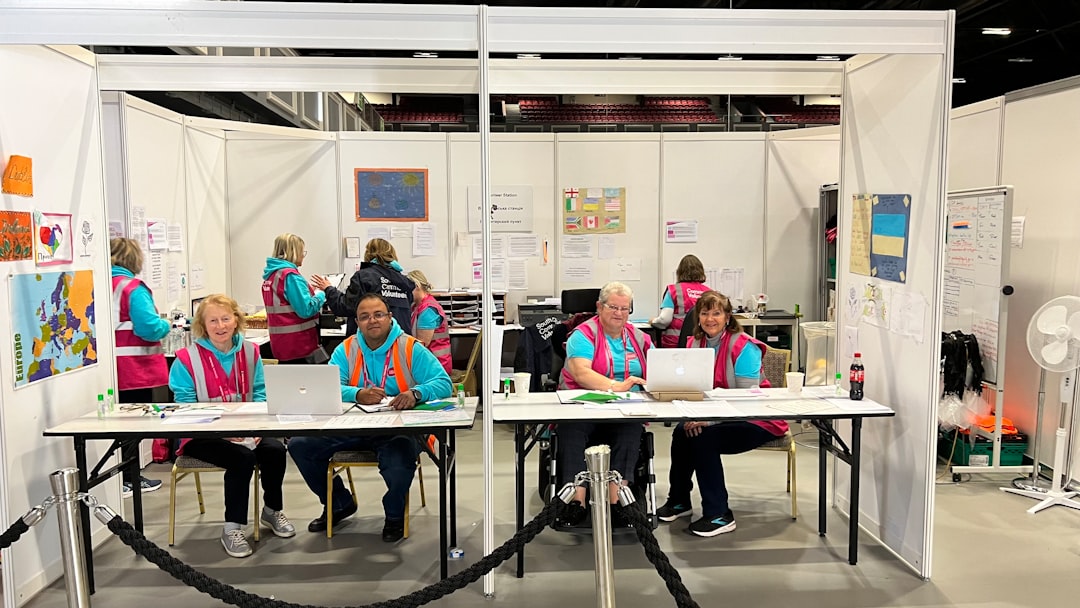
A booth staffing calculator earns its keep because staffing is the single largest operational variable in a European trade fair participation budget after stand build, and it is the variable that most directly determines conversation count, lead quality, and the eventual cost-per-qualified-lead. Get staffing right and a EUR 220,000 Hannover Messe budget delivers 850 qualified conversations across five days.
Get it wrong and the same budget delivers 350 conversations with staff visibly exhausted by Day 3 and senior management trapped in non-productive conversations at the espresso bar. This article walks through the vertical-by-vertical staffing-ratio guide experienced European exhibition managers use, with sqm-to-staff math, rotation patterns, role definitions, and named-fair benchmarks.
The framework draws on CEIR’s exhibition staffing research, UFI’s Global Exhibition Barometer commentary on exhibitor operational benchmarks, AUMA’s exhibitor cost benchmark database, and observed practice across mid-market and enterprise European exhibitors at the major Messe Frankfurt, Deutsche Messe, Messe Düsseldorf, Koelnmesse, IFEMA, Fiera Milano, and RAI Amsterdam venues.
Why staffing ratios matter more than headcount
The conversational unit at a trade fair is not the exhibitor’s stand. It is the booth-staff-conversation. A stand with insufficient staff coverage cannot scale conversations beyond what its staff team can physically handle, regardless of how impressive the stand build, how good the demo, or how strong the pre-show marketing.
CEIR’s longitudinal research shows that the visitor approach-to-conversation conversion rate at understaffed stands runs 25 to 40 percent, while well-staffed stands hit 65 to 80 percent. The difference is dominated by visitor wait time. A visitor who arrives at a stand and waits more than 90 seconds for engagement walks past 60 to 75 percent of the time. A visitor engaged within 30 seconds stays in conversation 80+ percent of the time.
“The single most predictable cause of disappointing cost-per-qualified-lead at otherwise well-executed European trade fair participations is understaffing. Exhibitors who budget aggressively on stand build but lean on staff cost almost always underperform on conversation volume.”, CEIR exhibition staffing research, 2024 update
The implication is structural: staffing ratios should be designed against visitor density, not against a fixed share of total budget. High-density fairs need more staff regardless of stand cost. Low-density fairs work with leaner teams.
The staffing-ratio guide by industry vertical
The table below summarises CEIR-aligned staffing ratios for major European fair verticals, with named-fair examples at each density tier.
| Vertical | Density tier | Ratio (1 staff per X sqm) | Named-fair examples |
|---|---|---|---|
| Industrial automation, electronics manufacturing | High | 1 per 4-5 sqm | Hannover Messe, SPS Nuremberg, productronica |
| Machine tools, metalworking | High | 1 per 4-5 sqm | EMO Hannover, AMB Stuttgart |
| Construction equipment | High | 1 per 4-5 sqm | Bauma Munich, INTERMAT Paris |
| Food and beverage | High | 1 per 4-6 sqm | Anuga Cologne, SIAL Paris, IFFA Frankfurt |
| Retail technology | Medium-high | 1 per 5-6 sqm | EuroShop Düsseldorf, EuroCIS, ShopTalk Europe |
| Audiovisual integration | Medium-high | 1 per 5-7 sqm | ISE Barcelona, IBC Amsterdam |
| Packaging, converting | Medium-high | 1 per 5-6 sqm | drupa, K, Interpack, FachPack |
| Consumer electronics | Medium | 1 per 6-8 sqm | IFA Berlin, MWC Barcelona |
| Lighting, building tech | Medium | 1 per 6-7 sqm | Light + Building Frankfurt |
| Design, furniture, lifestyle | Medium-low | 1 per 7-9 sqm + hospitality | Salone del Mobile, Maison & Objet, IMM Cologne |
| Travel, tourism | Medium-low | 1 per 7-10 sqm + hospitality | ITB Berlin, FITUR Madrid |
| Beauty, cosmetics | Medium | 1 per 6-7 sqm | Cosmoprof Bologna, In-Cosmetics Paris |
The ratios assume B2B exhibitor configurations with mixed demo and selling activity. Hospitality-heavy participations (Salone del Mobile, ITB, premium Anuga halls) add dedicated hospitality roles outside the core selling ratio.
A worked example: 75 sqm at Hannover Messe
Consider a 75 sqm corner stand at Hannover Messe in Hall 14. Applying the 1 staff per 4-5 sqm ratio for high-density industrial automation:
- 75 sqm ÷ 4.5 sqm per staff = 17 staff total across two shifts.
- Two shifts of approximately 8-9 staff each, with 2-3 staff overlap during peak Tuesday-Wednesday afternoon hours.
- Each shift runs 4.5 hours (morning: 9:00-13:30, afternoon: 13:30-18:00).
- Lunch overlap and break rotation managed within each shift.
The 17-staff roster covers six role functions (greeter/qualifier, demo specialist, senior salesperson, hospitality lead, lead-capture operator, booth manager) plus replacement depth for fatigue, illness, or unexpected demand spikes.
Many first-time exhibitors at Hannover Messe staff this same stand with 8 to 10 people total, single-shift across 9-hour days. The visible result is Tuesday-afternoon fatigue, missed lead-capture opportunities, and Wednesday-evening senior-management conversations that never get the right buyer focus.
“The Hannover Messe 75-sqm stand staffed by ten people single-shift is one of the most consistent under-investment patterns we observe in first-time exhibitor reviews. The same stand staffed by seventeen people across two shifts delivers materially better outcomes for roughly twenty percent additional staff cost.”, AUMA Exhibitor Survey commentary on staffing patterns, 2025
Two-shift rotation: the European standard
European trade fairs longer than 3 days are universally staffed in two shifts. The standard pattern:
- Morning shift: 9:00 (or 8:30 for early-access fairs) to 13:30. Captures the morning visitor rush and the productive 11:00-13:00 buyer hour.
- Afternoon shift: 13:30 to 18:00 (or fair closing). Captures the substantial 14:00-17:00 buyer block and end-of-day stand visits.
- Peak overlap: Tuesday and Wednesday 11:00-15:00, both shifts on stand, doubling coverage during the most intense buyer hours.
Each staff member typically works one shift per day, totaling 4-5 hours on stand. Off-shift time covers lead-qualification follow-up, competitor intelligence walking, lunch, rest, and the daily evening debrief.
Three-shift rotation appears at very long fairs (Salone del Mobile’s 6-day run, ITB Berlin’s 5-day intensive) and at fairs with extended evening hours (some IFA Berlin halls run to 19:00). Three-shift rotation requires roster sizes 50 to 75 percent larger than two-shift equivalents.
The six core roles
Most B2B European trade fair stands operate with six functional roles:
Greeter and qualifier. First-line visitor engagement at stand edge. Responsible for warm greeting, brief qualification (decision-making authority, category fit, geography), and routing to the right next conversation. Typically 25-35 percent of the staff roster at high-density fairs. Multilingual capability is most important in this role.
Demo specialist. Product demonstration and technical question handling. Requires product knowledge that is hard to substitute. Typically 25-30 percent of the staff roster at technical fairs (Hannover Messe, SPS Nuremberg, productronica), lower at hospitality-led fairs.
Senior salesperson. Engages qualified buyers in commercial conversation, books follow-up meetings, and handles pricing discussions. Typically 15-20 percent of the staff roster. These are the team’s most senior account executives, frequently flown in from headquarters specifically for the fair.
Hospitality lead. Coordinates on-stand catering, client logistics, evening hospitality events, and meeting room scheduling. Typically 8-12 percent of the staff roster at hospitality-heavy participations, less at demo-led participations.
Lead-capture operator. Manages CRM integration, badge scanning, conversation logging, and live lead routing to follow-up teams. Often combined with the greeter role on smaller stands; on larger stands, dedicated specialist. Typically 8-12 percent of roster.
Booth manager. Oversees rotation, handles escalation, runs the daily evening debrief, and manages the on-stand contingency reserve (budget, materials, troubleshooting). Always at least one per shift; on larger stands, one per shift per side of the stand.
Larger stands (above 150 sqm) add product specialists for individual categories and senior management presence during peak hours.
Multilingual coverage at pan-European fairs
Pan-European fairs target buyer audiences across multiple language regions. The staffing roster needs to reflect this. Observed best practice at fairs targeting Germany, France, Italy, Spain, the Nordics, and Eastern Europe:
| Total staff | Required language coverage |
|---|---|
| 4-6 staff | English fluent across all + native fluency in 2 of: German, French, Italian, Spanish |
| 7-10 staff | English fluent across all + native fluency in 3-4 of: German, French, Italian, Spanish + 1 Eastern European |
| 11-15 staff | English fluent across all + native fluency in all 5: German, French, Italian, Spanish, English + 1-2 Eastern European |
| 16+ staff | All major European languages + at least one staff for Mandarin and Arabic if Asian/Middle Eastern buyers are in target |
Most B2B conversations work in English at major European fairs, survey data from UFI suggests 60 to 70 percent of conversations conducted in English. The remaining 30 to 40 percent require native-language capability, and that fraction is disproportionately the high-value senior-buyer conversation where language barrier most damages conversion.
When to use temporary staff
Temporary booth staff hired locally cost EUR 180-340 per day at major European venues. They make sense for:
- Greeter and qualifier roles where the conversation is brief and the language coverage is the key requirement.
- Hospitality and catering support.
- Lead-capture operation where CRM training is short.
- Booth tear-down and on-stand logistics.
Temporary staff do not make sense for:
- Demo specialist roles requiring product knowledge.
- Senior selling roles requiring relationship continuity.
- Booth manager roles requiring on-site decision-making authority.
The hybrid model most experienced exhibitors converge on is roughly 60 to 70 percent in-house headcount for technical and selling roles, plus 30 to 40 percent local temp staff for hospitality, greeter, and lead-capture roles. This split typically delivers better economics than fully in-house staffing while preserving the technical depth where it matters.
Cost-per-conversation math
The cost-per-conversation calculation translates staffing decisions to ROI metrics. Typical math at a 75 sqm Hannover Messe stand with 17-staff two-shift roster:
| Metric | Value |
|---|---|
| Total stand area | 75 sqm |
| Staff per sqm | 1 per 4.4 sqm |
| Conversations per staff per shift | 18-25 |
| Total shifts across 5 days | 170 (17 staff × 2 shifts × 5 days) |
| Total conversations | 3,000-4,200 |
| Qualified-buyer share | 28-35% |
| Total qualified leads | 850-1,470 |
| All-in budget | EUR 220,000 |
| Cost per qualified lead | EUR 150-260 |
Comparable single-shift staffing at 9 people across 5 days yields roughly 1,200-1,800 total conversations, 350-630 qualified leads, and cost per qualified lead in the EUR 350-630 range, visibly worse economics on equivalent budget.
“Doubling staff coverage from 1:9 sqm to 1:5 sqm typically lifts conversation count by 40 to 65 percent at modest incremental cost. The cost-per-qualified-lead improvement is one of the most reliable patterns in European trade fair ROI data.”, UFI Global Exhibition Barometer, exhibitor operational commentary, 2024-2025
The pre-fair briefing and post-shift debrief discipline
Booth staffing is not only about how many people are on stand. It is about how the team operates. Two discipline structures matter:
The pre-fair briefing should run a full half-day before show open. Content: target buyer profile, qualification criteria, demo flow, CRM workflow, lead-routing rules, escalation paths, daily schedule, hospitality coordination, and competitor positioning intelligence. Staff who arrive on-site without a pre-fair briefing produce visibly weaker outcomes for two to three days while learning on the job.
The daily post-shift debrief should run 45 to 60 minutes at end of each fair day. Content: today’s conversation count, lead quality observations, demo execution feedback, hospitality logistics for next day, and adjustments to staffing or messaging. The debrief surfaces tactical adjustments that compound across the fair: a Tuesday-evening message-recalibration typically lifts Wednesday and Thursday conversion materially.
Common staffing mistakes
Three mistakes recur consistently.
First, single-shift staffing across 9-hour days. The third day of a 5-day fair sees visible staff fatigue, and the fourth and fifth days see meaningful conversation-quality decline. Two-shift rotation eliminates this.
Second, under-staffing on Tuesday and Wednesday peak hours. Most exhibitors plan flat staffing across the show week. Peak Tuesday-Wednesday hours need 30 to 50 percent more staff coverage than the lighter Monday-Friday bookends.
Third, hiring all roles in-house when a hybrid temp-staff model would deliver better economics. The temptation is to assume the brand requires fully in-house staffing; the data shows hybrid models with temp staff in greeter and hospitality roles routinely match or exceed in-house-only outcomes at meaningfully lower cost.
How to operationalise on the directory
The /calculator at Exhibition Stands EU includes a booth-staffing module that translates stand size, fair density profile, and rotation pattern into recommended roster size and role mix. The /staffing-agencies hub lists verified European staffing agencies with multilingual rosters and fair-specific experience.
Related reading
- Multilingual Staff Strategy for European Trade Fairs, the language-coverage approach in detail
- Pre-Fair Staff Training Curriculum, what the pre-show half-day briefing covers
- Daily Booth Briefing Template, what the evening debrief discipline looks like
- Live Demo Script Framework, what demo specialists actually run
- Exhibition Budget Allocation Framework, where staffing sits in the broader line-item structure
References and primary sources
- CEIR exhibition staffing research and Index Report 2024, ceir.org
- UFI Global Exhibition Barometer (Union des Foires Internationales), exhibitor operational commentary, ufi.org
- AUMA Exhibitor Outlook, Association of the German Trade Fair Industry, auma.de
- ESSA UK exhibitor staffing commentary, essa.uk.com
- Deutsche Messe Hannover Messe Exhibitor Operational Guidelines 2026
- Messe Frankfurt exhibitor briefing on staffing patterns
- Reed Exhibitions / RX Global European exhibitor performance index 2025
- AUMA Exhibitor Survey 2025, staffing section
FAQFrequently asked questions
CEIR’s standard benchmark is 1 booth staff per 4-6 sqm of stand area for high-density B2B fairs and 1 per 6-9 sqm for medium-density fairs. The right ratio depends primarily on visitor density and conversation depth: high-density technical fairs (Hannover Messe, drupa, Bauma) need closer to 1:4. Medium-density commercial fairs (FachPack, SPS Nuremberg, Cosmoprof Bologna) work at 1:6.
Hospitality-heavy fairs (Salone del Mobile, Anuga premium halls) need closer to 1:5 with additional dedicated hospitality roles.
Rarely. Two-shift rotation is the European standard for fairs longer than 3 days. A 5-day fair typically operates two shifts of 4-5 hours each with 2-3 staff overlap during peak hours (Tuesday and Wednesday afternoon). Rotation gives staff time to lead-qualify follow-up actions during the show, take lunch breaks, walk the floor for competitor and adjacent-category intelligence, and rest. Single-shift staffing across 9-hour days produces visible staff fatigue by Day 3.
Six roles cover most B2B exhibition needs: greeter/qualifier (initial visitor engagement and qualification), demo specialist (product demonstrations and technical questions), senior salesperson (qualified-buyer conversation and meeting booking), hospitality lead (catering, client logistics, meeting room coordination), lead-capture operator (CRM integration, badge scanning, conversation logging), and booth manager (rotation oversight, escalation handling, daily debrief). Larger stands add product specialists and senior management presence during peak hours.
For fairs targeting pan-European buyer audiences (Hannover Messe, EuroShop, ISE, Anuga, IFA), staff should collectively cover German, English, French, Italian, and Spanish. Most exhibitors find 60-70% of conversations work in English alone, but the 30-40% that require native-language engagement materially affect conversation quality and conversion.
A 6-staff team should target 4 languages collectively; an 12-staff team should target all 5 plus at least one Eastern European language depending on buyer mix.
Yes for tier-three roles (greeters, hospitality support, lead-capture operators), no for tier-one roles (demo specialists, senior salespeople, booth managers). Local temp staff typically cost EUR 180-340 per day at major European venues, fully reasonable for hospitality and greeter roles. Demo and selling roles require product knowledge that temp staff cannot acquire in a pre-show briefing, and exhibitor outcomes consistently suffer when temp staff are used for technical roles.
Understaffing is the single most common cause of inflated cost-per-qualified-lead. Visitors who approach an unstaffed stand zone walk past 60-75% of the time. Doubling staff coverage from 1:9 sqm to 1:5 sqm typically lifts conversation count by 40-65% at modest staffing-cost increase, with cost-per-lead dropping meaningfully. The breakpoint is the visitor density of the specific fair: high-density fairs reward heavier staffing, low-density fairs reward leaner.