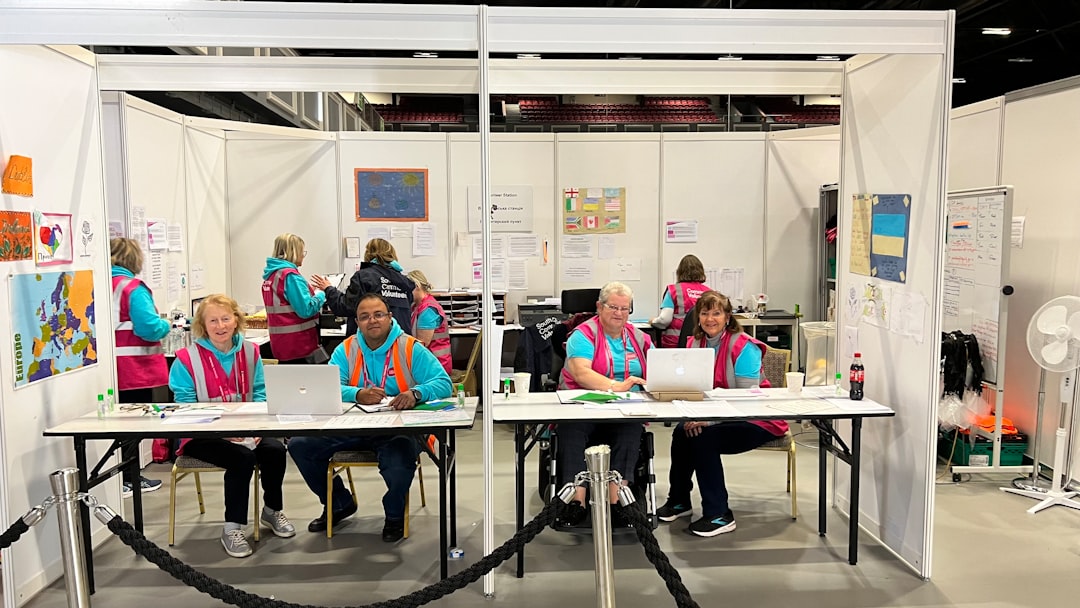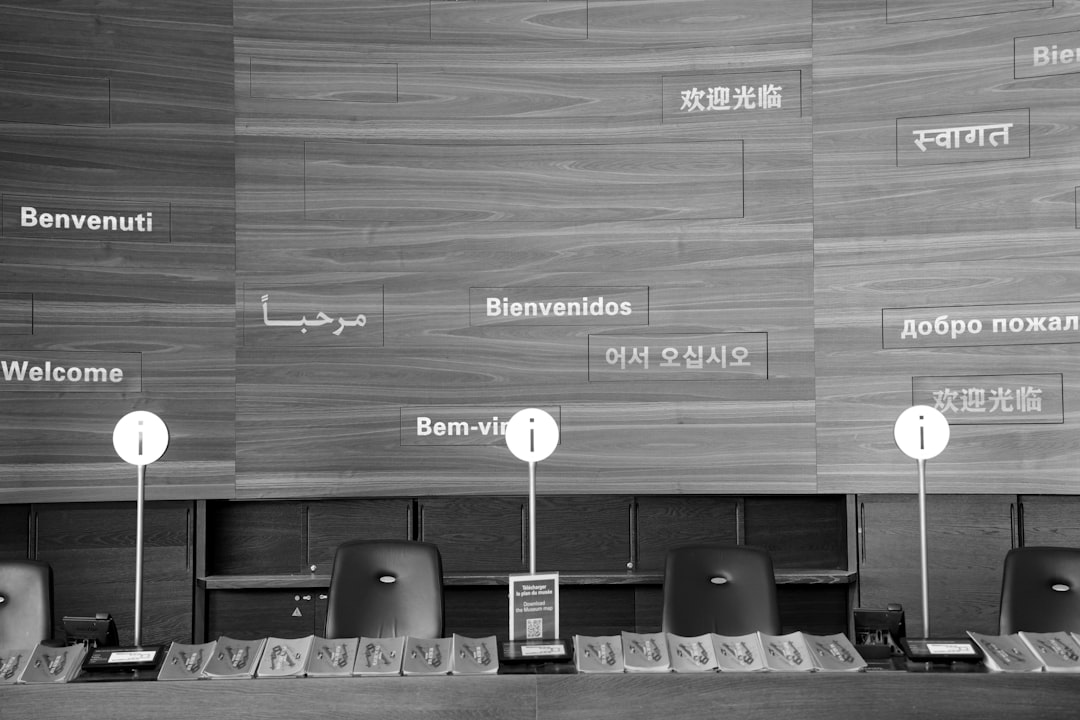
Understaffing breaks more European fair plans than under-budgeting. A stand that is twenty percent under-staffed will still process visitors, but the qualified-contact rate, the meeting conversion rate, and the lead-quality scoring all collapse to levels that no booth execution can recover.
The visible symptoms appear by the second-day afternoon: long visitor waits at the qualifier zone, exhausted senior staff defaulting to transactional conversations, and meeting rooms running empty because nobody is shepherding the booked calendar.
This article walks through the staffing framework experienced European exhibition managers use to avoid that pattern. It covers the staff-per-sqm ratio, the seven booth-role archetypes, the four-hour rotation discipline, and the language-coverage rules that apply across the major European fair venues: Hannover Messe, EuroShop, Salone del Mobile, MWC Barcelona, IFA Berlin, Anuga, Bauma, ISE, Light + Building, drupa, and the regional vertical fairs that complete most exhibitor calendars.
The staffing ratio
The defensible staffing ratio for European trade fairs is one floor-active staff member per ten to fifteen square metres of usable booth space. The ratio is consistent enough across European venues and fair tiers that it functions as a planning rule rather than a guideline.
| Stand type | Footprint range | Staff per sqm rule | Floor staff per shift |
|---|---|---|---|
| Row stand, low visitor density | 12-36 sqm | 1 per 15 sqm | 1-3 |
| Row stand, high visitor density | 24-60 sqm | 1 per 12 sqm | 2-5 |
| Corner stand | 36-90 sqm | 1 per 12 sqm | 3-8 |
| Peninsula stand | 60-150 sqm | 1 per 11 sqm | 6-14 |
| Island stand | 90-200 sqm | 1 per 10 sqm | 9-20 |
| Block / mega-island | 250-500 sqm | 1 per 10 sqm + meeting room staff | 25-50+ |
The ratio applies to floor-active staff during open hours. It excludes meeting-room staff, hospitality staff dedicated to evening receptions, technical staff running back-of-house operations, and rotation reserves who are off-floor during their break shift. The total staffing roster typically runs forty to sixty percent above the floor-active number once rotation, meetings, and hospitality are factored in.
“The ratio is not a comfort number. It is the threshold below which the second-day afternoon visibly collapses. We have run the experiment in both directions across fifty European fairs. The ratio holds.”, Common framing among AUMA-affiliated booth staffing consultants
A 90 sqm island stand at a tier-one European fair therefore requires nine floor-active staff per shift, two rotation reserves, two meeting-room staff for the booked-meeting calendar, and one hospitality lead, a total roster of fourteen people across the fair days, with at least six being company employees with qualifying authority.
The seven booth-role archetypes
Defensible European booth staffing plans organise around seven recurring role archetypes. At small footprints, individual staff combine roles. At large footprints, each role expands to multiple people per shift.
Role 1: Stand lead. Single point of accountability per shift. Owns the floor plan, the meeting calendar, the staff rotation, and escalation handling. The stand lead does not personally qualify visitors at peak hours, the role is operational, not commercial.
Role 2: Qualifier. Initial-contact triage. Greets visitors, runs the first two-minute qualification conversation, captures the lead data, and routes qualified visitors to the appropriate product specialist. Qualifiers are the highest-throughput role on the stand and the most operationally demanding.
Role 3: Product specialist. Deep technical or design expertise per product line. Engages qualified visitors after the qualifier hand-off. At fairs with multiple product lines on the stand, one specialist per product line is the minimum.
Role 4: Demo lead. Runs scheduled product demonstrations and presentations. The demo lead is dedicated to the demo asset (theatre, demo bench, presentation screen) and does not absorb general qualifier duties during demo windows.
Role 5: Meeting coordinator. Manages the booked-meeting calendar, shepherds meeting attendees from the qualifier zone to the meeting room, handles room turnover, and tracks meeting outcomes back to the lead-capture system.
Role 6: Hospitality lead. Coffee, refreshments, snacks, evening receptions. The hospitality lead also owns the on-stand visual standards, clearing used cups, refreshing the meeting-room water, removing visible clutter.
Role 7: Floater. Rotation reserve plus problem-solving. Covers unexpected staff absences, escalations from the stand lead, language-coverage gaps, and overflow qualifier load during peak hours.
The role structure scales with footprint:
| Footprint | Role 1 | Role 2 | Role 3 | Role 4 | Role 5 | Role 6 | Role 7 | Total per shift |
|---|---|---|---|---|---|---|---|---|
| 24 sqm | combined with R2 | 1 | combined | none | combined with R2 | combined | none | 2 |
| 48 sqm | 1 | 1-2 | 1 | combined with R3 | combined with R1 | combined with R3 | none | 3-4 |
| 75 sqm | 1 | 2 | 1-2 | 1 | 1 | combined with R5 | none | 6-7 |
| 120 sqm | 1 | 2-3 | 2 | 1 | 1 | 1 | 1 | 9-10 |
| 200 sqm | 1 | 3-4 | 3 | 1-2 | 2 | 1 | 1-2 | 12-15 |
| 400 sqm | 2 | 5-7 | 4-6 | 2-3 | 3 | 2 | 2-3 | 20-28 |
The roles map onto a recognisable European booth staffing convention: qualifier zones near the open frontages, product-specialist zones in the stand interior, meeting rooms or semi-private hospitality zones at the rear, and demo theatres or presentation spaces visible from outside the stand to draw traffic.
The four-hour rotation discipline
Four hours of continuous active stand duty is the working maximum before contact quality degrades measurably. The discipline of rotating staff at the four-hour mark is the single largest protection against the second-day-afternoon collapse pattern.
The standard fair day at major European venues runs eight to nine open hours (typically 09:00-18:00). A defensible rotation pattern divides the day into two four-hour shifts with a coordinated break window between them.
| Time block | Activity | Staff load |
|---|---|---|
| 08:00-09:00 | Pre-open briefing, stand prep, demo system check | Full team on stand |
| 09:00-13:00 | Shift A on floor; Shift B in rotation rest, meeting prep, lunch | Shift A active |
| 13:00-14:00 | Mid-day overlap; both shifts available for peak hour | Both shifts active |
| 14:00-18:00 | Shift B on floor; Shift A in rotation rest, meeting prep, debrief | Shift B active |
| 18:00-19:00 | Stand close-down, lead-data sync, daily debrief | Full team on stand |
| 19:00 onwards | Hospitality, dinners, evening events | Selected staff |
The four-hour shift discipline produces several measurable outcomes. Qualifier conversation quality holds across the day. Meeting attendance rates stay above ninety percent because the meeting coordinator remains alert. Lead data entry accuracy stays above the threshold where post-fair followup remains feasible. Staff energy survives to the end of the fair days.
“The first time we ran the four-hour rotation strictly was at Hannover Messe 2023. Our qualified-lead count for the four days was thirty-eight percent above the previous year on the same booth and the same staff count. The only variable was the rotation discipline. We have not skipped it since.”, Common framing among European B2B exhibition managers
The rotation discipline requires explicit shift assignments documented before the fair, not improvised during it. The most common failure pattern: a manager arrives at the fair, sees high traffic, and asks Shift A to “just stay for another hour.” Within two days the rotation collapses entirely and the second-day-afternoon pattern reasserts itself.
Day-rate benchmarks for European booth staff
AUMA tracks European booth-staff day rates as part of its exhibitor cost surveys. The benchmarks below reflect 2024-2026 observed rates across major European venues.
| Role | Day rate (EUR) | Notes |
|---|---|---|
| External multilingual hostess (greeting, light qualifier) | 280-420 | Higher in Frankfurt, Düsseldorf, Geneva |
| Lead-capture assistant (badge scanning, data entry) | 220-350 | Often booked through organiser-approved agencies |
| Hospitality service staff (coffee, refreshments) | 200-300 | Frequently agency-bundled with kitchen support |
| Technical demo specialist (external freelance) | 600-900 | Industry-specific; expect upper end for complex products |
| Multilingual interpreter (booth-attached) | 380-580 | Per language combination; higher for Mandarin, Japanese |
| Company sales staff (fully loaded blended) | 500-800 | Includes salary, benefits, opportunity cost |
| Company technical staff (fully loaded blended) | 600-950 | Engineering, design, product management |
| Stand-lead role (external freelance, senior) | 750-1,100 | For exhibitors without internal stand-lead capacity |
Rates run higher in expensive labour markets (Switzerland, Norway, peak-season Frankfurt/Düsseldorf) and lower in Madrid, Bologna, and Eastern European venues. UK rates carry a fifteen to twenty percent premium since 2021 due to currency and labour-market factors.
The defensible staffing-cost calculation: staff count × day rate × (show days + 1 training day + 1 followup day) × language and rotation multipliers. For a 90 sqm tier-one fair with six company staff and three external support staff over four show days, the total staffing line typically lands at EUR 38,000-52,000, plus EUR 18,000-26,000 in travel and accommodation.
Language coverage rules
Tier-one European fairs require minimum English coverage plus the local language at all times. Beyond the baseline, language-coverage decisions follow audience composition rather than convenience.
| Venue / fair | Baseline languages | Strongly recommended additional |
|---|---|---|
| Hannover Messe | English + German | French, Italian, Mandarin (selected shifts) |
| Messe Frankfurt fairs | English + German | French, Italian, Spanish |
| Koelnmesse fairs (Anuga, gamescom) | English + German | French, Spanish, Italian, Mandarin (Anuga) |
| Messe Düsseldorf (EuroShop, drupa, K) | English + German | French, Italian, Spanish, Portuguese |
| Fiera Milano (Salone del Mobile, Vicenzaoro) | English + Italian | French, Spanish, German, Mandarin |
| IFEMA Madrid | English + Spanish | Portuguese, French, German |
| Fira Barcelona (MWC, ISE) | English + Spanish | Catalan, French, German, Mandarin |
| RAI Amsterdam (IBC, ISE pre-2021) | English + Dutch | German, French, Italian |
| ExCeL London | English | Spanish, French, German, Mandarin |
| Vivatech Paris | English + French | Spanish, German, Italian |
| Watches & Wonders Geneva | English + French | German, Italian, Mandarin, Japanese |
The pragmatic structure: two languages always present, additional languages scheduled into peak-traffic shifts when audience analysis supports the investment. Hiring a Mandarin-speaking external hostess for the morning shift at Hannover Messe is a small line item with disproportionate impact when the morning concentrates Chinese delegations.
The pre-fair training day
The pre-fair training day is the line item that converts a staffing roster into a functioning booth team. A defensible pre-fair training day covers seven topics:
- Product positioning briefing. What we are showing, why it matters, what the launch story is.
- Qualifier script and pain-point map. Two-minute conversation structure for the qualifier role, with the named pain points the product addresses.
- Lead-capture workflow. How the scanner works, how data routes to the CRM, what fields are mandatory.
- Meeting calendar walkthrough. Who has booked meetings, what each meeting is expected to deliver, who is leading each meeting.
- Demo run-through. Live demo of every demo asset on the stand, with each staff member operating each asset at least once.
- Rotation schedule and break discipline. Shift assignments, break locations, communication protocols.
- Escalation protocols. What to do when a senior buyer arrives unexpectedly, when a competitor visits the stand, when a journalist asks for a quote, when equipment fails.
The pre-fair training day is the single highest-ROI day of the entire fair budget. Skipping it produces a staff team that improvises through the first show day and only reaches operational competence by the second. By that point, the fair is forty percent complete and the early-day visitor flow has been processed at suboptimal quality.
“We protect the training day above the booth budget if it ever comes to a choice. A trained team on a modular stand outperforms an untrained team on a custom stand every single time.”, Common framing among AUMA-affiliated booth staffing consultants
The post-fair followup day
The post-fair followup day is the second highest-ROI day in the staffing plan. The day immediately following the fair close is the only window in which on-stand context, conversation memory, and lead-data freshness all align. Followup that begins three days after the fair runs at substantially lower conversion rates.
A defensible followup day covers:
- Lead data review and cleanup
- Lead routing to the appropriate sales territory
- Personal email sequences for top-tier leads (sent within forty-eight hours of fair close)
- Meeting-outcome documentation in the CRM
- Press and journalist followup
- On-stand contact notes added to lead records
- Hot-lead phone calls within seventy-two hours
Companies that skip the post-fair followup day routinely lose forty to sixty percent of the qualified-lead value the fair generated. The booth investment was made to produce the leads; the followup day captures the value.
Common booth staffing mistakes
The framework above catches the staffing mistakes that recur across European exhibitor plans.
Mistake 1: Treating staff count as the only variable. A six-person team at 90 sqm can be either well-rostered or badly rostered. The count alone does not determine performance.
Mistake 2: Skipping the four-hour rotation discipline. Improvising rotation during the fair produces the second-day-afternoon collapse pattern. The discipline must be enforced from open of day one.
Mistake 3: Underweighting the qualifier role. Qualifiers are the highest-throughput role on the stand and the most operationally demanding. Staffing them with junior personnel produces a qualification bottleneck that distorts every downstream metric.
Mistake 4: Skipping the pre-fair training day. A trained team materially outperforms an untrained team. The training day is the single highest-ROI investment in the staffing plan.
Mistake 5: Hiding senior staff in meeting rooms. Senior staff who never appear on the floor signal to visitors that the booth lacks decision-makers. The defensible practice: senior staff rotate through the floor for at least one hour per shift to maintain visibility.
Mistake 6: Skipping the post-fair followup day. The lead value the fair generated requires followup to convert. The followup day is the second highest-ROI investment in the staffing plan.
Related reading
- Staff Training and Briefing for European Fairs, the detailed structure of the pre-fair training day
- Participation Budget Planning, how staffing fits into the 1:3 budget rule
- Networking and Hosted-Buyer Programmes, how meeting volume shapes meeting-coordinator staffing
- Product Demos and Presentations, how demo theatre staffing differs from on-stand staffing
- Choosing the Right European Trade Fair, the fair-selection decision that comes before staffing planning
How to act on this
Staffing a European stand properly is arithmetic before it is judgement, and it starts from the footprint and works outward through roles, shifts, training and languages until every hour of the open hall has a named person against it. Work through the following sequence in order:
- Calculate floor-active staff from footprint using the one-per-ten-to-fifteen-sqm rule.
- Build the seven-role assignment matrix, scaling by footprint per the role table.
- Document the four-hour rotation schedule before the fair, with explicit shift assignments per person.
- Budget the pre-fair training day and post-fair followup day into the staffing line.
- Validate language coverage against the venue baseline plus audience-composition recommendations.
- Cost staff at fully loaded blended day rates using AUMA-typical benchmarks.
- Use the Booth Cost Calculator to model the staffing-cost arithmetic.
References and primary sources
- AUMA Exhibitor Outlook, Association of the German Trade Fair Industry, auma.de
- fwd: Bundesvereinigung Veranstaltungswirtschaft (formerly FAMAB, renamed 2021) training and staffing resources
- UFI Global Barometer 2026, Union des Foires Internationales, ufi.org
- Deutsche Messe Hannover exhibitor manual 2026, on-stand staffing recommendations
- Messe Frankfurt Technical Guidelines 2026, hospitality and staffing standards
- IFES (International Federation of Exhibition and Event Services) booth-staffing playbook
- CEIR (Center for Exhibition Industry Research) attendee-engagement studies
FAQFrequently asked questions
The defensible ratio for European trade fairs is one staff per ten to fifteen square metres of usable booth space, depending on stand type and visitor density. Row stands and corner stands tolerate the lower end of the range (one per fifteen sqm). Peninsula and island stands need the upper end (one per ten sqm) because the visitor flow approaches from multiple sides simultaneously.
The ratio assumes staff active on the floor, not staff present at the fair, meeting-room staff, hospitality staff, and rotation reserves sit on top of the floor-staffing baseline. A 90 sqm island stand therefore typically requires nine floor-active staff per shift plus two to three rotation reserves, for a total staffing roster of eleven to twelve people.
Four hours of continuous active stand duty is the working maximum before contact-quality degradation becomes measurable. Studies at Messe Frankfurt and Koelnmesse have documented qualified-contact rates dropping fifteen to thirty percent in the fifth and sixth hour of a continuous shift.
The practical implication: an eight-hour fair day requires two staff rotations per role with a thirty-to-sixty minute break between rotations. Skipping the rotation discipline produces the second-day-afternoon collapse that most fair-experienced managers can describe, visible staff fatigue, defensive body language, transactional rather than consultative conversations, and a measurable drop in lead-capture rate.
The defensible mix is roughly seventy percent company employees and thirty percent external booth-support staff. Company employees deliver product depth, qualifying authority, and the ability to commit to follow-up, irreplaceable for engaging genuine prospects.
External booth staff (multilingual hostesses, lead-capture assistants, hospitality service staff) handle volume, language coverage, and operational continuity during rotations. The mix shifts toward higher external proportion at very large stands (above 250 sqm) where the volume of casual visitor interaction outstrips the company employee population.
Trying to staff entirely with company employees at large stands burns out the senior team by day three.
Staffing-and-travel typically runs eighteen to twenty-eight percent of the total fair budget per AUMA benchmarks. For a 90 sqm tier-one presence with six company staff and three external support staff, the staffing line typically lands in the EUR 35,000-55,000 range across the pre-fair training day, the four show days, and the post-fair followup day.
Day rates for European booth staff: external multilingual hostess EUR 280-420 per day, lead-capture assistant EUR 220-350, hospitality service staff EUR 200-300, technical demo specialist EUR 600-900. Company employee blended day rates of EUR 500-800 are defensible for fully loaded sales and technical talent.
Tier-one European fairs require minimum English coverage plus the local language at all times. Hannover Messe needs English and German continuously. MWC Barcelona needs English and Spanish. Salone del Mobile needs English and Italian. RAI Amsterdam needs English and Dutch.
Beyond the baseline, language-coverage decisions follow audience composition: a fair with strong French-speaking buyer presence (Vivatech, certain Maison&Objet visitor segments) benefits from a French-speaking staff member. Mandarin and Japanese coverage justifies itself at fairs with concentrated Asian buyer delegations.
The pragmatic structure: two languages always present, additional languages scheduled into peak-traffic shifts.
Seven role archetypes recur in defensible European fair staffing plans: stand lead (one per shift, single point of accountability), qualifier (initial-contact triage staff), product specialist (deep technical or design expertise per product line), demo lead (running scheduled product demos and presentations), meeting coordinator (managing the booked-meeting calendar and room turnover), hospitality lead (coffee, refreshments, evening receptions), and floater (rotation reserve plus problem-solving for unexpected situations).
At smaller footprints (under 50 sqm) staff often combine roles. At larger footprints (above 150 sqm) each role typically requires two people per shift.