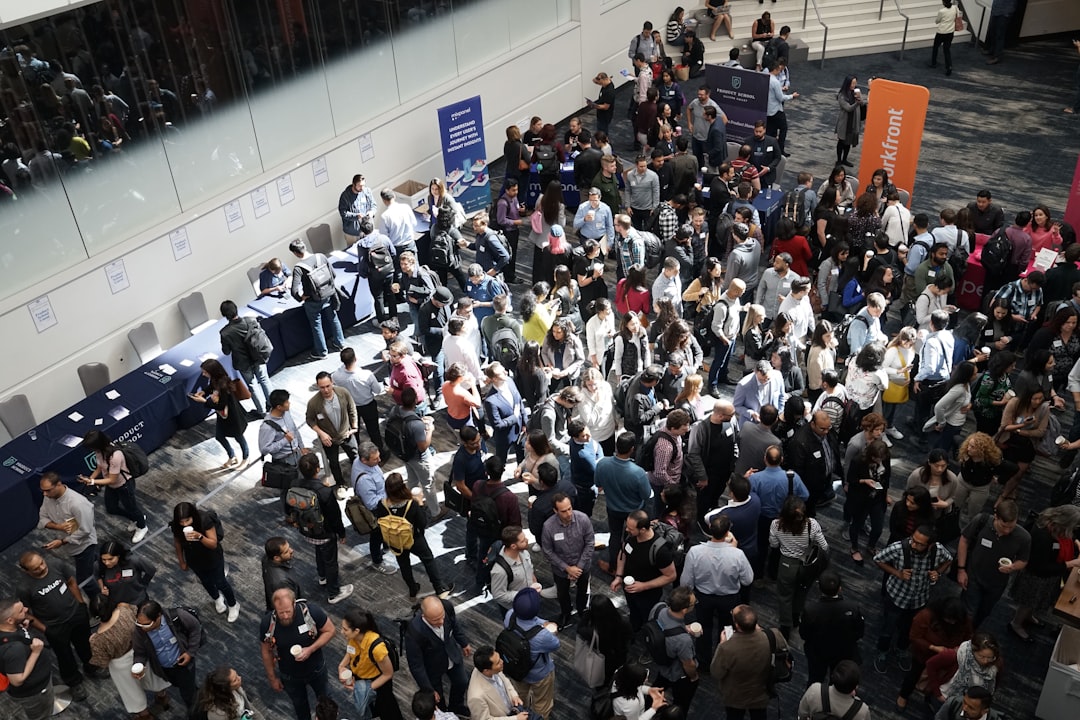


A trade fair booth captures leads under a constraint that does not exist in any other B2B selling environment: the qualification window is roughly 20 to 30 seconds inside a 90-second walk-in conversation, or three to five minutes inside a pre-booked meeting. The qualification framework you choose has to live within that window or it does not get used.
The frameworks that work, BANT, MEDDIC, A/B/C tagging, and the hybrid patterns experienced European exhibitors deploy in combination, are the subject of this article.
The arithmetic that justifies the rigour: a tier-one European B2B fair typically delivers 200-600 captured leads, of which 15-25 percent convert to first-meeting opportunities within 90 days, of which 25-40 percent close to revenue within 12 months. Each capture-to-opportunity conversion is worth EUR 18,000-80,000 of attributable pipeline at A-grade quality.
Lead-quality differences of 20 percent at point of capture compound into 30-50 percent differences in 12-month attributed revenue. The qualification flow is therefore not a process detail; it is the principal lever on annual fair ROI after pre-show meeting volume.
Why on-stand qualification matters more than CRM-side scoring
CRM-side lead scoring runs after the fair. By then, the qualification opportunity is gone. The visitor’s pain, urgency, project status, competitor relationships, and decision-process state were all on display in the booth conversation and are largely invisible to any after-the-fact enrichment. The on-stand capture is the only window in which those signals can be recorded.
“We used to qualify entirely post-show with a marketing-operations team running the data. Conversion rates were stuck at 6-8 percent of captured leads to opportunity. We moved qualification on-stand with a 20-second BANT-lite flow and the same data team handling post-show enrichment, and conversion moved to 12-14 percent within two fair cycles. The signal was always there; we were just discarding it.”, Common observation among European B2B sales operations leads
The economic case for on-stand qualification: a 6-point improvement in capture-to-opportunity conversion on 400 leads at average opportunity value EUR 28,000 represents roughly EUR 672,000 of additional 90-day pipeline per fair. The cost of implementing on-stand qualification is roughly EUR 600-2,500 in flow design and EUR 200-600 per stand person in training. The ROI on qualification rigour is one of the cleanest in the entire exhibition programme.
The three frameworks compared
A/B/C tagging
A/B/C tagging is the simplest framework. Every captured lead receives a single tag, A (high priority, sales engages within 48 hours), B (mid priority, marketing-nurture cadence with sales handoff at conversion signal), or C (low priority, automated nurture only). The tag is applied at point of capture by the stand person based on a quick judgement: this visitor is in active buying mode (A), this visitor is interested and educated but not buying-now (B), this visitor is browsing or junior ©.
A/B/C tagging takes 5-8 seconds and works in any conversation length. It is the practical default for high-traffic walk-in booths. The limitation: a single tag carries no structured detail about why the lead is A, B, or C, so post-show enrichment and CRM routing depend heavily on the stand person’s written or voice note.
BANT
BANT (Budget, Authority, Need, Timeline) is a four-factor mid-funnel qualification framework. In a booth context, BANT is typically reduced to four short questions with pre-populated answer options:
- Budget: Project budget band (under EUR 25k / EUR 25-100k / EUR 100-500k / over EUR 500k / not yet defined)
- Authority: Visitor role in the decision (decision-maker / influencer / evaluator / researcher)
- Need: Use case maturity (active project / planning phase / exploratory / no current need)
- Timeline: Decision window (next 90 days / 3-6 months / 6-12 months / beyond 12 months / undefined)
A pre-populated BANT flow takes 18-25 seconds in the booth and produces structured data that maps cleanly into Salesforce or HubSpot lead fields. The framework is well-suited to mid-traffic B2B booths and to the second half of pre-booked meetings.
MEDDIC
MEDDIC (Metrics, Economic Buyer, Decision Criteria, Decision Process, Identify Pain, Champion) is the enterprise-sales qualification framework. The six factors run too long for walk-in qualification but fit naturally into pre-booked meetings of five minutes or longer.
In a booth context, MEDDIC is rarely deployed as a structured question flow; instead, the pre-booked meeting follows a conversation script that surfaces the six factors over the natural course of the discussion, with the stand person logging answers into the lead capture app afterwards.
MEDDIC produces the richest lead data of the three frameworks and is the standard for European exhibitors selling enterprise software, industrial equipment above EUR 100,000 list price, and consulting engagements. It is overkill for transactional B2B selling and inappropriate for walk-in qualification.
Side-by-side comparison
| Dimension | A/B/C tagging | BANT | MEDDIC |
|---|---|---|---|
| Capture time | 5-8 seconds | 18-25 seconds | 90 seconds (post-conversation) |
| Best-fit traffic level | High (walk-in dominated) | Mid (mixed walk-in and pre-booked) | Low (pre-booked meeting dominated) |
| Structured data captured | Single tag + note | 4 fields | 6 fields + narrative |
| Stand-staff training time | 30 minutes | 1-2 hours | 4-8 hours plus ongoing coaching |
| Post-show enrichment value | High (data is thin) | Medium | Low (data is already rich) |
| Best-fit fair examples | Anuga, MWC Barcelona walk-in halls | Hannover Messe, EuroShop, Light + Building | Bauma, drupa, EMO enterprise-meeting tracks |
| Best-fit deal size | Any | EUR 10k-250k | EUR 100k+ |
| CRM field-mapping complexity | Low | Medium | High |
The hybrid that experienced European exhibitors actually run
In practice, most tier-one European exhibitors run a hybrid: A/B/C tagging as the universal capture, with BANT-lite layered on for B and A leads when bandwidth allows, and MEDDIC reserved for pre-booked meetings and follow-up qualification calls in the 48-hour post-show window.
The hybrid flow works as follows. The stand person engages a visitor, has a 30-90 second qualifying conversation, and at the conversation’s natural close enters the lead capture app. The first interaction is the priority swipe (A/B/C), which takes 3 seconds. If the lead is C, the stand person logs the badge scan with a 5-10 word voice note and the qualification ends.
If the lead is B or A, the stand person adds the BANT-lite flow (budget band, timeline, role) plus a 10-20 second voice note describing the conversation. If the lead is A and the conversation was longer than 4 minutes, additional MEDDIC fields are populated either at the booth or in the 24-hour post-fair enrichment pass.
“Standard practice at tier-one B2B exhibitors is to design the qualification flow as a depth-on-demand structure, minimum data for C, more for B, most for A. The mistake is forcing the same flow on every lead. Stand staff stop using a heavy flow after the first day of fair fatigue, and you lose data quality across the board.”, Common framing among MEDDIC Academy-trained sales operations leads
Scoring weights that translate qualification answers into priority
The qualification answers need to translate into a priority score for CRM routing. The table below shows a typical scoring matrix used by European B2B exhibitors at industrial fairs. Scores are summed across the four BANT fields; the total determines the tier override on the stand-person’s initial A/B/C tag.
| BANT field | Answer | Score |
|---|---|---|
| Budget | Over EUR 500k | 4 |
| Budget | EUR 100-500k | 3 |
| Budget | EUR 25-100k | 2 |
| Budget | Under EUR 25k | 1 |
| Budget | Not defined | 0 |
| Authority | Decision-maker | 4 |
| Authority | Strong influencer | 3 |
| Authority | Evaluator | 2 |
| Authority | Researcher | 1 |
| Need | Active project | 4 |
| Need | Planning phase | 3 |
| Need | Exploratory | 1 |
| Need | No current need | 0 |
| Timeline | Next 90 days | 4 |
| Timeline | 3-6 months | 3 |
| Timeline | 6-12 months | 2 |
| Timeline | Beyond 12 months | 1 |
| Timeline | Undefined | 0 |
Score totals: 14-16 = A-grade (sales engages within 48 hours), 10-13 = B-grade (sales engages within 7 days, marketing nurture in parallel), 6-9 = C-grade (marketing nurture only, sales engages on signal), 0-5 = D-grade (low-priority nurture, no sales engagement). The thresholds calibrate by industry; software and SaaS typically use a lower A threshold (12) while industrial-equipment vendors with longer sales cycles use higher thresholds (16-18 with an extended scoring matrix).
EUR conversion benchmarks by tier
| Lead tier | Share of total leads | 90-day conversion to opportunity | 12-month close rate | Avg opportunity value (EUR) |
|---|---|---|---|---|
| A | 15-25% | 35-55% | 25-40% | 18,000-80,000 |
| B | 35-45% | 15-25% | 10-18% | 5,000-20,000 |
| C | 35-50% | 3-8% | 3-7% | 1,000-5,000 |
| D | residual | % | % | ,000 |
The economic insight: A-grade leads receive the most attention and convert best per lead, but B-grade leads typically generate the largest share of pipeline volume because they outnumber A-grade leads by 2-3x.
A booth that captures 400 leads with the typical distribution generates roughly EUR 540,000 of expected 12-month attributable revenue: EUR 280,000 from A leads, EUR 200,000 from B leads, and EUR 60,000 from C leads. Defending the budget for B-grade nurture cadences is critical because that segment is the volume backbone of the programme.
Designing the 20-second qualification flow
The design principles for on-stand qualification flows:
- Pre-populate answer options. Tap-to-select is 3-5x faster than typing and produces cleaner structured data.
- Auto-advance between fields. Each tap moves to the next question without an additional confirm step.
- Voice-to-text for notes. Free-text notes via voice capture 4-7x more context per second than typed notes.
- Minimum required fields. Only the priority tag is required; everything else is optional to avoid blocking submission under load.
- Branching logic for depth-on-demand. C-tagged leads skip BANT questions; A-tagged leads see all four.
- Offline-mode buffer. The flow must work without connectivity and sync once the device reconnects.
All four major platforms (Cvent, Swapcard, iCapture, Captello) support these design principles. The differences are in flexibility of branching logic (iCapture and Captello lead) and depth of CRM field-mapping (Cvent leads for enterprise systems). See the Lead Capture Systems Compared article for the platform-by-platform detail.
The end-of-day calibration ritual
“Common practice at well-managed European exhibitor teams is a 15-minute end-of-day-one huddle to audit the qualification distribution. If A-grade tags are running above 30 percent, stand staff are over-tagging and the threshold gets recalibrated for days 2-4. If A-grade tags are below 10 percent, the threshold is too tight. This single ritual moves the post-fair conversion rate by 2-4 percentage points across the team.”, Standard practice at Cvent-certified European exhibitors
The end-of-day calibration uses the lead capture platform’s dashboard to display the day-one A/B/C distribution per stand person. Variation across stand staff is normal, some run hot, some run cold, but team-wide drift outside the 15-25 / 35-45 / 35-50 bands signals a definitional problem that needs correcting before the next show day.
Post-show enrichment within 24 hours
The on-stand qualification produces 70-85 percent accurate priority tags. Post-show enrichment within 24 hours brings the accuracy to 90-95 percent. The enrichment pass:
- Verifies the stand-tag against CRM-side intelligence (existing account, prior engagement, account size, vertical fit)
- Adds intent-data signals where available (third-party intent platforms, web behaviour, prior content engagement)
- Validates the BANT or MEDDIC answers against account context (a “EUR 500k budget” answer from a five-person startup gets adjusted)
- Confirms the routing assignment to the right sales owner
- Triggers the appropriate follow-up cadence (see the Post-Show Follow-Up article)
The 24-hour enrichment window matters because the sales-team handoff happens at the 48-hour mark. Leads that enter the sales team’s queue with verified tags and clean routing convert at substantially higher rates than leads that arrive raw from the booth.
How to act on this
A qualification framework only survives contact with the show floor if the booth, the devices and the platform all support it, so the flow has to be chosen and briefed alongside the stand design. Set your qualification approach up using the following:
- Brief stand builders via /rfq on the qualification flow you intend to run, the booth design needs to support the device-handling pattern (charging stations, scanner mounts, conversation zones).
- Use the Builders Directory to find partners experienced in qualification-flow design alongside booth construction.
- Use the Fairs Directory to identify which fairs in your calendar default to which lead capture platform, that determines which qualification flow is technically deployable.
- Run the Booth Cost Calculator to model the lead-capture-and-qualification share of total fair budget.
Related reading
- Lead Capture Systems Compared, the four platforms qualification flows run on
- Pre-Show Marketing Ramp, how to fill the pre-booked meeting calendar that supports MEDDIC depth
- Post-Show Follow-Up, converting qualified leads in the 24-48 hour window
- ROI Measurement, closing the loop from qualification to attributed revenue
- Account-Based Event Marketing, how qualification frameworks change in named-account ABM contexts
References and primary sources
- AUMA Exhibitor Cost Benchmarks 2024-2026, auma.de
- UFI Global Barometer 2026 wave, ufi.org
- MEDDIC Academy framework documentation
- Cvent State of the Event Industry 2026 report
- Swapcard Exhibitor Benchmark Report 2025-2026
- Salesforce State of Sales 2026 benchmarks for B2B opportunity conversion
- HubSpot Sales Operations Benchmark Report 2026
- MPI EventScape 2026 industry outlook, mpi.org
FAQFrequently asked questions
BANT (Budget, Authority, Need, Timeline) is the four-factor mid-funnel qualification framework that fits well into 20-30 seconds of structured questions. MEDDIC (Metrics, Economic Buyer, Decision Criteria, Decision Process, Identify Pain, Champion) is the six-factor enterprise-sales framework that fits pre-booked meetings of 5+ minutes but is too detailed for walk-in conversations.
A/B/C tagging is the simple three-tier priority flag that fits any conversation length and is the practical default for high-traffic stands. Most experienced European exhibitors run A/B/C as the primary capture tag with BANT-lite questions layered on for B and C tier leads where bandwidth allows.
An A-grade lead at a tier-one European B2B fair typically represents EUR 18,000-80,000 of expected opportunity value over the next 12 months, with a 25-40 percent 12-month close rate. B-grade leads represent EUR 5,000-20,000 of expected opportunity value at 10-18 percent close rates. C-grade leads represent EUR 1,000-5,000 of expected opportunity value at 3-7 percent close rates.
The actual figures vary by industry and average contract size, but the 5-10x value spread between A and C tiers is consistent across vertical B2B fairs (Hannover Messe, Bauma, EMO, drupa) and roughly half that on consumer-facing or design fairs.
Twenty to thirty seconds is the practical ceiling for in-conversation qualification. Beyond 30 seconds, the conversation feels like an interview and the visitor disengages. The standard pattern is: 8 seconds for the priority tag (A/B/C swipe), 10-15 seconds for two or three BANT-lite questions (budget band, timeline, role), and 5-8 seconds for a free-text note in the lead capture app.
Voice-to-text notes have largely replaced typed notes in 2026 because they preserve more context per second of input time. For pre-booked meetings where the conversation runs 5-15 minutes, deeper MEDDIC-style qualification fits naturally into the conversation flow rather than being a separate ritual.
Both, in sequence. At the booth: a priority tag (A/B/C) and structured qualification answers entered directly into the lead capture app. Post-show within 24 hours: the same data is enriched with CRM-side intelligence (account size, prior engagement, intent signals, competitor relationships), the priority tag is validated or adjusted, and the lead is routed to the right sales owner.
The on-stand score sets the initial follow-up cadence; the enriched score sets the longer-term nurture path. Skipping the enrichment step is the most common mistake, booth tags entered under time pressure are correct 70-85 percent of the time and need a second pass to hit the 90+ percent accuracy required for sales-team handoff.
Cvent LeadCapture and Swapcard both ship with BANT-style template flows out of the box and allow per-fair customisation of the question set. iCapture’s strength is field-mapping flexibility, you can design a fully custom MEDDIC flow with branching logic and map each answer to the correct Salesforce or HubSpot field.
Captello layers gamification on top of qualification: point-based scoring that auto-tags leads based on accumulated activity (demo viewed, video watched, quiz completed, calculator used).
For most European B2B exhibitors, the platform’s qualification flow capability matters less than the discipline of using the flow consistently, the best-designed flow that gets skipped under booth load is worse than a simple flow that gets used every time.
Typical distribution at a well-managed European B2B booth is roughly 15-25 percent A-grade, 35-45 percent B-grade, and 35-50 percent C-grade. If the A-grade share exceeds 30 percent, stand staff are over-tagging, usually because they feel the volume of A-tags reflects on their performance.
If the A-grade share is below 10 percent, either the audience-fit is wrong for the fair or the qualification threshold is being applied too strictly. The B-grade band is the most economically important segment for most exhibitors because it represents the largest share of pipeline value when multiplied by close rates.
Standard practice is to calibrate the A/B/C definitions with the sales team before the fair and audit the distribution at the end of day 1 to recalibrate if needed.