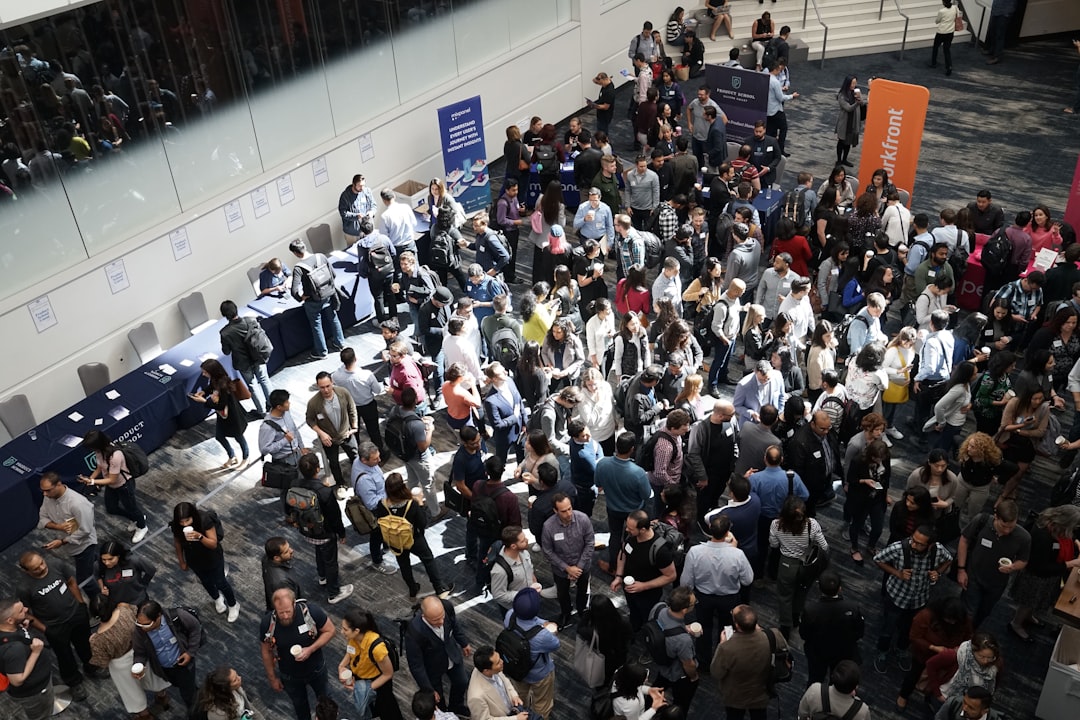


The 25-minute conversation at a trade fair stand is structurally identical to the discovery call that sits at the centre of enterprise sales methodology. The difference is that it happens on a noisy floor at Hannover Messe, MWC Barcelona, or EuroShop, with three other visitors waiting nearby, after the rep has already had eleven similar conversations that morning.
MEDDIC, Metrics, Economic Buyer, Decision Criteria, Decision Process, Identify Pain, Champion, was designed precisely for the complex enterprise deal where the qualifier must extract structural information about the buying process from limited conversation time. Adapted properly, it is the most operationally useful qualification framework available for European tier-one fair conversations.
This article documents how to adapt MEDDIC for the fair-floor context: which fields to capture, what scripts work at fair-floor pace, how to integrate the captured signal with composite lead scoring, and what conversion uplift to expect. The frame throughout: MEDDIC at the fair captures the qualification skeleton, the follow-up call fills the bones.
Why MEDDIC fits the trade fair conversation
The trade fair conversation is a constrained discovery call. The rep has limited time, the visitor is not necessarily the decision-maker, the conversation will not resume tomorrow, and the information captured must drive a follow-up motion that may involve different people on both sides. This is exactly the problem MEDDIC was designed to solve for complex enterprise deals.
BANT works for inbound qualification of single-buyer SaaS deals. MEDDIC works for committee-driven, six-figure-plus enterprise purchases where the qualifier needs to reconstruct the buying committee structure from limited signal. European tier-one trade fairs disproportionately feature buyers from large industrial, manufacturing, telecom, retail, and infrastructure organisations where the buying-committee dynamic dominates.
“The enterprise deals that close at six and seven figures are won or lost on the qualification quality at the first conversation. The conversation usually happens in fifteen minutes at a trade fair stand. MEDDIC is a methodology built to take that fifteen minutes seriously.”, common framing among enterprise sales practitioners
The six MEDDIC elements at fair-floor pace
Metrics. The quantified business outcomes the visitor’s organisation is trying to achieve. At the fair, this is the answer to “how will you measure whether this works?” Captured well, Metrics provides the financial frame for the follow-up business case. Captured poorly, the follow-up team builds a generic value pitch that converts at half the rate of a metric-anchored one.
Economic Buyer. The person with discretionary budget authority. At the fair, this is rarely the visitor; the visitor is more often the researcher or evaluator. The qualifier is to identify who that economic buyer is, what their priorities are, and how the visitor can introduce the follow-up team to them.
Decision Criteria. The formal and informal evaluation criteria the buying committee will apply. At the fair, this is captured at headline level, “what would have to be true for you to choose a solution?”, with full depth left to the follow-up call.
Decision Process. The procurement and approval steps the deal will follow. At the fair, basics only: is there an RFP planned, who signs off, what is the typical procurement timeline at this organisation.
Identify Pain. The specific business problem driving the evaluation. This is the most important MEDDIC field to capture cleanly at the fair, because without it nothing else matters. The pain anchors every subsequent conversation.
Champion. A person inside the buyer organisation who actively advocates for the solution. The visitor may be the champion; if not, the qualifier identifies who the champion is or could be. Champion existence is the single strongest predictor of deal close in MEDDIC-trained organisations.
What can realistically be captured in 25 minutes
A trained rep in a 25-minute fair conversation can capture credible signal on:
| MEDDIC element | Fair-floor capture realism | Field type |
|---|---|---|
| Identify Pain | Essential, achievable | Free text + tagged categories |
| Economic Buyer | Essential, achievable at name/role level | Structured field |
| Metrics | High value, partially achievable | Free text + headline numeric |
| Decision Criteria | Headline only, full depth in follow-up | Tagged categories |
| Champion | Identifiable, often not nameable | Boolean + free text |
| Decision Process | Headline only | Tagged categories + free text |
The depth gap is closed in the follow-up call. The fair conversation is calibrated to capture enough signal to (a) score the lead accurately and (b) inform the follow-up rep on what to dig into first.
Conversation scripts that capture multiple MEDDIC fields per question
The mistake of running MEDDIC at fair pace is treating it as an interview. Six discrete MEDDIC questions feel like an interrogation and produce defensive, low-quality answers. The trained pattern uses open-ended industry-relevance questions, each of which captures signal across multiple MEDDIC fields simultaneously.
Question 1, opener. “What’s driving the timeline on this for you?”
Captures: Identify Pain (the driver), Decision Process (the timeline), Metrics (sometimes, when the answer mentions a target).
Question 2, committee mapping. “Who else inside [company] is going to shape this decision?”
Captures: Economic Buyer (named or role-identified), Champion (the visitor’s positioning), Decision Process (committee structure).
Question 3, success definition. “How will you measure whether the solution worked, six months in?”
Captures: Metrics (quantified outcome), Decision Criteria (the evaluation lens), Identify Pain (the underlying business problem).
Question 4, competitive landscape. “What else are you evaluating?”
Captures: Decision Criteria (comparison lens), Decision Process (evaluation stage), Identify Pain (because the alternatives reveal the pain).
Question 5, procurement reality. “How does [company] usually run this kind of evaluation?”
Captures: Decision Process (depth), Economic Buyer (approval authority), Decision Criteria (formal vs informal weight).
Five questions, capturing signal across all six MEDDIC fields, in a conversation that feels like consultative discovery rather than qualification interrogation. This is the script pattern that experienced trade fair reps run.
“The qualification questions that work at trade fair pace are the ones the visitor wants to answer because the answer reveals their problem in a way that helps them think about it. The questions that fail are the ones that feel like the rep is filling in a CRM form. Same data captured, different conversation quality, completely different conversion rate.”, common framing among sales-effectiveness practitioners
Integration with composite lead scoring
MEDDIC-captured fields integrate cleanly with the 100-point composite scoring model documented separately. The mapping:
| MEDDIC element | Scoring fields it informs | Point contribution |
|---|---|---|
| Identify Pain | Use Case, Current Solution | Up to 20 points |
| Economic Buyer | Decision Role, Job Seniority | Up to 20 points |
| Metrics | Use Case (depth), Budget Signal | Up to 14 points |
| Decision Criteria | Use Case (specificity) | Up to 10 points |
| Decision Process | Timeline | Up to 15 points |
| Champion | Bonus field (boolean) | +5 to +8 bonus |
A lead captured with strong MEDDIC signal across all six fields scores in the 85-100 band of the composite model. A lead captured with only Identify Pain and Economic Buyer signal scores in the 50-70 band. The scoring band drives routing automation; the MEDDIC depth informs the follow-up conversation quality.
MEDDIC adaptation by fair type
European tier-one fairs vary in audience seniority and decision-maker representation. The MEDDIC capture realism varies accordingly.
| Fair | Senior decision-maker presence | MEDDIC capture realism |
|---|---|---|
| Hannover Messe | High | Full MEDDIC achievable |
| EuroShop | Medium-high | Full MEDDIC, some Champion gaps |
| MWC Barcelona | Medium (heavy press/partner mix) | Strong on Metrics and Identify Pain, weaker on Decision Process |
| Anuga | High | Full MEDDIC achievable |
| IFA Berlin | Low-medium (consumer mix) | Reduced MEDDIC depth |
| Salone del Mobile | Medium (project-based audience) | Strong on Metrics, weak on Decision Process |
| Light+Building | Medium-high | Full MEDDIC achievable |
| Ambiente | Medium | Reduced MEDDIC depth |
| productronica | High | Full MEDDIC achievable |
| Bauma | High | Full MEDDIC achievable |
At consumer-mix fairs (IFA Berlin, Salone del Mobile press days, MWC Barcelona partner days), drop MEDDIC depth expectations and focus on Identify Pain + Economic Buyer + Champion as the three essential fields. Capture the rest in follow-up.
Training requirements
MEDDIC training for fair-floor adaptation is not a full enterprise-sales MEDDIC curriculum. It is a 90-minute pre-fair refresher focused on:
- Five-question conversation pattern (above)
- Mapping captured signal to CRM fields
- Champion-identification scripts
- Disqualification discipline (knowing when to release a low-fit conversation politely)
- Real-time scoring visibility during the fair
The training works only for staff who already work in MEDDIC-aligned sales organisations. For organisations running other methodologies (Challenger, Sandler, MEDDPICC, Solution Selling), adapt the training to the in-use framework rather than introducing MEDDIC for the fair. The methodology mismatch otherwise creates more confusion than it resolves.
| Training component | Duration | Cost per staff (EUR) |
|---|---|---|
| Pre-fair virtual session | 90 min | 60-100 |
| Role-play practice | 60 min | 80-130 |
| On-site dry run | 30 min | 50-80 |
| Daily morning huddle review | 15 min × 5 days | 30-50 |
| Total per staff member | ~4 hours | 220-360 |
Conversion uplift expectations
European exhibitors running MEDDIC-trained on-stand teams report consistent conversion uplift against baseline (untrained or BANT-only) capture:
| Metric | Baseline | MEDDIC-trained | Uplift |
|---|---|---|---|
| Captured leads with scorable qualification depth | 55-70% | 75-88% | +18-20 pp |
| Opportunity-to-closed-won conversion | 14-22% | 28-42% | +14-20 pp |
| Average deal size on closed-won | EUR 65-110K | EUR 95-180K | +40-65% |
| Sales cycle length (fair to close) | 5-9 months | 4-7 months | -1-2 months |
Common industry framing holds that MEDDIC-trained fair qualification can meaningfully improve trade fair lead quality, alongside pre-show meeting booking as one of the highest-leverage interventions available.
Worked example: MEDDIC conversation at Hannover Messe
Setting: 28-minute scheduled meeting at a 150 sqm industrial automation exhibitor’s stand. Visitor: Operations Director from a German automotive Tier-1 supplier, 2,400 employees.
Conversation flow:
- Opener: “What’s driving the timeline on this evaluation for you?” Answer: “We’re committed to a Q3 production-line upgrade and need the controller decision locked by end of Q2.” Captures: Pain (production-line upgrade), Decision Process timeline (end Q2), Champion (visitor is committed).
- Committee question: “Who else inside [company] is shaping the controller decision?” Answer: “Our VP Operations signs off, but the production line engineers are the technical evaluators. CFO needs to see capex justification.” Captures: Economic Buyer (VP Operations), Decision Process (technical + financial gate), formal Decision Criteria split.
- Metrics question: “How will the success of the new line be measured?” Answer: “Target is 12 percent throughput increase and downtime under 2 percent.” Captures: Metrics (quantified), Decision Criteria (operational performance).
- Competitive question: “What other controllers are you evaluating?” Answer: “Siemens, Beckhoff, and your platform.” Captures: Decision Criteria (competitive set), Decision Process stage.
- Procurement question: “How does [company] usually structure capex evaluation at this size?” Answer: “Formal RFP, three vendors, decision committee, capex board approval in May.” Captures: full Decision Process structure.
Captured fields populate as: Pain (production-line upgrade), Economic Buyer (VP Operations + CFO approval), Metrics (12% throughput, % downtime), Decision Criteria (operational performance + capex justification), Decision Process (RFP, May approval), Champion (visitor as technical advocate).
Composite score: approximately 88 points. Routes to senior named-account manager, 24-hour SLA. Follow-up call focuses on capex business case (because Metrics and CFO Decision Process are documented), with the Operations Director visitor as the champion who introduces the follow-up team to the VP Operations economic buyer.
Common mistakes
- Treating MEDDIC as a checklist. The five-question conversational approach captures the data; the checklist approach kills the conversation.
- Pushing for Champion confirmation when none exists. Forced champion identification creates false-positive signal that misleads follow-up.
- Skipping the Disqualification discipline. MEDDIC’s value is partly in fast disqualification; staff who keep engaging low-fit visitors burn capacity.
- No MEDDIC visibility post-fair. Fields captured at the fair but not visible in the CRM follow-up workflow are wasted capture.
- Inconsistent field definitions across staff. “Economic Buyer = direct report of CFO” must mean the same thing across the team.
Integration with the broader strategy
MEDDIC capture is one approach within the broader lead qualification and scoring framework. The lead capture systems playbook covers the technology; the post-show follow-up sequence acts on MEDDIC-captured signal; the ROI measurement framework validates the conversion uplift.
For deeper coverage of adjacent topics, see our exhibition strategy hub, our account-based event marketing playbook, our pre-show marketing playbook, our KPI framework, our builders directory, and our RFQ tool.
References
- Center for Exhibition Industry Research (CEIR) research on exhibitor qualification practices, 2024.
- UFI Global Exhibition Barometer, 32nd edition. Rep-effectiveness benchmarks. 2025.
- McKinsey & Company commentary on adapting enterprise sales qualification to trade fair pace, 2024.
- Harvard Business Review commentary on discovery calls in enterprise sales, 2024.
- Bain & Company commentary on qualification quality and trade fair ROI, 2024.
- Force Management. MEDDPICC and MEDDIC Implementation Guide. 2024 edition.
- Forrester (formerly SiriusDecisions) enterprise qualification framework research.
- AUMA Exhibitor Outlook 2024-2026, Association of the German Trade Fair Industry, auma.de.
FAQFrequently asked questions
BANT (Budget, Authority, Need, Timeline) was designed for inbound qualification cycles where the rep has multiple conversations with the buyer over weeks. MEDDIC (Metrics, Economic Buyer, Decision Criteria, Decision Process, Identify Pain, Champion) is designed for complex enterprise deals where the qualifier must reconstruct the buying committee structure from one or two conversations.
The trade fair conversation is precisely the second context: one 20-30 minute conversation on a noisy floor, often with a non-decision-maker representative of a larger committee. MEDDIC fields capture the structural information about the buying process that BANT does not, which is exactly the information the post-fair follow-up team needs.
Not all six, and not at full depth. The realistic field-capture goal at a tier-one European fair is Identify Pain (essential), Economic Buyer existence and role (essential), Decision Criteria headline (high-value), Metrics (high-value), Champion existence (medium-value), and Decision Process basics (medium-value).
A trained rep can capture credible signal across all six in a 25-minute conversation; the depth comes later during the follow-up call. The fair conversation establishes the qualification skeleton; the follow-up fills the bones.
The senior staff running scheduled meetings and product demos should be MEDDIC-trained; the greeter/qualifier staff handling 30-second walk-up engagements do not need it. Train roughly half the on-stand team, typically the demo specialists, meeting hosts, and stand manager.
A 90-minute pre-fair MEDDIC refresher with role-played qualification conversations is sufficient for staff who already work in MEDDIC-aligned sales organisations. For organisations not running MEDDIC in their normal sales process, the fair is not the place to introduce it; use a simpler BANT-plus framework instead.
Each MEDDIC element maps to one or more scoring fields in the composite-scoring model: Metrics maps to Use Case and Need scoring; Economic Buyer maps to Decision Role and Job Seniority scoring; Decision Criteria captures into qualifier free-text and influences Need scoring; Decision Process maps to Timeline scoring; Identify Pain maps to Current Solution and Use Case scoring; Champion is captured as a separate boolean field that adds 5-8 bonus points when present.
The composite scoring approach lets MEDDIC-captured qualitative signal flow into the same routing automation that drives the rest of the lead-processing pipeline.
The scripts that work follow a pattern of open-ended industry-relevance questions that capture multiple MEDDIC fields per answer.
Example: ‘What’s driving the evaluation timeline?’ captures Identify Pain plus Decision Process simultaneously. ‘Who else is involved in shaping the decision?’ captures Economic Buyer plus Champion. ‘How will you measure whether the solution worked?’ captures Metrics plus Decision Criteria. Three or four well-crafted questions cover most MEDDIC ground without feeling like an interview.
Closed-ended direct questions (‘do you have budget approval?’) destroy the conversation flow and produce lower-quality answers than the open-ended approach.
European exhibitors who run MEDDIC-trained on-stand teams report opportunity-to-closed-won conversion rates of 28-42 percent on fair-captured leads, against industry-average rates of 14-22 percent for non-MEDDIC-qualified fair leads.
The 14-20 percentage point uplift comes primarily from two sources: lower wasted follow-up time on under-qualified leads (because Identify Pain and Economic Buyer signals are captured upfront), and higher win rates on qualified leads because the post-fair sales motion has a clearer map of the buying committee. The methodology is not magic; it is just structured information capture, applied consistently.