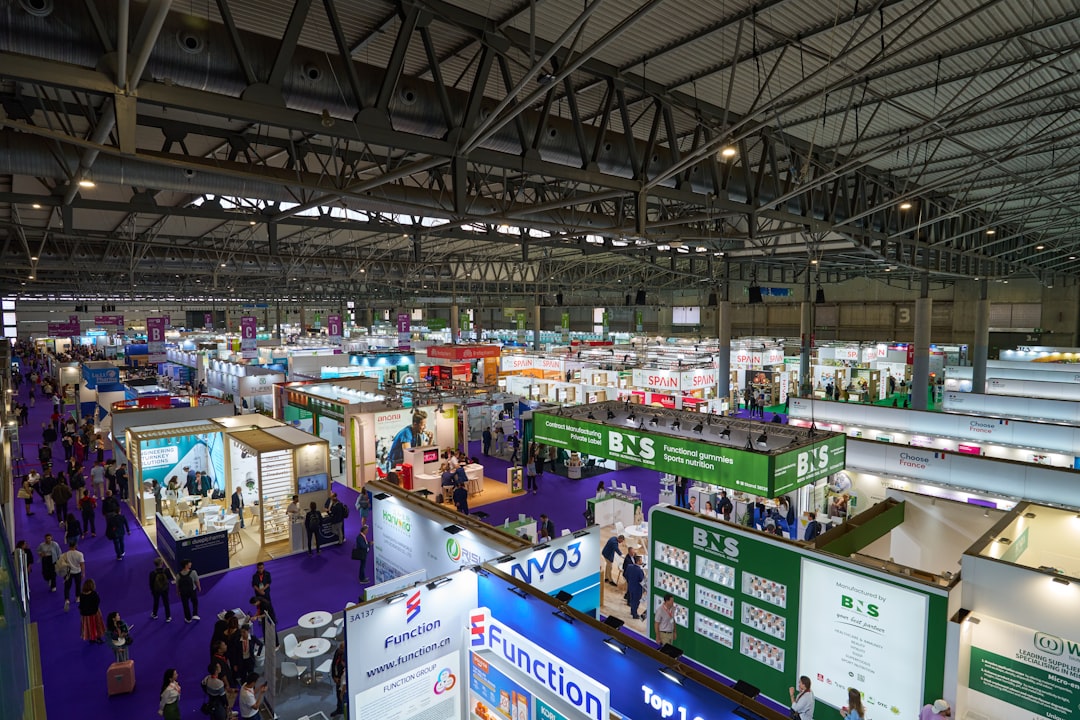
Messe Wien Exhibition and Congress Center is Vienna’s flagship fair venue and the strategic exhibition gateway between Western Europe and the Central European bloc. Located in the city’s Prater district adjacent to the Vienna International Centre and the Danube riverfront, Messe Wien spans approximately 55,000 square metres of hall space across four halls (A, B, C, D) plus a congress centre.
The venue hosts approximately 60 events per year, including Allesfürdas-Tier (pet industry), the Vienna Auto Show, the Vienna Wedding Fair, and a strong portfolio of medical, education, and B2B sector events that anchor Austria’s role as Central European business hub.
For European exhibitors, Messe Wien delivers a distinctive value proposition: pan-Central European buyer access in a German-language operational environment, at cost levels 15-20 percent below comparable Munich stands. The strategic positioning makes Vienna the right answer for many brands whose default would have been a German Messe but who want broader CEE-region buyer engagement without committing to multiple individual CEE-market presences.
This article walks through the strategy framework experienced exhibitors apply to Messe Wien, drawing on the published exhibitor manual, Wirtschaftskammer Österreich’s CEE-region exhibition guidance, AUMA International Exhibitor Service comparative analysis, and the operational documentation of Vienna-region stand builders.
Why Messe Wien functions as the CEE-region gateway
Vienna’s geographic and economic positioning gives Messe Wien a distinctive role in European exhibition strategy:
- Direct accessibility from CEE capitals. Vienna sits within 80 kilometres of Bratislava, roughly 140 kilometres of Brno, roughly 60 kilometres of the Hungarian border, approximately 232 kilometres of Budapest, and approximately 260 kilometres of Prague. The accessibility supports cross-border day-trip buyer attendance from CEE markets that would not travel to Munich or Frankfurt.
- German-language commercial culture aligned with both German and CEE-business expectations. Austrian German shares enough linguistic and cultural register with German business norms to support German-Austrian commercial flow, while also operating in business modes familiar to historic-Austro-Hungarian markets in Czech Republic, Slovakia, Hungary, and Slovenia.
- Cost advantage over Munich and Frankfurt. Vienna stand costs sit 15-20 percent below Munich and 25-30 percent below Frankfurt. The cost discount is real and structural rather than transient, reflecting lower Vienna-region labour rates.
- CEE-buyer logistics-friendly visa and travel arrangements. Schengen-zone arrangements support visa-free travel from CEE-Schengen states; even non-Schengen CEE markets (Romania, Croatia) face fewer travel barriers to Vienna than to other Western European destinations.
“Vienna is the most strategically-positioned European exhibition city for brands targeting the wider CEE market. The combination of German-language operational fluency, Schengen-accessible CEE-buyer logistics, and cost discount versus Munich makes Messe Wien the right answer for brands whose default would have been a German venue but who want CEE-region buyer reach.”, Common framing among Wirtschaftskammer-affiliated Austrian exhibition consultants
Messe Wien venue structure and hall allocation
Messe Wien’s hall structure across nine halls is organised more by event-rotation than by permanent sector specialisation. The main halls and their typical event allocations:
| Hall | Hall area (sqm) | Typical event types | Visitor flow |
|---|---|---|---|
| Halls A1-A2 (main exhibition) | 14,500 each | Vienna Auto Show | High; primary venue traffic |
| Halls B1-B2 (auxiliary) | 8,500 each | Sector pavilions; mid-tier events | Medium |
| Halls C1-C2 (specialty) | 6,200 each | Niche-sector events; sub-pavilions | Sector-specific |
| Halls D1-D2 (compact) | 4,000 each | Smaller specialised fairs | Niche |
| Congress Center | 24,000 | Conferences with exhibition components | Conference-driven |
The Vienna Auto Show typically uses Halls A1-A2 and B1-B2 in combination for large-footprint exhibitor presence. Mid-tier and niche events distribute across the smaller halls based on visitor projections.
Cost structure for Messe Wien stand presence
The table below summarises 2026 typical costs for Messe Wien stand presence across stand tiers.
| Build tier | Footprint range (sqm) | Space rental per sqm (EUR) | All-in budget (EUR) | Recoverable USt (20%) |
|---|---|---|---|---|
| Modular entry | 18-50 | 245-310 | 24,000-68,000 | 4,000-11,300 |
| Hybrid mid-tier | 60-150 | 265-335 | 72,000-148,000 | 12,000-24,700 |
| Custom established | 200-400 | 285-360 | 175,000-385,000 | 29,200-64,200 |
| Flagship | 500+ | 305-385 | 485,000-1,250,000 | 80,800-208,300 |
Messe Wien stand costs sit comparable to Spanish equivalents at the mid-tier and below German equivalents at the flagship tier. The cost-quality ratio is among the best in Europe for German-language market access.
CEE-buyer engagement strategy
For brands targeting CEE-buyer engagement at Messe Wien, the stand strategy adjustments versus a pure-German-market approach:
Language preparation
Stand staff should be prepared for English-language conversations as the primary lingua franca for cross-border CEE business. Ideally have at least one team member with regional CEE language capability (Czech, Slovak, Hungarian, or Polish). German-language opening capability remains valuable for Austrian and German buyers but may be insufficient alone for the full CEE-buyer base.
Marketing materials in multiple languages
Brochures, product information sheets, and pricing documents in English plus at least one CEE-region language (typically Czech or Hungarian for Vienna fairs) signal CEE-market preparedness. Pricing in EUR with informal currency-conversion guidance for CZK, HUF, PLN, and RON makes commercial conversations more efficient.
Payment terms accommodating CEE-market practice
Some CEE-market buyers prefer extended payment terms (60-90 days net rather than 30-day net standard in Western European business). Stand sales staff should be authorised to negotiate payment terms with the cultural awareness that CEE-market norms differ from Western European defaults.
Cross-border logistics planning
For brands building stands and operating Vienna with subsequent CEE-region commercial follow-up, integrated logistics planning across Austria-Czech-Slovak-Hungarian crossings is valuable. Freight forwarders with established cross-border CEE logistics relationships add disproportionate value for multi-market commercial campaigns.
“Brands that approach Messe Wien with a purely-German stand strategy miss the CEE-market opportunity that makes Vienna strategically distinctive. The marginal investment in multi-language preparation and CEE-aware sales staffing typically delivers more incremental commercial value than the same investment in a pure-German strategy at a German venue.”, Common framing among Vienna-based exhibition strategy consultants
Build culture at Messe Wien
Messe Wien stand builds follow the German-aligned pragmatic build culture with some Austrian-specific characteristics:
Modular and hybrid dominance
Modular and hybrid construction are fully accepted at most Messe Wien fairs. Pure custom is reserved for flagship-tier presence at major sector events. The cost-quality ratio for modular at Messe Wien is excellent given strong Austrian and pan-European builder competition.
German-Austrian operational discipline
Austrian fair operations match German precision in build-up scheduling, technical-services deadlines, and operational coordination. Stand builders unfamiliar with German Messe operations face an operational learning curve at Messe Wien.
Bilingual operational coordination
Messe Wien exhibitor manuals operate primarily in German with English versions available. Site coordination happens in German by default; bilingual stand-builder project management is preferred for international brands.
Sustainability awareness rising
Sustainability standards at Messe Wien are progressively rising, with ISO 20121 alignment becoming the default expectation for flagship-tier presence. The directional pressure matches broader European trends.
Top fairs at Messe Wien
The Messe Wien calendar includes several events with pan-European significance:
- Vienna Auto Show (late April): Austria’s flagship automotive fair with strong CEE-buyer attendance
- Power-Days (biennial): electrical industry trade fair held at Messezentrum Salzburg, not Messe Wien
- Allesfürdas-Tier (October): pet industry trade fair
- Vienna Wedding Fair (January): consumer wedding industry fair
- Wiener Immobilien Messe (March): real estate industry
- WOHEN&INTERIEUR (March): home and interior fair
- GAST Salzburg satellite events: parallel Vienna programming for the Salzburg gastronomy fair
Builder selection for Messe Wien
The Vienna stand-builder ecosystem includes specialist firms with established Messe Wien portfolios. The signals that distinguish builders capable of delivering at flagship level:
- Documented portfolio of at least six Messe Wien stands in the previous 24 months
- Bilingual German-English project management
- Working relationships with Vienna-region freight forwarders and customs agents
- ISO 20121 sustainability documentation
- Cross-border German-Austrian and Austrian-CEE operational capability
- CEE-region language capability within the project team
Pan-European builders based in Munich, Frankfurt, Prague, and Bratislava regularly deliver excellent results at Messe Wien. The cross-border builder market for Vienna is one of the most fluid in Europe.
Timeline gotchas specific to the Vienna calendar
Vienna-specific operational features:
- Vienna Auto Show late April: the annual Vienna-region stand-builder demand peak
- IFABO October: Vienna’s technology fair commands regional builder capacity in autumn
- Christmas closure 23 December - 7 January: longer than German equivalents due to Austrian Catholic feast calendar including Epiphany
- Summer break: lighter than Italian August closure; Austrian builders typically take 2 weeks of summer leave
- CEE-region public holidays: Czech, Slovak, Hungarian, and Polish public holidays sometimes affect cross-border builder logistics
For the wider Austrian fair context, see Exhibiting in Austria: Messe Wien CEE Gateway. For Austrian VAT mechanics, see Austria Exhibition VAT and Venue Guide.
Related reading
- Exhibiting in Austria: Messe Wien CEE Gateway, country baseline
- Austria Exhibition VAT and Venue Guide, VAT mechanics and venue cost benchmarks
- CEE Exhibition Fastest-Growing Region Guide, broader CEE-region context
- Modular vs Custom Decision Framework, applies to Messe Wien stand-type decisions
- Booth Cost Calculator, model Messe Wien stand budgets
- Builder Directory, Messe Wien-experienced builders with verified portfolios
References and primary sources
- Messe Wien Exhibition and Congress Center, exhibitor service manual 2026 edition
- Wirtschaftskammer Österreich, CEE-region exhibition guidance documentation
- Bundesministerium für Finanzen, Austrian VAT documentation for foreign exhibitors
- IFABO and Vienna Auto Show, fair-specific exhibitor regulations
- Power-Days organising committee, technical guidelines
- CEE-region exhibition industry associations, comparative data
- ISO 20121:2024 Event Sustainability Management Systems
- AUMA International Exhibitor Service, Austrian market comparative analysis 2026
FAQFrequently asked questions
Three structural features differentiate Messe Wien from German Messe alternatives: pan-Central European buyer access (Vienna’s geographic position within 250 km of Bratislava, Brno, and the Hungarian border supports CEE day-trip attendance not feasible from Munich or Frankfurt), German-language operational fluency aligned with both German and historic-Austro-Hungarian business norms, and a 15-20 percent cost discount versus Munich at comparable visitor quality.
For brands targeting CEE-region buyer engagement without committing to multiple individual CEE-market presences, Vienna delivers concentrated CEE access in a German-operations environment.
A 100 square metre hybrid Messe Wien stand runs EUR 72,000-148,000 all-in including space rental, build, install, dismantle, and basic technical services. Of that, approximately EUR 12,000-24,700 is recoverable USt for qualifying exhibitors. The Vienna cost sits 15-20 percent below equivalent Munich pricing. Modular entry-tier stands start at EUR 24,000-68,000 for 18-50 sqm.
Custom established-tier stands run EUR 175,000-385,000 for 200-400 sqm. Flagship presence (500+ sqm) runs EUR 485,000-1,250,000.
Three preparations matter: prepare stand staff for English-language conversations as the primary lingua franca for cross-border CEE business (and ideally have at least one team member with regional CEE language capability, Czech, Slovak, Hungarian, or Polish); prepare marketing materials in English plus at least one CEE-region language with informal currency-conversion guidance for CZK, HUF, PLN, and RON; authorise sales staff to negotiate payment terms with awareness that CEE-market norms differ from Western European defaults (often longer credit terms preferred).
Yes, the cross-border German-Austrian builder market is one of the most fluid in Europe. Vienna-based builders frequently deliver at Munich, Frankfurt, and other German venues; Munich-based builders frequently deliver at Vienna. Additionally, several Vienna-region builders have established CEE-region operational capability serving Czech, Slovak, Hungarian, and Polish fair markets.
For brands running both Austrian and CEE-region fair calendars, a single bilingual Vienna-based builder with CEE operational capability frequently delivers all markets cost-effectively.
The Vienna Auto Show (late April) has the strongest CEE-buyer attendance among Messe Wien fairs, with retailers and distributors from Czech Republic, Slovakia, Hungary, Romania, Croatia, and Bulgaria. IFABO (technology and digitalisation, October) attracts CEE B2B technology buyers. Power-Days (electrical industry) and Allesfürdas-Tier (pet industry) have strong regional and CEE-buyer participation.
The Vienna Wedding Fair and home/interior fairs see primarily Austrian-domestic and German-speaking visitor flow.
For flagship presence (above 500 sqm), commit 9-12 months before the fair given the cross-border builder coordination required and the structural-approval cycle for complex stands. For mid-tier hybrid presence (60-150 sqm), commit 6-8 months out. For modular entry-tier presence (18-50 sqm), commit 4-6 months out.
The Vienna Auto Show in late April commands regional builder capacity in early Q1, so commitments for that fair should be in by November of the prior year. IFABO October commitments should be in by April of the same year.