Belgium is the European exhibition market that operates on three official languages, hosts the densest concentration of EU-policy buyer audiences in the world, and rewards exhibitors who navigate the Flemish-Walloon-Brussels regional politics with diplomatic care.
Brussels hosts the European Commission, the Council of the European Union, the European Parliament’s secondary chamber, NATO headquarters, and dozens of EU-policy-adjacent industry associations and regulatory bodies.
The result is that Belgian flagship fairs at Brussels Expo draw EU-policy-adjacent buyer audiences (regulatory affairs directors, public-affairs leads, EU-institutions procurement officers) that have no equivalent concentration at any other European fair venue.
This guide walks through the Belgian exhibition reality: the venue map dominated by Brussels Expo with Flanders Expo Ghent and Antwerp Expo as the regional Flemish alternatives; the multilingual NL/FR/DE/EN working culture; the 21 percent VAT mechanics and BCE/KBO commercial registry; and the EU-institutions audience profile that makes Brussels strategically distinct from any other European fair venue.
The Belgian exhibition map
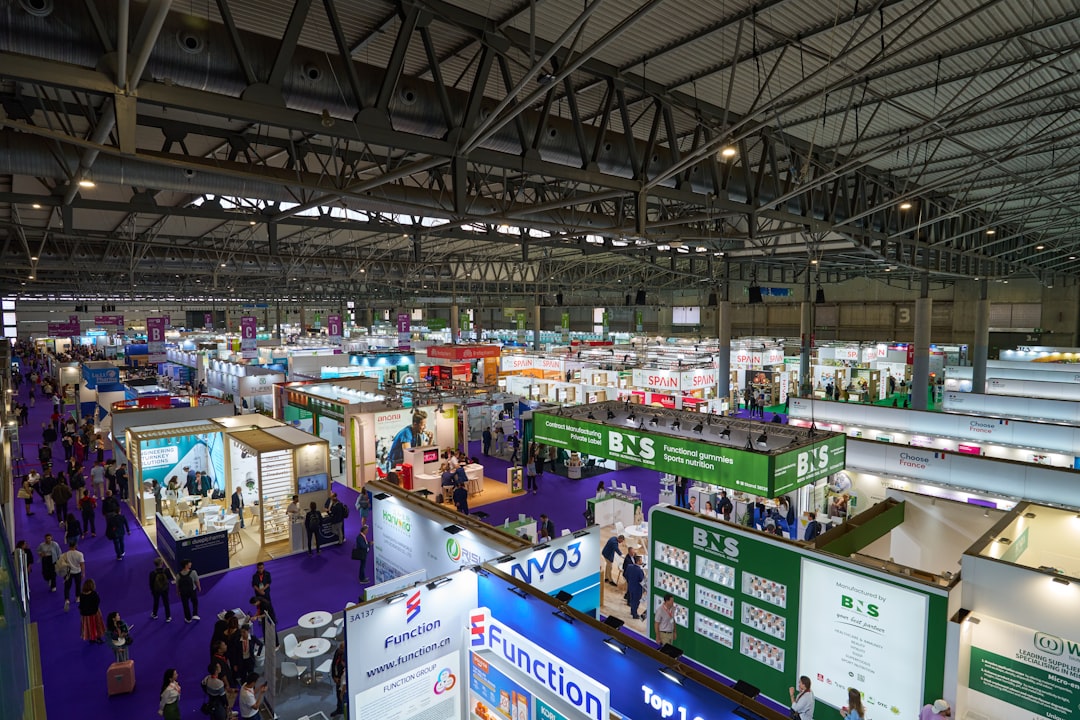
The Belgian commercial exhibition footprint distributes across three anchor venues, with Brussels Expo carrying the largest absolute exhibitor floorspace and the EU-institutions audience concentration, and Flanders Expo Ghent and Antwerp Expo serving Flemish-region buyer audiences with distinct sector strengths.
| Venue operator | Flagship fairs | Sector strength | Indicative space cost (EUR/sqm) |
|---|---|---|---|
| Brussels Expo (Heysel) | Batibouw, Salon de l’Auto Brussels, Seafood Expo Global, Cocoon | Construction, automotive, seafood, interior design, EU-institutions adjacent | 260-490 |
| Flanders Expo Ghent | Accenta, Horse Event, Flanders Tech Reveal | Consumer goods, equine industry, regional technology | 220-410 |
| Antwerp Expo | Antwerp Jewellery Week, Antwerp Boat Show, Bis Bouwbeurs | Diamond and jewellery industry, marine consumer, building | 230-420 |
| Liege Expo | EuroSkills (when rotating), Walloon regional fairs | Vocational skills, Walloon industry | 200-360 |
| Charleroi Expo | Charleroi regional fairs | Walloon regional B2B | 190-340 |
Headline base rates above reflect tier-A in-hall positions for standard row stands on the 2026 published calendar. Corner positions add 8-12 percent, head-of-aisle 12-18 percent, and island positions 18-25 percent. At Seafood Expo Global (Brussels Expo, globally anchored), premium positions in seafood-anchor halls can clear 30-45 percent above headline.
Belgium at a glance: the country-specific exhibitor facts
| Fact category | Belgium-specific reality |
|---|---|
| Top fairs by exhibitor spend | Seafood Expo Global Brussels, Batibouw, Salon de l’Auto Brussels, Antwerp Jewellery Week, Accenta |
| Top venues | Brussels Expo, Flanders Expo Ghent, Antwerp Expo |
| Standard VAT rate | 21% (reduced 12% and 6% applicable to some categories not typically applicable to exhibition activity) |
| Trade registry | BCE/KBO (Banque-Carrefour des Entreprises / Kruispuntbank van Ondernemingen), unified national registry |
| Industry association | Febelux for Belgian-Luxembourg event industry; multiple regional Chambers of Commerce |
| On-site forwarders | Multiple accredited handlers at all three venues; Ziegler, Crown Worldwide, and others |
| Payment-term norm | Net 30 standard; venues require typically 30% deposit on space booking, balance 60 days before opening |
| Working language for build-up | French and English at Brussels Expo; Dutch and English at Flanders Expo Ghent and Antwerp Expo |
| Working language for visitor engagement | Multilingual NL/FR/DE/EN with language mix matched to venue’s primary linguistic catchment |
| Structural-calculation framework | Eurocodes (EN 1990 to EN 1999), signed by a Belgian-registered ingenieur en construction / constructie-ingenieur |
| Currency | EUR |
| Build-day cultural norm | Pragmatic multilingual operation; closer to Dutch flexibility than French process-discipline |
“Brussels is the European exhibition market where political fluency matters as much as commercial fluency. The buyer at Seafood Expo Global is making procurement decisions inside the regulatory envelope of the European Commission’s food-safety directorate, and the brand that has demonstrated EU-policy understanding before the conversation begins has already half-won. The brand that treats Brussels as just another B2B venue misses the audience entirely.”, Common framing from EU-policy-adjacent exhibitor consultants
The EU-institutions audience profile
The single most strategically distinctive fact about the Brussels exhibition market is the EU-institutions buyer audience concentration.
Brussels Expo flagship fairs draw EU-policy-adjacent attendees in densities not found at any other European fair: regulatory affairs directors from pharmaceutical, chemical, agricultural, and financial-services companies; public-affairs leads from technology and energy companies engaged with EU regulatory consultations; EU-institutions procurement officers (the European Commission alone manages procurement programmes exceeding EUR 60 billion annually); industry-association policy directors maintaining permanent Brussels offices; consultancy firms operating EU-affairs practices.
For exhibitor categories where EU-policy positioning matters, pharmaceutical regulatory affairs, environmental compliance technology, financial services regtech, agri-food policy categories, defence and security, digital-platform regulation, a Brussels Expo presence delivers buyer audiences that would require expensive direct lobbying programmes to access via any other route.
Seafood Expo Global at Brussels Expo, for instance, draws not just commercial seafood buyers but EU food-safety regulators, fisheries-policy officials, and EU-trade-policy specialists whose decisions shape the regulatory frameworks the seafood industry operates within.
The strategic implication is that Brussels fairs justify investment levels disproportionate to their direct commercial-buyer numbers. A Brussels Expo presence at the right sector flagship can shape EU-policy positioning that affects multi-year revenue streams across the broader European market.
The multilingual working culture in practice
Belgium operates under three official languages with English as the dominant international lingua franca. The practical implications for stand operations:
- Brussels Expo: communications default to French and English, with Dutch accommodation expected for Flemish-business visitors. Stand staffing should include native French speakers, native Dutch speakers, and fluent English speakers.
- Flanders Expo Ghent: communications default to Dutch and English. French-language staffing is appreciated but not essential; German-language staffing is unnecessary unless targeting specific German-speaking eastern Cantons buyer audiences.
- Antwerp Expo: communications default to Dutch and English, with French accommodation for Walloon-business visitors. Antwerp’s distinct international character (driven by the diamond industry’s global English-language working norm) makes English the most reliable single-language fallback.
- Liege Expo and Charleroi Expo: communications default to French and English, with Dutch unnecessary outside specific Flemish-buyer-targeted exhibitor strategies.
The pragmatic recommendation across all Belgian venues is multilingual local-language plus English staffing matched to the venue’s primary linguistic catchment, with explicit acknowledgement of language mix when greeting visitors (a simple “bonjour-goedendag” opening signals diplomatic awareness that visibly affects Belgian visitor engagement).
Brussels Expo, Flanders Expo Ghent, and the Belgian flagship calendar
The Belgian flagship calendar concentrates at Brussels Expo with regional Flemish alternatives:
- Seafood Expo Global was hosted at Brussels Expo for many years but relocated permanently to Fira de Barcelona in 2022; it is no longer part of the Belgian calendar. Historically it drew roughly 30,000 trade visitors including EU food-safety and fisheries-policy officials.
- Batibouw (Brussels Expo, annually each February), Benelux construction and renovation industry flagship.
- Salon de l’Auto Brussels (Brussels Expo, annually each January), Belgian motor show with strong Benelux consumer audience.
- Cocoon Brussels Expo, Belgian interior design and home decoration flagship.
- Accenta (Flanders Expo Ghent, annually), Flemish consumer-goods flagship.
- Horse Event (Flanders Expo Ghent, annually), European equine industry trade fair.
- Antwerp Jewellery Week (Antwerp Expo, annually), European diamond and jewellery industry trade event distinct from Vicenzaoro’s global flagship status.
- Bis Bouwbeurs (Antwerp Expo), Flemish construction industry flagship.
The current calendar is maintained at /fairs?country=belgium. Verified stand builders with documented Belgian project history are at /builders?country=belgium. The Brussels, Ghent, Antwerp, and Liege city pages aggregate venue, builder, and logistics context at /cities/brussels, /cities/ghent, /cities/antwerp, and /cities/liege.
The 21% VAT mechanics and BCE/KBO
Belgium’s standard VAT rate (BTW/TVA/MwSt) is 21 percent, identical to the Dutch BTW and Spanish IVA rates. The mechanics for foreign exhibitors mirror the broader EU framework: EU-resident exhibitors typically benefit from the reverse-charge mechanism on venue-supplied services, with the venue invoicing net of VAT and the exhibitor accounting for VAT in its home country. The mechanism breaks at the standard EU triggers.
Belgian VAT registration runs through the Service public federal Finances (SPF Finances, also operating in Dutch as FOD Financien). Typical first-registration timelines run 4-7 weeks. Recovery of unregistered Belgian VAT through the EU portal typically completes in 4-7 months, among the fastest in Europe alongside Dutch and Danish equivalents.
The BCE/KBO, Banque-Carrefour des Entreprises / Kruispuntbank van Ondernemingen, is the Belgian unified commercial registry, accessible publicly at kbopub.economie.fgov.be in French, Dutch, German, and English. Every Belgian company carries a BCE/KBO number that appears on commercial invoices and contracts. The unified-registry structure (replacing previously fragmented Flemish, Walloon, and Brussels regional registries in the early 2000s) operates more accessibly than several EU equivalents.
Common pitfalls for first-time exhibitors in Belgium
- Treating Brussels as just another B2B venue. Brussels carries EU-institutions audience density that justifies investment levels disproportionate to direct commercial-buyer numbers. Plan accordingly.
- Single-language stand staffing. Multilingual local-language plus English staffing is the operational baseline; single-language staffing produces visible visitor disengagement in mixed-language Belgian audiences.
- Assuming Flemish-Walloon-Brussels regional distinctions are merely linguistic. They reflect real political, business-culture, and buyer-network distinctions that affect commercial commitment patterns.
- Underestimating the strategic value of Seafood Expo Global for non-seafood EU-policy positioning. The event draws EU food-safety regulators whose decisions affect adjacent food-and-beverage categories beyond seafood.
- Hiring builders without Belgian multilingual fluency. Cross-language coordination between French-speaking and Dutch-speaking contractors is operationally consequential; builders without Belgian multilingual experience struggle.
- Belgian VAT cash-flow planning errors. Recovery is fast (4-7 months) but documentation rigour matters; first-time exhibitors who underprepare documentation discover the fast recovery becomes slow.
Worked example: first-time exhibitor budget at a Brussels Expo flagship fair
A first-time international exhibitor booking 70 square metres at a Brussels Expo flagship fair (such as Batibouw) with a hybrid build targeting both commercial buyers and EU-policy-adjacent audiences:
- Space rental, 70 sqm at EUR 390/sqm tier-A position: EUR 27,300
- Febelux marketing and Seafood Expo Global registration: EUR 1,100
- Hybrid build with bespoke surface treatments and EU-policy-relevant content displays: EUR 52,000
- Structural calculation by Belgian-registered ingenieur en construction: EUR 2,000
- Inbound freight (one truckload, EU origin): EUR 3,400
- Brussels Expo on-site handling: EUR 3,000
- On-stand electrics, water, refrigeration for seafood demonstrations: EUR 4,800
- On-stand catering with chef demonstrations (four days): EUR 8,400
- Trilingual hostess and translation services (FR/NL/EN, four days): EUR 5,600
- Site supervisor (Brussels Expo-experienced, four days): EUR 3,800
- EU-policy briefing preparation for stand staff: EUR 2,400
- Contingency at 8 percent: EUR 9,100
- Total all-in budget: approximately EUR 123,000 (excluding staff travel, accommodation, and pre-fair marketing)
The market-entry decision framework for Belgium
- Is your category EU-policy-adjacent (pharmaceutical regulatory, environmental compliance, financial regtech, agri-food, defence)? → Brussels Expo flagship in your category is strategically distinct from any other European fair venue. Plan a 50-150 sqm hybrid build with multilingual staffing and EU-policy briefing preparation.
- Is your category globally anchored at a Brussels Expo flagship (Seafood Expo Global; Batibouw for Benelux construction)? → The Brussels Expo flagship is the right tier. Plan 60-100 sqm hybrid build.
- Is your category Flemish-region-led (consumer goods, equine, regional construction, diamond and jewellery)? → Flanders Expo Ghent or Antwerp Expo is the right tier. Lower per-sqm costs than Brussels Expo with stronger Flemish buyer audience density.
- Are you targeting Benelux markets jointly? → Belgium’s Brussels Expo or Flanders Expo Ghent combined with one Dutch venue (RAI Amsterdam or Jaarbeurs Utrecht) delivers full Benelux audience coverage in two fairs per year.
- Have you exhibited at three or more Belgian fairs? → You are operating at calendar level. The multilingual hybrid build refreshed across the Belgian calendar becomes the right cost structure.
Find builders, fairs, and city context for Belgium
- /builders?country=belgium, verified stand builders with documented Belgian multilingual project history
- /fairs?country=belgium, full calendar of Belgian fairs
- /cities/brussels, /cities/ghent, /cities/antwerp, /cities/liege, city-level aggregations
Related reading
- Exhibiting in the Netherlands, the northern Benelux neighbour with shared English-default culture and lower multilingual complexity
- Exhibiting in France, the French-speaking neighbour with comparable conversation conventions
- Exhibiting in Germany, the German-language neighbour relevant for Belgian-German cross-border strategies
- Exhibiting in the UK, the English-language alternative for non-EU-policy exhibitor strategies
- Modular vs Custom Decision Framework, build-type framework underneath the Belgian hybrid recommendation
- Customs and ATA Carnet, EU customs picture for Belgium-bound freight
References and primary sources
- Febelux Belgian-Luxembourg event industry federation, febelux.com
- Brussels Expo Exhibitor Technical Guidelines 2026
- Flanders Expo Ghent Exhibitor Service Manual 2026
- Antwerp Expo venue technical documentation 2026
- Eurocodes EN 1990 to EN 1999, Belgian structural-design implementation
- SPF Finances / FOD Financien, foreign-exhibitor VAT registration requirements
- BCE/KBO unified Belgian commercial registry (publicly searchable at kbopub.economie.fgov.be)
- Seafood Expo Global, Batibouw, Salon de l’Auto Brussels exhibitor statistics 2024-2026 editions
FAQFrequently asked questions
Brussels hosts the European Commission, the Council of the European Union, the European Parliament’s secondary chamber, and the headquarters of NATO and dozens of EU-policy-adjacent industry associations, think tanks, and regulatory bodies.
Belgian flagship fairs at Brussels Expo draw EU-policy-adjacent buyer audiences (regulatory affairs directors, public-affairs leads, EU-institutions procurement officers, industry-association policy directors) that have no equivalent concentration at any other European fair venue.
For exhibitor categories where EU-policy positioning matters, pharmaceutical regulatory affairs, environmental compliance technology, financial services regulatory technology, agri-food policy categories, defence and security, a Brussels Expo presence delivers buyer audiences that would require expensive direct lobbying programmes to access via any other route.
Belgium operates under three official languages, Dutch (Flemish), French (Walloon and Brussels), and German (eastern Cantons), with English as the dominant lingua franca for international business.
Brussels Expo communications default to French and English; Flanders Expo Ghent communications default to Dutch and English; Antwerp Expo communications default to Dutch and English; venues in eastern Belgium default to German and English. Stand-staff briefing should reflect the venue location and expected visitor linguistic mix.
A Brussels Expo stand staffed exclusively in English will function but miss visible commercial commitment signals to French-speaking visitors; a Flanders Expo stand staffed exclusively in French will encounter active visitor disengagement among Dutch-speaking Flemish business audiences. The pragmatic recommendation is bilingual local-language plus English staffing matched to the venue’s primary linguistic catchment.
For EU-resident exhibitors renting space only, the Belgian reverse-charge mechanism applies on venue services, so no Belgian VAT number is required for the booking itself. The threshold breaks on the standard EU triggers: on-stand sales for Belgian fulfilment, payments collected in Belgium, or contracting directly with Belgian suppliers without an EU VAT ID.
The Belgian standard rate (BTW in Dutch, TVA in French, MwSt in German) is 21 percent, identical to the Dutch and Spanish rates. Belgian VAT registration runs through the Service public federal Finances (SPF Finances). Recovery of unregistered Belgian VAT through the EU portal typically takes 4-7 months, among the fastest in Europe alongside Dutch and Danish equivalents.
BCE/KBO, Banque-Carrefour des Entreprises in French / Kruispuntbank van Ondernemingen in Dutch, is the Belgian unified commercial registry, accessible at kbopub.economie.fgov.be in multiple languages. Every Belgian company carries a BCE/KBO number that appears on commercial invoices and corporate communications.
The registry was unified across Flemish, Walloon, and Brussels regions in the early 2000s, replacing a previously fragmented registry system. Belgian counterparties verify foreign exhibitor entities against their home-country equivalent registry; for on-stand commercial contracts signed at Belgian fairs, the foreign exhibitor’s home-country registry equivalent is the standard evidence-of-existence requirement.
Belgium has fewer globally-anchored flagships than Germany, France, or Italy, but several Belgian fairs serve strategically distinctive audiences. Salon de l’Auto Brussels (Brussels Expo) is the Belgian motor show with strong Benelux audience. Batibouw at Brussels Expo is the Benelux construction and renovation flagship. Cocoon at Brussels Expo serves Belgian interior design.
Bedouin Festival serves Brussels cultural events. Flanders Expo Ghent hosts Accenta (consumer flagship), Horse Event (equine industry), and several B2B Flemish-industry events. Antwerp Expo hosts the Antwerp Jewellery Industry trade fair (separately from Vicenzaoro’s global flagship status, Antwerp serves the European diamond trade specifically).
The Belgian flagship calendar is generally smaller-scale than Western European peers but delivers high-quality EU-policy-adjacent buyer engagement particularly at Brussels Expo events.
Belgian build-day discipline sits operationally between Dutch flexibility and French process-discipline. Brussels Expo, Flanders Expo Ghent, and Antwerp Expo operate published time-slot allocations, accredited-contractor lists, and on-site safety officer enforcement.
The Eurocodes structural-calculation regime applies, with stamping by a Belgian-registered ingenieur en construction (French) or constructie-ingenieur (Dutch). On-site handling is competitive with multiple accredited handlers operating concurrently.
The cultural framing is multilingual and pragmatic, closer to the Dutch operating model than the French equivalent, with French-Belgian Brussels Expo somewhat more process-oriented than the Flemish Belgian venues. For builders fluent in Dutch operating conventions, Belgian venues operate familiarly; for builders bringing French operating conventions, the language overlap helps but the operating tempo differs.