Held annually in April at Palexpo Geneva (14 to 20 April in 2026) Watches and Wonders Geneva is the global reference event for fine watchmaking. Each year the fair brings together the heritage Maisons of haute horlogerie as well as Patek Philippe, Rolex, Cartier, Vacheron Constantin, Audemars Piguet, IWC Schaffhausen, Jaeger-LeCoultre, Panerai and A.
Seven days at Palexpo bring together Lange & Söhne, Tudor, Hermes, Chanel Horlogerie and a curated group of independent watchmakers for four trade days followed by three public days. Overall visitor numbers for the 2026 event were expected to be close to 60,000 in total and among them were more than 6,000 retailers and about 1,700 journalists.
Watches and Wonders hosts the year’s top platform for product launches, distributor engagement, retailer briefings and worldwide press presence for the brands that anchor the fair and heritage-Maison stand budgets run routinely above CHF 5 million for a four- to six-day presence. The largest stands - those by Rolex, Patek Philippe and Cartier - reach up to CHF 12 million when combined with concurrent boutique-programmes across Geneva.
Drawing on the published practices of established Maisons, the fair’s official organisational documentation and Palexpo’s flagship-tier exhibitor service standards as well as the operational documentation of the specialist builders who set up the fair’s flagship presence each year, this article goes through the strategy system that experienced luxury-watch brands use for Watches and Wonders.
Why Watches and Wonders operates at a different aesthetic standard
Watches and Wonders is not a conventional trade fair. The defining operational features:
- Stands are temporary luxury retail flagships. In Geneva, Place Vendome Paris or Bond Street London, construction standards, material choice and operational discipline are the same as for permanent boutiques. A stand is not exhibition design. It is luxury retail architecture.
- Buyer access is structured by appointment. Retailers, distributors and collectors get appointment-only access to the flagship Maisons. The stand works instead as a private salon rather than open exhibition space.
- Press programming is exhaustive. International watch press attendance is the most concentrated of any European exhibition. Major Maisons host 100-300 individual press appointments across the fair days.
- Heritage cultural register dominates. International exhibitors have to adapt to the Maisons instead of getting generic international templates pushed on them. The Maisons draw on brand-heritage architectural elements such as Patek’s Geneva workshop language and Audemars Piguet’s Le Brassus Vallée de Joux references.
- Confidentiality is integral. Launches of new products at Watches and Wonders are kept tight and stand layouts have audio-isolated meeting rooms as well as infrastructure for confidential meetings with collectors.
Industry perspective: Watches and Wonders stand budgets at the heritage tier reflect the operational reality of building a temporary luxury retail flagship in a Swiss-franc cost base, with materials specification matching permanent boutique standards and infrastructure supporting 200-plus confidential appointments across six days. The numbers look extraordinary in conventional trade-fair terms because Watches and Wonders is not conventional trade-fair territory.
Cost structure for Watches and Wonders presence
The table below summarises typical 2026 stand budgets at Watches and Wonders Geneva.
| Stand tier | Footprint range (sqm) | All-in budget (CHF / EUR) | Build complexity | Typical brand profile |
|---|---|---|---|---|
| Independent watchmaker | 30-80 | 280,000-680,000 / 291,000-707,000 | Custom with high-spec finishes | Independent Maisons, small heritage brands |
| Mid-tier Maison | 100-200 | 850,000-1,800,000 / 884,000-1,872,000 | Architect-designed custom | Established but not top-tier heritage |
| Major Maison | 250-500 | 2,200,000-4,800,000 / 2,288,000-4,992,000 | Architect-designed installation-grade | Top-tier heritage brands |
| Heritage flagship | 600-1,200 | 5,500,000-12,000,000 / 5,720,000-12,480,000 | Architect-designed with brand-heritage references | Patek, Rolex, Cartier, Vacheron |
Space rental, build, install, dismantle, dedicated lighting design, AV integration, hospitality programming and Watches and Wonders official service charges are all included in these figures. Parallel Geneva-city programming such as boutique events, collector dinners and press hotel hosting gets left out. That routinely adds CHF 500,000 to CHF 3,000,000 to what heritage-flagship budgets would be.
Industry perspective: A Watches and Wonders heritage flagship budget breakdown typically shows 35-40 percent build and materials, 20 percent hospitality and operational service, 15 percent AV and lighting infrastructure, 12-15 percent space rental and official fair fees, and 10-15 percent ongoing operational running costs across the show days. The build component reflects luxury retail standards rather than exhibition standards.
The Watches and Wonders build expectation
Flagship Watches and Wonders stand builds prioritise five operational components:
Heritage-architectural design language
Stand architecture references the Maison’s brand heritage, manufactory workshop references for vertically-integrated brands, atelier references for heritage Maisons, retail-boutique references for distribution-heritage brands. The architectural register is sober, refined and distinctly Swiss rather than generically international.
Museum-grade materials specification
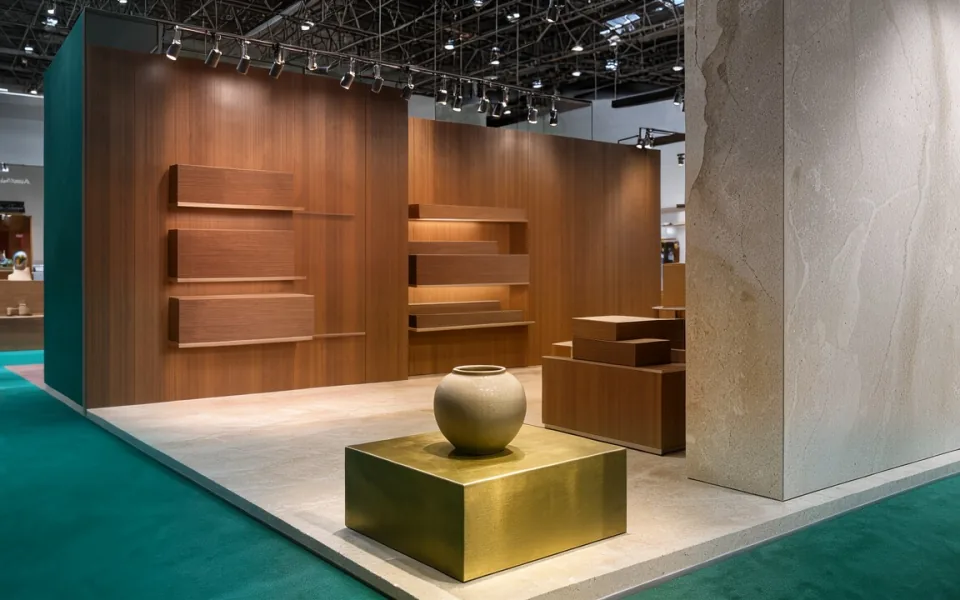
Materials at the Maison tier include hand-finished metalwork at horological-craft standard, museum-grade conservation glass, hand-polished concrete, real Geneva-quarried stone, hand-stitched leather upholstery and integrated lighting fixtures designed by named luxury-lighting consultants. The materials specification is the largest single component of build budget at the flagship tier.
Watch-display infrastructure at retail standard
Watch display cases are commissioned to retail-boutique standards with conservation lighting, climate control, anti-theft integration and aesthetic coherence with the parent Maison’s permanent boutique design language. Many flagship Maisons commission custom display infrastructure for each Watches and Wonders edition.
Private salon meeting infrastructure
About 40 percent of the space in Major Maison tier stands goes to audio-isolated meeting rooms that give collector-grade hospitality including espresso, fine spirits and light catering. Throughout the fair days, confidential product presentations, retailer briefings and collector meetings happen in each of these rooms.
Press hosting infrastructure
With interview seating, controlled product-photography spaces and recording-quality lighting and acoustics, dedicated press areas support the 100 to 300 individual press appointments that flagship Maisons host.
Hospitality conventions at Watches and Wonders
Watches and Wonders hospitality operates at hotel-five-star standard rather than trade-fair standard:
- Espresso and tea service throughout the day with named Swiss specialty coffee suppliers
- Light catering is available at lunch times with Swiss specialty foods including fine chocolates, regional cheeses and fresh pastries.
- Fine spirits available for collector appointments, typically Swiss-distillery whiskies, fine champagnes, premium vodkas
- Personal-attendant hospitality during appointments with dedicated stand staff providing one-to-one service
- Confidential conversation infrastructure, sound-isolated rooms, private salons, separate entrance flows
Across the six fair days, the hospitality budget for a flagship Watches and Wonders stand comes to CHF 400,000-1,200,000. There is no other European exhibition fair where the budget envelope is as large.
Builder selection for Watches and Wonders
The Watches and Wonders builder market is small and specialised. The shortlist of builders capable of delivering at the heritage-Maison tier is approximately ten firms across Switzerland, Italy and southern Germany. The signals that distinguish Watches and Wonders-capable builders:
- At the flagship tier, there is a documented portfolio of at least three Watches and Wonders or Baselworld-heritage stands for each of the past five years
- Material-sourcing relationships for luxury-retail grade specifications (heritage-quarry stone, museum-grade glass, hand-finished metalwork)
- Working relationships with Swiss permanent-boutique architects and shopfitters
- Multi-lingual project management (French, German, Italian, English)
- Brand-heritage cultural fluency demonstrated through portfolio work
Building partnerships with chosen builders takes 18 to 24 months in advance and that is what most Heritage-Maison projects need from partners who commit ahead of time.
Timeline for flagship Watches and Wonders presence
The flagship Watches and Wonders timeline runs approximately eighteen months end-to-end:
- Month 18-15 before fair: strategic decision; product-launch alignment; architect or design studio appointment
- Month 15-12: concept development; brand-heritage architectural research; material studies
- Month 12-9: design lock; structural engineering; Palexpo flagship approval submissions
- Month 9-5: fabrication; bespoke material sourcing; display infrastructure commissioning
- Month 5-2: install rehearsal; press strategy lock; collector-appointment scheduling
- Week 3 before fair: Palexpo build-up commences
- Watches and Wonders week: six days of live operations including press preview and public day
- Post-fair: dismantle within 72 hours; key components archived for brand-museum or next-year reuse
Mid-tier presence within nine months is possible for brands new to Watches and Wonders at the heritage tier through specialist builders. Commitment inside 14 months blocks any chance of heritage-grade execution and that is the timeline reality.
How Watches and Wonders interacts with the wider luxury-fair calendar
Major luxury brands go to three to four of these annually and position their brands coordinately. Watches and Wonders fits into the European spring luxury-fair calendar that takes in Salone del Mobile Milan (mid-April), Art Basel Hong Kong (March) and the events following Baselworld for jewellery and watches.
The adjacent luxury-industry events include:
- Salone del Mobile takes place in Milan during mid-April and it gives luxury watch brands that have home and accessories lines the chance to sit next to designs.
- Art Basel (Basel, mid-June), contemporary art adjacency with collector-network overlap
- Jewellery and watch programming has been restructured following the discontinuation of Baselworld as from 2020 onward.
- Sotheby’s and Christie’s spring watch auctions (variable dates), collector-market adjacency
For the wider Swiss fair context, see Exhibiting in Switzerland: Messe Basel and Palexpo. For Swiss customs and VAT mechanics, see Switzerland Exhibition Non-EU Customs Guide.
Related reading
- Exhibiting in Switzerland: Messe Basel and Palexpo, country baseline
- Switzerland Exhibition Non-EU Customs Guide, customs and MWST mechanics
- Salone del Mobile Flagship Design Strategy, adjacent luxury-design fair comparison
- Modular vs Custom Decision Framework, Watches and Wonders is the canonical custom-luxury case
- Booth Cost Calculator, model Swiss flagship budgets
- Builder Directory, Watches and Wonders-experienced builders with verified portfolios
References and primary sources
- Watches and Wonders Geneva, official organising committee documentation 2026 edition
- Fondation de la Haute Horlogerie (FHH), industry standards and member documentation
- Palexpo Geneva, flagship-tier exhibitor service standards
- Expo Event Swiss LiveCom Association, luxury-fair operational guidance
- Swiss Federal Customs Administration, temporary admission procedures for luxury goods
- Watchmakers’ associations of Switzerland (FH and AHCI), industry context
- MCH Group, Swiss exhibition operator standards
- AUMA International Exhibitor Service, luxury-fair market comparative analysis 2026
FAQFrequently asked questions
Budgets scale sharply by tier. An independent watchmaker at 30 to 80 sqm runs CHF 280,000 to 680,000, a mid-tier Maison at 100 to 200 sqm runs CHF 850,000 to 1,800,000, a major Maison at 250 to 500 sqm runs CHF 2,200,000 to 4,800,000, and a heritage flagship at 600 to 1,200 sqm runs CHF 5,500,000 to 12,000,000.
The fair is held each year in April at Palexpo Geneva, with the 2026 edition running 14 to 20 April. It spans seven days in total: four trade days followed by three public days. The 2026 edition was expected to draw close to 60,000 visitors overall, including more than 6,000 retailers and approximately 1,700 journalists.
The tier figures cover space rental, build, install, dismantle, dedicated lighting design, AV integration, hospitality programming and official Watches and Wonders service charges. They exclude parallel Geneva-city programming such as boutique events, collector dinners and press hosting at hotels, which routinely adds CHF 500,000 to 3,000,000 to heritage-flagship budgets.
A typical heritage flagship breakdown shows 35 to 40 percent build and materials, 20 percent hospitality and operational service, 15 percent AV and lighting infrastructure, 12 to 15 percent space rental and official fair fees, and 10 to 15 percent ongoing operational running costs across the show days. The build component reflects luxury retail standards rather than exhibition standards.
Stands at this fair function as temporary luxury retail flagships. Construction standards, materials specification and operational discipline match permanent boutiques in Geneva, Place Vendome Paris or Bond Street London. Stand build is not exhibition design, it is luxury retail architecture, which is why the materials specification becomes the largest single component of build budget at the flagship tier.
Major Maison tier stands allocate about 40 percent of their space to audio-isolated meeting rooms offering collector-grade hospitality including espresso, fine spirits and light catering. Confidential product presentations, retailer briefings and collector meetings run in each of these rooms throughout the fair days, because buyer access at the flagship Maisons is appointment-only rather than open exhibition space.
Major Maisons host 100 to 300 individual press appointments across the fair days, and international watch press attendance is the most concentrated of any European exhibition. That volume requires dedicated press areas with interview seating, controlled product-photography environments, and recording-quality lighting and acoustics built into the stand rather than improvised on site.
The hospitality budget for a flagship stand routinely runs CHF 400,000 to 1,200,000 across the six fair days, an envelope with no parallel at any other European exhibition fair. It covers espresso and tea service with named Swiss specialty coffee suppliers, light catering with Swiss specialty foods, fine spirits for collector appointments and personal-attendant service during appointments.
The flagship timeline runs approximately eighteen months end-to-end, from strategic decision and architect appointment at month 18 to 15, through design lock and Palexpo approval submissions at month 12 to 9, to fabrication at month 9 to 5. Commitment inside 14 months rules out heritage-grade execution, though specialist builders allow mid-tier presence within nine months.
The shortlist is approximately ten firms across Switzerland, Italy and southern Germany. Distinguishing signals include a documented portfolio of at least three flagship-tier stands at this fair or Baselworld-heritage stands in the previous five years, material-sourcing relationships for luxury-retail grade specifications, working relationships with Swiss permanent-boutique architects, and multi-lingual project management.