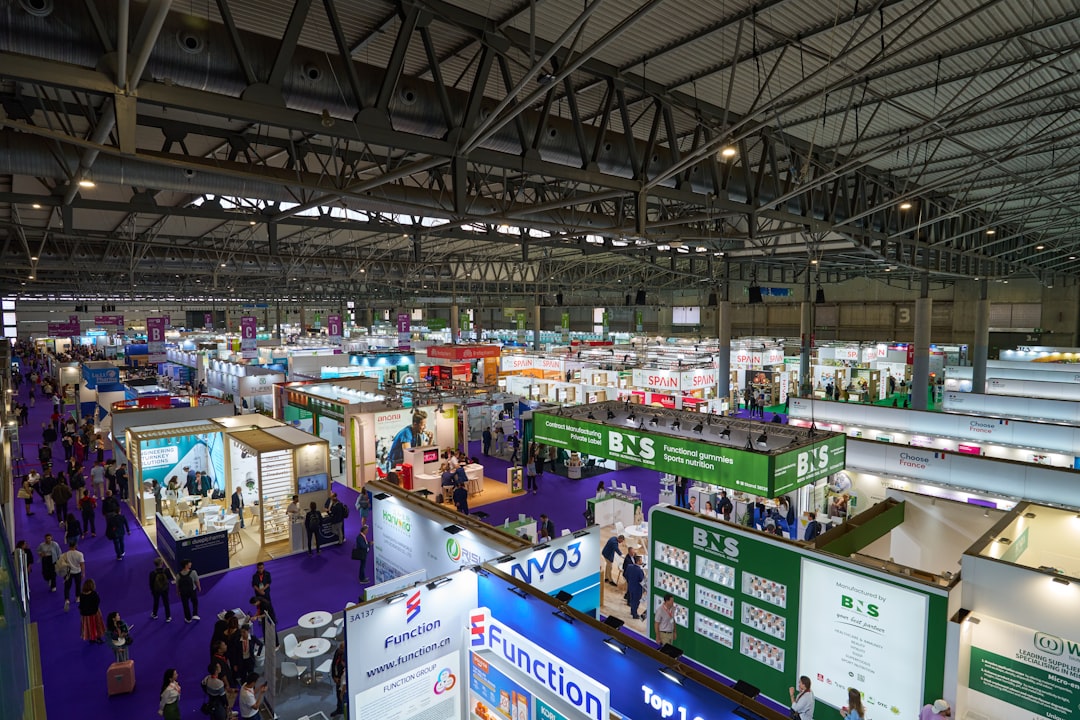
Spain runs Europe’s most pronounced slow-opening, strong-close trade-fair rhythm. The first three hours of a Spanish fair day produce relationship-building conversations, exploratory coffee discussions, and orientation; the final three hours produce signed letters of intent, commercial commitments, and meeting bookings for the next edition.
Stand-staff scheduling that mirrors northern-European front-loaded patterns routinely misses the highest-value Spanish conversation windows. This one cultural fact, more than any tax, customs, or registry detail, determines whether a Spanish stand performs.
This guide walks through the Spanish exhibition reality: the binary venue structure dominated by IFEMA Madrid and Fira Barcelona; the flagship calendar anchored by MWC Barcelona, ISE, FITUR, Alimentaria, and Salon del Automovil; the 21 percent IVA mechanics and Registro Mercantil registry; and the day-rhythm conventions that distinguish Iberian B2B conversion from the rest of Europe.
The Spanish exhibition map
Spain’s commercial exhibition footprint is sharply binary. IFEMA Madrid and Fira Barcelona together absorb roughly 80 percent of the country’s tier-one exhibitor floorspace, with regional venues at Valencia, Bilbao, Zaragoza, Seville, and Malaga handling sector-specific and regional fairs.
The Madrid-Barcelona binary reflects historical patterns of Spanish industrial-and-services concentration, with Madrid anchoring institutional, government-adjacent, and technology fairs and Barcelona anchoring industrial, design, and Mediterranean-trade fairs.
| Venue operator | Flagship fairs | Sector strength | Indicative space cost (EUR/sqm) |
|---|---|---|---|
| IFEMA Madrid | FITUR, ARCO, SIMO Educacion, IMEX Madrid, ePower&Building, Climatizacion, Fruit Attraction | Tourism, art, education, building services, fresh produce | 230-440 |
| Fira Barcelona (Gran Via and Montjuic) | MWC Barcelona, ISE, Alimentaria, Hostelco, Hispack, Bizbarcelona, IBTM World | Mobile, AV/integrated systems, food, packaging, MICE | 280-540 |
| Feria Valencia | Cevisama, Fimma-Maderalia, Habitat | Ceramics, woodworking, furniture | 200-360 |
| Bilbao Exhibition Centre | Sevatec, Subcontratacion, Ferroforma | Subcontracting, industry, hardware | 190-340 |
| Feria de Zaragoza | SMAGUA, Power Expo, Tecnoebro | Water, energy, industry | 180-320 |
| FIBES Sevilla | Andalusian sector fairs, conferences | Conference and corporate events | 200-370 |
Headline base rates above reflect tier-A in-hall positions for standard row stands on the 2026 published calendar. Corner positions add 10-15 percent, head-of-aisle 15-20 percent, and island positions 20-28 percent. At MWC Barcelona, premium hall positions can clear 80-150 percent above the headline base, MWC carries the highest per-sqm rates of any annual European fair. At ISE (Fira Barcelona Gran Via), the premium ranges sit at 30-45 percent above headline. At FITUR (IFEMA), 25-40 percent.
Spain at a glance: the country-specific exhibitor facts
| Fact category | Spain-specific reality |
|---|---|
| Top fairs by exhibitor spend | MWC Barcelona, ISE, FITUR, Alimentaria, ARCO, Fruit Attraction, Hostelco, IBTM World |
| Top venues | IFEMA Madrid, Fira Barcelona Gran Via, Fira Barcelona Montjuic, Feria Valencia, Bilbao Exhibition Centre |
| Standard VAT rate | 21% (reduced rates 10% and 4% on specific categories not typically applicable to exhibition activity) |
| Trade registry | Registro Mercantil, maintained by the local Registrador Mercantil |
| Industry association | AFE (Asociacion de Ferias Espanolas) for venues; OPE (Organizacion de Profesionales de Eventos) for event services |
| On-site forwarders | Resa, Servisa, and SIT Group are the largest accredited at IFEMA and Fira |
| Payment-term norm | Net 30 standard; venues require typically 30% deposit on space booking, balance 60 days before opening |
| Working language for build-up | Spanish at IFEMA; Catalan and Spanish at Fira Barcelona; English fully workable at MWC, ISE, and FITUR top halls |
| Working language for visitor engagement | Spanish strongly preferred for Iberian and Latin American audience capture; English fully accepted at globally-positioned flagships |
| Structural-calculation framework | Eurocodes (EN 1990 to EN 1999), signed by an ingeniero colegiado registered in Spain |
| Currency | EUR |
| Day-rhythm convention | Slow morning, strong late-afternoon close; staffing weighted toward 15:00-closing |
“The Spanish stand that performs is the one staffed for the close, not the open. The doors open at 09:30 and the meaningful conversations start at 15:30. Northern-European exhibitors who staff the morning heavy and the afternoon thin discover their best conversations happening while the senior team is at lunch. The fix is to flip the staffing pattern.”, Common framing among IFEMA and Fira Barcelona-experienced exhibition managers
MWC Barcelona: the category of its own
MWC Barcelona is the global mobile and telecommunications industry’s annual flagship, drawing more than 100,000 attendees across four days with C-suite participation density unmatched by any other European technology fair. Telecom operators, equipment vendors, and software platforms structure their annual product-launch calendars around its dates. The cultural and commercial weight is closer to CES Las Vegas than to any other European trade fair.
The operational implications cascade through every aspect of stand planning. MWC stand budgets routinely exceed any other European fair on a per-square-metre basis, EUR 1,800-4,500 per square metre for tier-one positions is the working range, with flagship anchor positions clearing EUR 6,000 per sqm.
The stand functions more as a private-meeting infrastructure than as a visitor-conversation platform: the MWC visitor flow is roughly 70 percent pre-booked C-suite meetings and 30 percent walk-in, the inverse of most European trade fairs. The implication for stand design is heavy investment in private meeting rooms, executive hospitality, and on-stand demo theatres rather than open-plan visitor-engagement zones.
“MWC is the European exhibition equivalent of a New York investment-banking pitch week. The walk-in visitor is not the target audience. The target audience is the seventy CEOs and CTOs you have booked into meetings across four days, and the stand is the venue where those meetings happen. Anyone who designs an MWC stand around the walk-in visitor has misread the assignment.”, Common framing among MWC-experienced telecoms exhibitors
The MWC lead-time discipline is similarly distinctive. Tier-one MWC positions are typically booked 18-24 months in advance, with returning-exhibitor rights absorbing premium positions in the closing-day rebooking cycle. First-time MWC exhibitors typically secure residual hall positions on first edition and use that edition’s performance to negotiate better positions for the second.
ISE, FITUR, Alimentaria, and the rest of the Spanish flagship calendar
Outside MWC, the Spanish flagship calendar carries several globally-anchored events:
- ISE (Integrated Systems Europe), at Fira Barcelona Gran Via each January-February, the global professional AV and integrated-systems industry flagship, relocated from RAI Amsterdam in 2021.
- FITUR (Feria Internacional del Turismo) at IFEMA Madrid each January, one of the global travel industry’s three anchor fairs, with distinctive Latin American exhibitor density.
- Alimentaria at Fira Barcelona, biennial in odd years, the Spanish-anchored global food and beverage flagship.
- ARCO Madrid at IFEMA each February-March, Spain’s flagship contemporary art fair.
- Hostelco at Fira Barcelona, biennial, hospitality industry flagship.
- Fruit Attraction at IFEMA Madrid each October, fresh produce industry flagship for the European-Latin American axis.
- IBTM World at Fira Barcelona Gran Via each November, global MICE industry flagship.
- Salon del Automovil de Barcelona at Fira Barcelona, Spanish motor show.
The current calendar is maintained at /fairs?country=spain. Verified stand builders with documented Spanish project history are at /builders?country=spain. The Madrid, Barcelona, Valencia, Bilbao, and Seville city pages aggregate venue, builder, and logistics context at /cities/madrid, /cities/barcelona, /cities/valencia, /cities/bilbao, and /cities/seville.
The 21% IVA mechanics and Registro Mercantil
Spain’s standard VAT rate (IVA, Impuesto sobre el Valor Anadido) is 21 percent. The mechanics for foreign exhibitors mirror the broader EU framework: EU-resident exhibitors typically benefit from the reverse-charge mechanism on venue-supplied services, so the venue invoices net of IVA and the exhibitor accounts for VAT in its home country.
The mechanism breaks at the standard EU triggers, on-stand sales for Spanish fulfilment, payments collected in Spain, or contracting directly with Spanish suppliers without an EU VAT ID.
Spanish VAT registration runs through the Agencia Tributaria (Agencia Estatal de Administracion Tributaria). Non-EU exhibitors must appoint a fiscal representative. Typical first-registration timelines run 4-8 weeks, requiring a NIF (Numero de Identificacion Fiscal) for the foreign entity. Recovery of unregistered Spanish VAT through the EU portal or 13th-Directive process typically takes 6-12 months, with documentation rigour broadly comparable to the German equivalent.
The Registro Mercantil, Spain’s commercial registry, maintained by the local Registrador Mercantil, is the publicly-searchable equivalent of the German Handelsregister, French RCS, or UK Companies House. For on-stand commercial contracts signed at Spanish fairs, the foreign exhibitor’s home-country registry equivalent is the standard evidence-of-existence requirement.
The Catalan-Madrid working culture difference
A practical operational fact: Catalan business culture at Fira Barcelona is somewhat more compressed and northern-European in rhythm than the Madrid equivalent. The slow-open, strong-close pattern persists at Fira Barcelona but with the opening period shortened and the closing peak intensified. At IFEMA Madrid, the pattern stretches across the full day with more pronounced relationship-building emphasis.
The implication for stand-staff briefing: Catalan-context staff briefings emphasise concise opening engagement and rapid escalation to commercial discussion; Madrid-context briefings emphasise extended exploratory conversation and explicit rapport-building before commercial framing. Builders and event-services contractors operate fluently in either rhythm but ask the right questions to identify the venue context they are briefing for.
Working language at Fira Barcelona includes Catalan alongside Spanish, particularly for venue technical-office communications and on-site contractor relationships. English is fully workable at MWC, ISE, and IBTM World top halls; less consistently workable at Hostelco and Alimentaria stand-builder level. Working language at IFEMA Madrid is Spanish primarily, with English fully workable at FITUR, ARCO, and SIMO Educacion top halls.
Common pitfalls for first-time exhibitors in Spain
- Northern-European front-loaded staffing patterns. Spanish fair days produce their highest-value conversations from 15:00 to closing. Stand-staff scheduling must reflect this.
- Treating MWC Barcelona as a typical trade fair. MWC is private-meeting infrastructure with walk-in supplement, not the inverse. Stand design that fails to reflect this misses the assignment.
- Assuming Fira Barcelona and IFEMA Madrid operate identically. Catalan-context rhythm differs from Madrid-context rhythm. Brief differently.
- Underestimating MWC per-sqm premium. MWC tier-one positions clear EUR 4,500-6,000 per sqm; first-time exhibitors who budget from other-European-fair benchmarks find themselves materially under-resourced.
- Spanish VAT cash-flow planning errors. Refund recovery typically takes 6-12 months; faster than Italian but slower than German equivalents.
- Skipping the fiscal representative appointment for non-EU exhibitors triggering Spanish VAT registration. Compulsory and produces a months-long delay if discovered after invoicing has begun.
- Assuming Catalan and Spanish are interchangeable in Fira Barcelona venue communications. Catalan is the local language; Spanish is reliably understood but professional engagement benefits from Catalan acknowledgement where competence allows.
Worked example: first-time exhibitor budget at MWC Barcelona
A first-time international exhibitor booking 80 square metres at MWC Barcelona with a meeting-focused hybrid build:
- Space rental, 80 sqm at EUR 2,400/sqm tier-A position: EUR 192,000
- AFE marketing and MWC registration fees: EUR 4,200
- Meeting-focused hybrid build with private meeting rooms and demo theatre: EUR 168,000
- Structural calculation by Spain-registered colegiado engineer: EUR 2,600
- Inbound freight (one truckload, EU origin) and customs: EUR 4,200
- Fira Barcelona on-site handling and storage: EUR 4,800
- On-stand electrics, water, fibre and 5G test connections: EUR 6,500
- On-stand catering for private meetings (four days, premium): EUR 14,000
- Hostess and translation services (four days, MWC-tier): EUR 6,800
- Site supervisor (Fira-accredited, four days): EUR 4,400
- Pre-MWC meeting booking and CRM integration: EUR 8,500
- Contingency at 8 percent: EUR 33,200
- Total all-in budget: approximately EUR 449,000 (excluding staff travel, accommodation, and pre-fair marketing)
For comparison, a 60 sqm hybrid build at FITUR or Alimentaria typically runs EUR 110,000-160,000 all-in, broadly comparable to Vivatech or SIAL equivalents in France, and substantially below MWC tier-one budgets.
The market-entry decision framework for Spain
- Is your sector mobile, telecoms, or adjacent? → MWC Barcelona is structurally non-substitutable. Plan a meeting-focused hybrid build with 18-24 month lead time and tier-one budget.
- Is your sector professional AV, integrated systems, or commercial display? → ISE (Fira Barcelona Gran Via) is the global flagship. Plan 80-200 sqm hybrid with 10-14 month lead time.
- Is your sector travel, tourism, or hospitality with Iberian-Latin American audience targeting? → FITUR (IFEMA Madrid) is structurally non-substitutable. Plan 50-100 sqm hybrid.
- Is your sector food, beverage, or fresh produce with Iberian-Latin American audience targeting? → Alimentaria (Fira Barcelona) or Fruit Attraction (IFEMA Madrid) depending on category.
- Are you testing Spain with no certainty of multi-year commitment? → Country pavilion or industry consortium presence at the sector-anchor Spanish fair. Spanish chambers of commerce and trade-promotion agencies operate consortium stands at most flagships.
- Have you already exhibited at three or more Spanish fairs? → You are operating at calendar level. The hybrid build refreshed across the Spanish calendar becomes the right cost structure.
Find builders, fairs, and city context for Spain
- /builders?country=spain, verified stand builders with documented Spanish project history
- /fairs?country=spain, full calendar of AFE-listed Spanish fairs
- /cities/madrid, /cities/barcelona, /cities/valencia, /cities/bilbao, /cities/seville, city-level aggregations
Related reading
- Exhibiting in Italy, the Mediterranean neighbour with shared design-led emphasis
- Exhibiting in France, the Latin-European neighbour with comparable conversation choreography
- Exhibiting in Portugal and Iberia, the Iberian peninsula context for cross-border exhibitor planning
- Exhibiting in the Netherlands, the ISE original-host venue context useful for ISE veterans
- Modular vs Custom Decision Framework, build-type framework underneath the Spanish hybrid recommendation
- Customs and ATA Carnet, EU customs picture for Spain-bound freight
References and primary sources
- AFE Asociacion de Ferias Espanolas, afe.es
- IFEMA Madrid Technical Guidelines 2026
- Fira Barcelona Gran Via and Montjuic Exhibitor Service Manual 2026
- MWC Barcelona, GSMA exhibitor and visitor statistics 2024-2026
- Eurocodes EN 1990 to EN 1999, Spanish structural-design implementation
- Agencia Tributaria, foreign-exhibitor VAT registration requirements
- Registro Mercantil, Spanish commercial registry (publicly searchable via the relevant Registrador Mercantil)
- FITUR, Alimentaria, ISE exhibitor statistics 2024-2026 editions
FAQFrequently asked questions
Spanish fair days open slowly and close strongly. The first three hours of a Spanish fair day produce relationship-building conversations, coffee discussions, and exploratory engagement; the final three hours produce commercial commitments, signed letters of intent, and meeting bookings for the next edition.
This rhythm reflects the broader Iberian working-day pattern where the morning is for orientation and the late afternoon is for action. The implication for stand-staff scheduling is that staffing should be heaviest from 15:00 to closing, not from doors-open through midday. Stands operating northern-European front-loaded staffing patterns routinely miss their highest-value conversation windows.
The Catalan business culture at Fira Barcelona is somewhat more compressed and northern-European in rhythm than the Madrid equivalent, but the pattern persists across both venues.
For an EU-resident exhibitor renting space only, the Spanish reverse-charge mechanism typically applies on venue services, so no Spanish VAT number (Numero de Identificacion Fiscal, NIF, with intracomunitario suffix) is required for the booking itself.
The threshold breaks on the standard EU triggers: on-stand sales for Spanish fulfilment, payments collected in Spain, or contracting directly with Spanish suppliers without an EU VAT ID. The Spanish standard rate (IVA, Impuesto sobre el Valor Anadido) is 21 percent. Spanish VAT registration runs through the Agencia Tributaria, with appointment of a fiscal representative for non-EU exhibitors.
Recovery of unregistered Spanish VAT through the EU portal or 13th-Directive process typically takes 6-12 months, somewhat faster than the Italian equivalent.
MWC Barcelona is the global mobile and telecommunications industry’s annual flagship, drawing roughly 95,000 trade visitors across four days with C-suite participation density unmatched by any other European technology fair. The event is so concentrated in commercial decision-making that telecoms operators, equipment vendors, and software platforms structure their annual product launch calendars around its dates.
The implication for exhibitors is that MWC stand budgets routinely exceed any other European fair on a per-square-metre basis, EUR 1,800-4,500 per sqm for tier-one positions is the working range, and the stand functions more as a private-meeting infrastructure than as a visitor-conversation platform.
The MWC visitor flow is roughly 70 percent pre-booked C-suite meetings and 30 percent walk-in, the inverse of most European trade fairs.
ISE, Integrated Systems Europe, is the global professional AV and integrated systems industry’s flagship event. It moved from RAI Amsterdam to Fira Barcelona Gran Via in 2021 after outgrowing the Amsterdam venue’s available floorspace. The 2026 edition continues to grow within the Fira Barcelona Gran Via footprint, with the venue’s larger hall capacity supporting the industry’s expansion.
The implication for exhibitors is that ISE budgets and operational planning now operate on the Spanish framework, IVA, Registro Mercantil compliance, Spanish on-site contractor relationships, rather than the Dutch framework that applied through 2020. Builders with Amsterdam ISE history but no Fira Barcelona history may struggle on first attempt at the new venue.
FITUR, Feria Internacional del Turismo, at IFEMA Madrid is one of the global travel industry’s three anchor fairs, alongside ITB Berlin and WTM London. FITUR’s distinguishing feature is the Latin American exhibitor density: roughly 40 percent of FITUR exhibitor floorspace represents Latin American destinations and operators, making FITUR effectively the European gateway fair for Latin American tourism trade.
For exhibitors targeting Spanish, Portuguese, or Latin American outbound and inbound tourism markets, FITUR is structurally non-substitutable. Mid-sized exhibitor budgets at FITUR run EUR 60,000-180,000 for 50-100 sqm hybrid builds; tier-one destination-marketing pavilions exceed EUR 600,000 routinely.
Alimentaria at Fira Barcelona is the Spanish-anchored global food and beverage flagship, biennial in odd years. The biennial pattern interleaves with SIAL Paris (biennial in even years) and Anuga Cologne (biennial in odd years, same as Alimentaria), creating overlapping competition for the global food-trade calendar.
Alimentaria’s distinguishing position is the Iberian and Latin American buyer density that mirrors the FITUR pattern in food rather than tourism, plus the Mediterranean Diet category positioning that draws specialist buyers from Northern Europe and North America.
Exhibitors targeting the Iberian and Latin American food trade rate Alimentaria as non-substitutable; exhibitors targeting Northern European or industrial food trade tend to prioritise Anuga or SIAL.